Witch Dungeon Museum
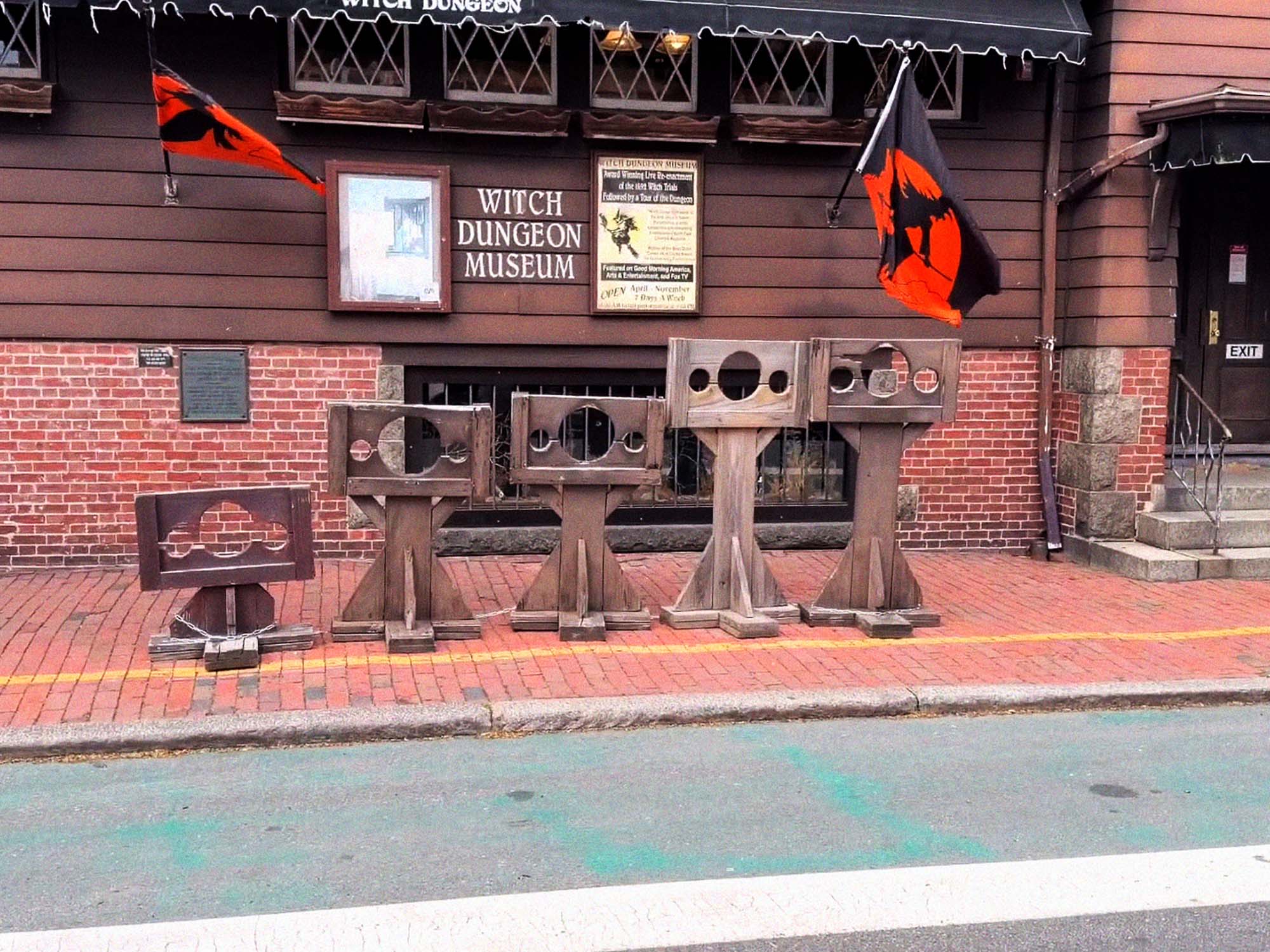
A Salem attraction combining a live reenactment of the examination and trial of Sarah Good with a reconstructed 1692 jail, including life-sized scenes of imprisonment, punishment and execution during the Salem witch trials.
Witch Dungeon Museum is a historical attraction at 16 Lynde Street in Salem devoted to the Salem witch trials of 1692. The museum began operating in the building in 1979 and presents the events through live theatre followed by a guided tour of a reconstructed colonial jail. Unlike the Witch House, the building itself has no direct connection with the trials.
Each visit begins with a live reenactment centred on Sarah Good, one of the first women accused of witchcraft in Salem Village. The performance is adapted from surviving court records and transcripts from 1692. Good was examined on 1 March 1692 by magistrates John Hathorne and Jonathan Corwin after several of the afflicted girls accused her of tormenting them through witchcraft. She denied the accusations and was later indicted, tried and found guilty by the Court of Oyer and Terminer on 29 June.
Sarah Good was executed at Proctor’s Ledge on 19 July 1692 together with Rebecca Nurse, Susannah Martin, Elizabeth How and Sarah Wildes. She was one of nineteen people hanged during the witch trials. Giles Corey was additionally pressed to death after refusing to enter a plea, while several accused people died while imprisoned.
After the performance, visitors descend into the museum’s reconstructed dungeon. The displays use life-sized figures, cells and other sets to illustrate how people accused of witchcraft were imprisoned while awaiting examination, trial or execution. The route includes representations of the village, jail cells and Gallows Hill, the name historically used for the wider area where the executions were believed to have taken place. Research announced in 2016 identified the actual execution location as nearby Proctor’s Ledge.
The original Salem Jail stood at the intersection of present-day Federal and St. Peter streets rather than at the museum. Built in 1684, it measured only about twenty feet square and probably had two storeys. Conditions were extremely poor: the jail had a dirt floor, barred windows, little ventilation and inadequate sanitation. Prisoners were confined in chains and shackles, including elderly and sick people, because authorities believed that restraining their bodies could prevent their supposed spectres from leaving the jail. Prisoners were also charged for their food, accommodation and even the chains used to restrain them.
The term “dungeon” should not necessarily be understood as a subterranean medieval-style prison. Surviving descriptions suggest that Salem Jail’s principal confinement room was probably on the ground floor, and there is no firm evidence that accused witches were kept in underground cells. The museum’s dungeon is therefore a reconstruction designed to demonstrate confinement conditions rather than the surviving historical jail itself.
One genuine piece of the original prison is preserved inside the museum: a wooden ceiling beam from the 1692 Salem Jail. The old jail was replaced in 1813, and timbers from the building were later reused in a house constructed on the site. When that property was demolished during the 1950s, several original beams were recovered. One is now held by Witch Dungeon Museum, with others preserved by the Salem Witch Museum and the Peabody Essex Museum.
The museum has also displayed an original 1705 land-transfer document signed by Jonathan Corwin, one of the magistrates involved in the witchcraft examinations and later a judge of the Court of Oyer and Terminer. Corwin’s surviving 17th-century home elsewhere in Salem is now known as the Witch House.
The building occupied by Witch Dungeon Museum was constructed in 1897 as a chapel for Salem’s East Church. From 1908 it was used by the First Church of Christ, Scientist, which remained there until around 1980. The Witch Dungeon Museum began operating in part of the property in 1979 and subsequently took over the building. Its former religious architecture remains clearly visible from the street.
Witch Dungeon Museum continues to operate primarily as a theatrical interpretation of the 1692 trials rather than as an artefact-heavy museum. Its combination of original court dialogue, reconstructed jail conditions and a surviving structural fragment from the actual Salem Jail provides a direct introduction to the imprisonment and execution of those accused during the witchcraft crisis.
Location: On Lynde Street in central Salem, close to the Witch House and the former locations of the 1692 courthouse and jail.
Address: 16 Lynde Street, Salem, MA 01970, United States
Category: museum, attraction
Tags: Salem witch trials, witchcraft accusations, Sarah Good, prison history, dungeon, executions, imprisonment, Court of Oyer and Terminer, Jonathan Corwin, reenactment
Darkness Level: ☠ ☠ ☠ ☠ ☠ ☠ ☠ ☠
Homepage: witchdungeon.com
Map: Open in Google Maps
Gallery