Whitby Abbey
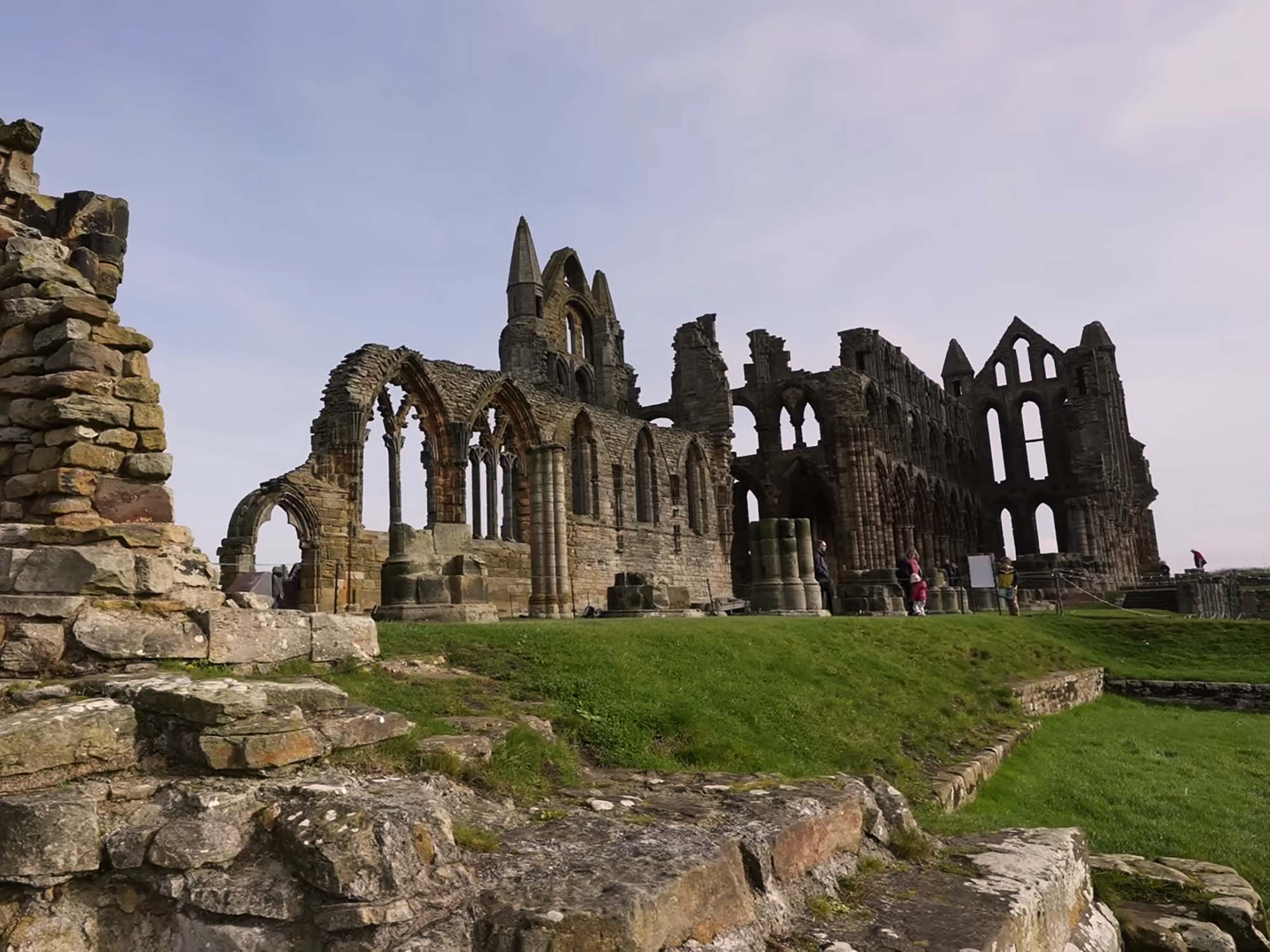
The ruins of a medieval Benedictine abbey on the cliffs above Whitby, built over an important Anglo-Saxon monastery and closely associated with Bram Stoker’s Dracula.
Whitby Abbey stands on East Cliff above the harbour town of Whitby. The earliest known monastery on the site was founded around 657 by Hild of Whitby, with the support of King Oswiu of Northumbria. Known at the time as Streaneshalch, it was a double monastery occupied by both monks and nuns and governed by an abbess. It became one of the most important centres of Christianity and learning in Anglo-Saxon Northumbria, and several members of the Northumbrian royal family were buried there.
In 664, the monastery hosted the Synod of Whitby, at which King Oswiu considered disagreements between Roman and Celtic Christian traditions. The most important dispute concerned the calculation of the date of Easter. Oswiu decided in favour of Roman practice, helping to establish the authority, calendar and customs of the Roman Church across much of England. The monastery was also associated with Cædmon, a herdsman who became the earliest English poet known by name.
The Anglo-Saxon monastery was abandoned during the ninth century, probably following Viking raids and subsequent Danish settlement in the region. Monastic life returned around 1078, when the Benedictine monk Reinfrid established a new religious community on the headland. A stone church was built around 1100, before being replaced by the much larger Gothic abbey church whose ruins survive today. Construction began around 1225 and continued in several stages into the 15th century. The surviving east end, transepts and sections of the nave remain important examples of medieval English Gothic architecture.
The Benedictine monastery was suppressed in 1539 during Henry VIII’s Dissolution of the Monasteries. Much of the monastic complex was subsequently demolished, while the Cholmley family acquired the property and converted parts of the former abbot’s lodgings into a private residence. The abandoned abbey church remained standing as an increasingly unstable shell. The south transept collapsed in 1736, much of the nave followed in 1763, the central tower fell in 1830 and part of the presbytery collapsed in 1839.
Whitby Abbey became internationally associated with vampire fiction after Bram Stoker stayed in Whitby in 1890. The ruined abbey, St Mary’s Church and its graveyard, the 199 Steps and the surrounding coastline were incorporated into Dracula, published in 1897. In the novel, Mina Murray describes the abbey above the town and records a legend that a white lady appears in one of its windows.
During his stay, Stoker also learned about the 1885 wreck of the Russian ship Dmitry, which ran aground on Tate Hill Sands beneath East Cliff. Elements of this incident were adapted for the arrival of the Demeter, the ship that carries Dracula to England. After the vessel runs aground in the novel, a large dog leaps ashore and runs up the steps towards the churchyard beneath the abbey. Stoker also discovered the name Dracula while researching a history of Wallachia and Moldavia in Whitby’s public library. Although the abbey is not Dracula’s residence in the novel, its ruins form an important part of the Whitby chapters and helped establish the town’s lasting connection with Gothic and vampire culture.
The ruins suffered further damage during the German naval bombardment of Whitby on 16 December 1914. Shellfire struck the abbey’s west front and caused part of the remaining structure to collapse. The damaged masonry was later repaired and reconstructed. The site passed into state care in 1920, after which archaeological excavations uncovered substantial evidence from the Anglo-Saxon monastery and the later Benedictine complex.
Whitby Abbey is now managed by English Heritage. Visitors can explore the medieval ruins and a museum housed within the former Cholmley estate buildings, where archaeological finds and displays cover the Anglo-Saxon monastery, the Synod of Whitby, medieval monastic life, the Dissolution and the site’s association with Dracula.
Location: On East Cliff above Whitby harbour, beside St Mary’s Church and the top of the 199 Steps.
Address: Abbey Lane, Whitby, North Yorkshire YO22 4JT, England
Category: abbey, ruins, museum
Tags: Gothic architecture, St Hild, Synod of Whitby, Cædmon, Viking raids, Dissolution of the Monasteries, Dracula, Bram Stoker, vampire literature, Gothic
Darkness Level: ☠ ☠ ☠ ☠ ☠ ☠ ☠
Homepage: english-heritage.org.uk
Map: Open in Google Maps
Gallery