Warwick Castle
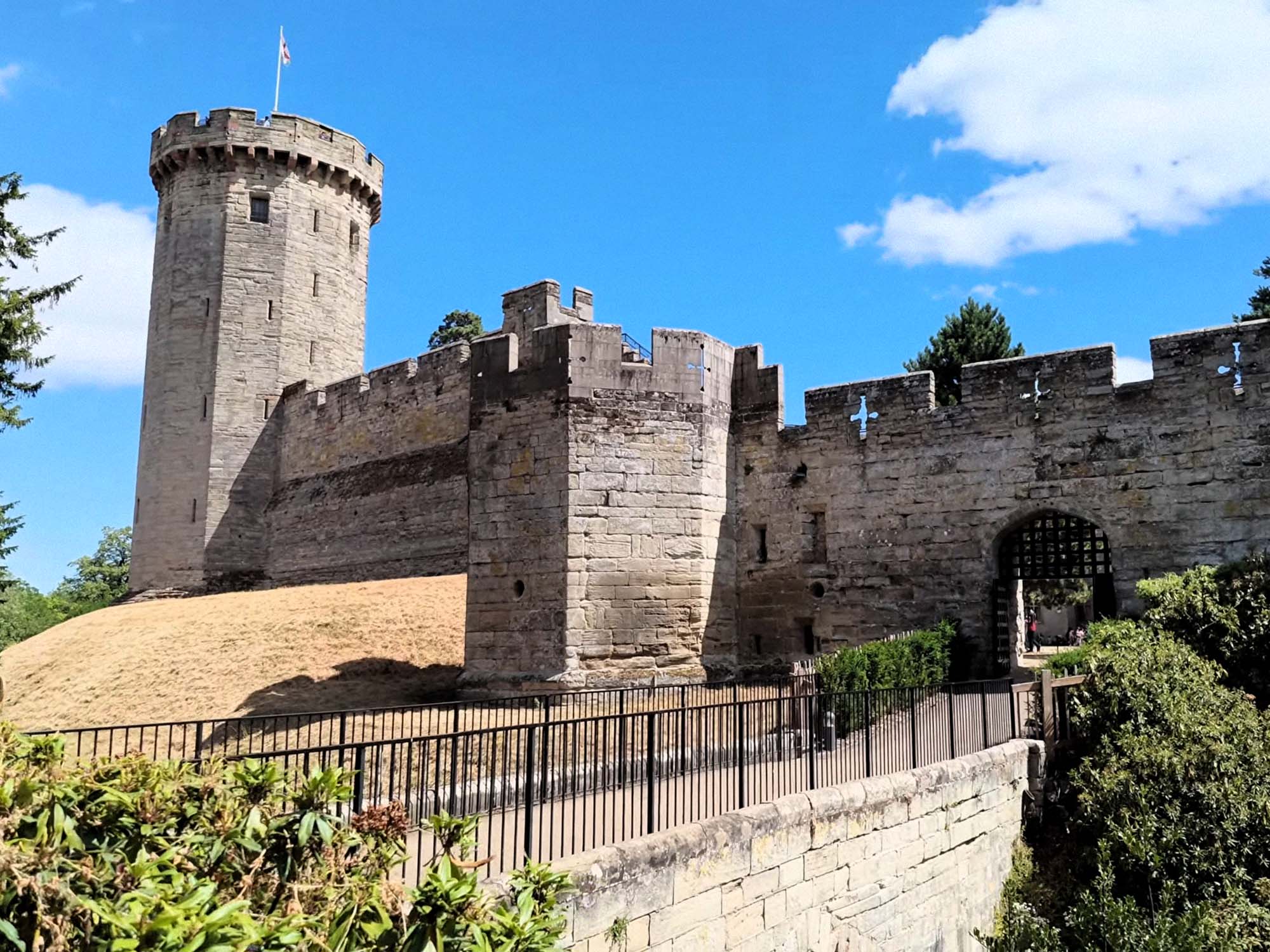
One of England's best-preserved medieval castles, built on a site fortified for more than a thousand years and associated with sieges, political prisoners, executions and the Wars of the Roses. Beneath Caesar's Tower survives the original castle gaol, complete with prisoner graffiti and an oubliette, while the Watergate Tower acquired a later reputation as the haunted home of murdered statesman Fulke Greville.
Warwick Castle stands above the River Avon in the centre of Warwick, occupying a defensive site whose history reaches back more than a thousand years. Behind its later state rooms, landscaped gardens and Victorian interiors survive massive medieval towers, curtain walls and a genuine underground gaol. Over the centuries the castle has been attacked, used to hold political and military prisoners and controlled by some of the most powerful families in medieval England.
The site's defensive history predates the castle itself. In 914, Æthelflæd, Lady of the Mercians and daughter of Alfred the Great, established a fortified burh at Warwick as part of a network intended to resist Danish expansion. The first castle followed after the Norman conquest. In 1068, William the Conqueror ordered a wooden motte-and-bailey fortress to be constructed here while consolidating Norman control over central England. The artificial mound survives inside the grounds and is now known as Æthelflæda's Mound.
The wooden fortress was gradually rebuilt in stone by the families who controlled Warwick during the following centuries. Its strategic importance also made it vulnerable during England's recurring civil conflicts. During the Second Barons' War in 1264, forces loyal to Simon de Montfort attacked Warwick Castle. Its owner, William Mauduit, had made little preparation for a siege. The attackers breached the defences, captured Mauduit and his wife and held them until a ransom was paid.
One of the castle's most notorious episodes occurred in 1312 and involved Piers Gaveston, the favourite and probable lover of King Edward II. Gaveston's influence over the king had made him deeply unpopular among a group of powerful nobles known as the Ordainers. After surrendering under an agreement intended to protect his life, Gaveston was seized at Deddington by Guy de Beauchamp, Earl of Warwick, and taken against his will to Warwick Castle.
Gaveston was held at the castle while Warwick and the Earls of Lancaster, Hereford and Arundel decided his fate. The castle's own history describes a summary hearing in the old Great Hall before he was condemned to death. On 19 June 1312, Gaveston was taken from Warwick to nearby Blacklow Hill. There he was killed and beheaded. Warwick himself remained at the castle, apparently distancing himself from the actual execution, but his role in Gaveston's seizure and condemnation helped create a major political crisis with Edward II.
Warwick grew considerably during the 14th century. The huge Caesar's Tower and Guy's Tower, together with the gatehouse and substantial sections of the curtain wall, date largely from this period. Caesar's Tower rises above the river side of the fortress, while Guy's Tower reaches six storeys. The castle's surviving medieval scale reflects the wealth accumulated by the Beauchamp family through warfare, political office and the ransoming of high-ranking prisoners captured during the Hundred Years' War.
Beneath Caesar's Tower lies one of the castle's most important surviving spaces for its darker history: the Gaol. Unlike the modern attraction marketed as the Castle Dungeon, this is the original prison space within Warwick Castle. Reached by steep steps beneath the tower, it contains scratched graffiti attributed to prisoners from the 14th, 15th and 17th centuries, including men believed to have been captured during medieval wars and Royalist prisoners held during the English Civil War.
The gaol also contains a small barred pit traditionally identified as an oubliette. The name comes from the French oublier, meaning “to forget,” and later tradition associated such pits with prisoners being lowered into confinement and effectively abandoned. Warwick Castle presents the pit in this way, although the exact treatment of individual medieval prisoners held there is not documented. What is beyond doubt is that the room itself functioned as a place of imprisonment and still preserves marks carved into the walls by people confined within it.
The castle became deeply involved in the power struggles of the Wars of the Roses. Its most famous owner from this period was Richard Neville, Earl of Warwick, remembered as “the Kingmaker.” Neville first supported Edward IV and later turned against him, helping restore Henry VI before being killed fighting Edward's forces at the Battle of Barnet in 1471. Warwick Castle then passed through the hands of George, Duke of Clarence, and Richard, Duke of Gloucester, the future Richard III. Richard began constructing the Bear and Clarence Towers as part of an ambitious new stronghold within the castle, but the project remained unfinished after his death at Bosworth in 1485.
The wider history of the Beauchamp family also connects Warwick with one of the most famous executions of the medieval period. Richard de Beauchamp, Earl of Warwick, served Henry V and later became an important figure in the government of the young Henry VI. In 1431 he was given responsibility for supervising the imprisonment, trial and execution of Joan of Arc at Rouen. The events did not take place at Warwick Castle, but they demonstrate the extraordinary political and military reach of the family controlling it during the 15th century.
By the beginning of the 17th century the castle had deteriorated badly and was reportedly considered for demolition. Instead, James I granted it in 1604 to poet, courtier and statesman Fulke Greville. Greville spent heavily repairing the medieval fortifications and transforming parts of the fortress into a comfortable residence. His ownership later became central to Warwick Castle's best-known ghost story, although the real circumstances of his death occurred almost a hundred miles away.
On 1 September 1628, Greville was attacked at Brooke House in Holborn, London, by his servant Ralph Haywood. Contemporary correspondence records that Haywood stabbed him twice following a dispute connected with Greville's will. Haywood then attacked himself. Greville initially survived but died from his wounds approximately four weeks later. His body was returned to Warwick and buried at the Collegiate Church of St Mary.
Greville is now said to haunt Warwick Castle's Watergate Tower, popularly known as the Ghost Tower. The story is much younger than his death. Historical research by Warwickshire specialists has found no clear record of Greville's ghost at the castle until the 1920s and 1930s. Earlier members of the Warwick family wrote about other supposed ghosts without mentioning him, and documentary research has even questioned whether Greville ever lived in the rooms later marketed as his study. The tower was formally opened to visitors as the “Ghost Tower” in 1973.
This makes the Greville story an unusually good example of how a genuine murder can develop into later supernatural folklore. Greville really was violently attacked by his servant and died after weeks of suffering, but not inside Warwick Castle. His association with the Watergate Tower appears to have strengthened at precisely the period when the castle's owners increasingly depended on tourism. The ghost story therefore says almost as much about the 20th-century reinvention of historic houses as it does about the 17th century.
Warwick Castle returned to military use during the English Civil War. Its owner Robert Greville, 2nd Baron Brooke, supported Parliament, and the castle's defences were strengthened in anticipation of an attack. In August 1642, Royalist troops under the Earl of Northampton laid siege to Warwick. The attackers subjected the fortress to intermittent cannon fire, but the medieval defences proved difficult to damage and the siege ended when Parliamentary relief forces approached.
Following the Battle of Edgehill later that year, prisoners were confined in Caesar's Tower and Guy's Tower. Warwick continued to serve as a Parliamentary garrison, and Royalist prisoners were held there during and after the conflict. The castle's own records state that a military garrison was maintained for this purpose into the 1650s. Graffiti surviving inside the gaol has been associated with prisoners from this period.
The castle's folklore extends beyond Greville. One story concerns Moll Bloxham, an elderly woman traditionally said to have sold surplus dairy produce from the castle. After losing this privilege following complaints that she cheated customers, she supposedly cursed the household and disappeared. A large black dog then began appearing inside the castle and was interpreted as Moll's transformed or returning spirit. According to the legend, priests eventually drove the creature to the top of Caesar's Tower, from where it plunged towards the River Avon. The story belongs firmly to folklore rather than documented castle history.
Other traditions include a Grey Lady, unexplained footsteps and the ghostly Dun Cow associated with the legendary hero Guy of Warwick. Frances “Daisy,” Countess of Warwick, wrote about unexplained footsteps in the castle during the early 20th century, while later staff and visitors added further reports of noises, figures and unusual sensations. None provides evidence for supernatural activity, but the stories form a long-running layer of folklore around a building that had already accumulated centuries of genuine imprisonment, violence and political conflict.
The castle experienced another major disaster on 3 December 1871, when a fire tore through the Great Hall and private apartments. Much of the interior was destroyed before the blaze could be controlled. Architect Anthony Salvin subsequently oversaw extensive restoration, meaning that some of the interiors seen today are Victorian reconstructions within much older medieval walls.
Warwick Castle finally ceased to be a private aristocratic residence in the modern sense when it was sold to the Tussauds Group in 1978. It later became part of Merlin Entertainments and developed increasingly elaborate historical attractions. Among them is The Castle Dungeon, an actor-led horror attraction featuring plague, torture and executions. It should not be confused with the authentic castle gaol beneath Caesar's Tower. The former is theatrical entertainment; the latter is the surviving medieval prison space.
Location: On a bluff above the River Avon in the historic centre of Warwick, Warwickshire.
Address: Warwick Castle, Castle Lane, Warwick, CV34 4QU, England
Category: castle
Tags: medieval castle, Norman castle, Æthelflæd, William the Conqueror, Piers Gaveston, execution, beheading, Blacklow Hill, prison, dungeon, gaol, oubliette, prisoner graffiti, Wars of the Roses, Richard Neville, Kingmaker, Richard III, Joan of Arc, Fulke Greville, murder, Ghost Tower, haunted, ghost lore, Moll Bloxham, black dog, Grey Lady, English Civil War, siege, Royalist prisoners
Darkness Level: ☠ ☠ ☠ ☠ ☠ ☠ ☠ ☠
Homepage: warwick-castle.com
Map: Open in Google Maps
Gallery