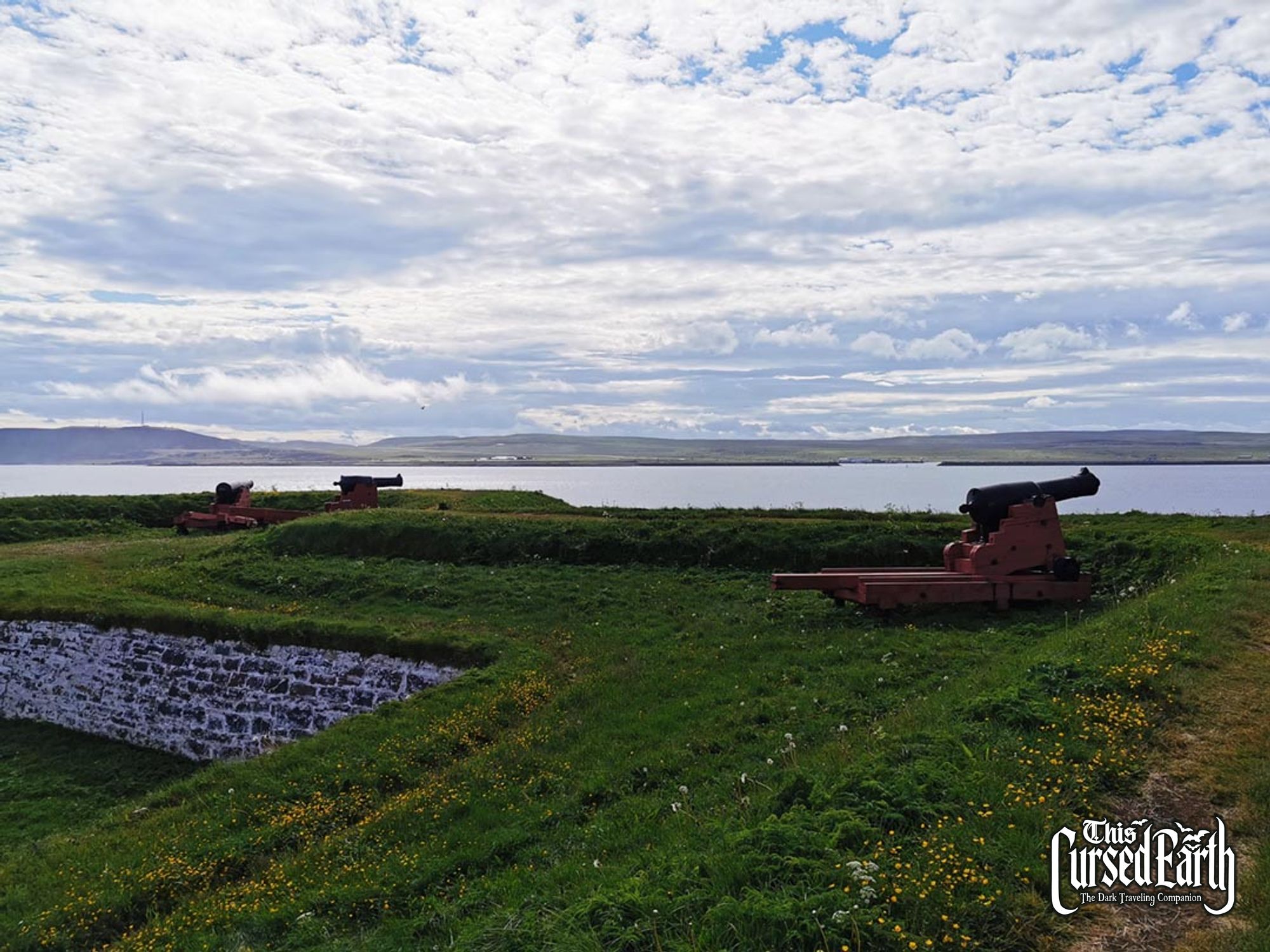
Vardøhus Fortress

The world's northernmost fortress, established at Norway's Arctic frontier around 1300 and rebuilt in its present star-shaped form in the 18th century. Its predecessor played a central role in the brutal Finnmark witch trials, where accused women and even children were held in a prison known in contemporary sources as the “witches' prison hole” before many were taken to nearby Steilneset and burned.
Vardøhus Fortress stands on the island of Vardøya in the Barents Sea, farther east than almost anywhere else in Norway and only a short distance from the Russian border. The present low, star-shaped fortress dates from the 18th century, but the history of Vardøhus reaches back more than seven hundred years. For much of that time it represented Norwegian authority at the extreme northeastern edge of the kingdom – a military post, administrative centre, prison and symbol of sovereignty in a region where borders and loyalties were not always clearly defined.
The first Vardøhus was probably established around 1300–1307 during the reign of King Håkon V Magnusson. Its purpose was partly defensive, protecting the growing Norwegian fishing settlements against raids from the east, but equally important was the assertion of royal authority and the collection of taxes in Finnmark. The fortress appears securely in written sources by 1339–1340. A second fortified complex replaced it during the 15th century, and it was this earlier Vardøhus – not the fortress standing today – that existed during the great witchcraft persecutions of the 17th century.
Vardø's location gave the fortress an importance far beyond its small size. Norway, Sweden and Russia all had overlapping interests in the north, while fishermen, traders, Sámi communities and tax collectors moved through a landscape where political boundaries remained disputed for centuries. Vardøhus became the seat of the governor responsible for much of Finnmark, and its presence helped reinforce the Danish-Norwegian crown's claim to territory stretching towards the Russian frontier.
The darkest period in the fortress's history came during the Finnmark witch trials. Between 1600 and 1692, 135 people in Finnmark are known to have been accused of witchcraft and 91 were sentenced to death. Seventy-seven of those executed were women and fourteen were men. Relative to the tiny population of the region, the scale of the persecution was exceptional, and the coastal communities around Vardø and the Varangerfjord became the centre of some of the most violent witch hunts anywhere in Scandinavia.
Vardøhus was directly involved. Contemporary sources refer to a prison inside the old fortress as the “trollkvinnefengselshullet” – the witches' prison hole. Accused women and children were confined there while awaiting interrogation and trial. Conditions in Vardø were already severe because of the Arctic climate and the fortress's isolation, but imprisonment was only one part of the process. Suspects could be subjected to intense psychological pressure, torture and the notorious water ordeal, in which their hands and feet were bound before they were thrown into the sea. Sinking was interpreted as innocence; floating could be accepted as evidence of guilt.
The first large wave of executions in eastern Finnmark came in 1621. Over a short period ten women were condemned to death in what was then the largest witch hunt Norway had experienced. Accusations frequently involved weather magic, shipwrecks, pacts with the Devil and gatherings on Domen, the bleak mountain on the mainland opposite Vardø. Later testimony described witches flying through the air, transforming into animals and meeting Satan on the mountain, stories produced within a judicial system increasingly influenced by European demonology.
The persecution reached its most extreme phase during the winter of 1662–1663. Thirty women and girls under the age of twelve were brought before the courts during the chain of accusations; eighteen received death sentences and two women were tortured to death before a final verdict could even be pronounced. Confessions and accusations produced under pressure generated new suspects, creating a cycle in which one name could lead investigators directly to another household.
One remarkable glimpse into the prison comes from Christmas Eve 1662. The middle-aged Sølvi Nilsdatter and eight-year-old Ingeborg Iversdatter were being held in the witches' prison at Vardøhus. Testimony later claimed that the pair had transformed themselves into cats, slipped beneath the fortress gate and flown to Kiberg to celebrate Christmas with Satan. Similar fantastic stories of animal transformation, demonic feasts and flight appear throughout the proceedings. They reveal less about supernatural events than about the ideas investigators expected frightened prisoners – including children – to describe.
The fortress also held Anna and Ambrosius Rhodius, an educated couple banished from Christiania after making accusations of corruption against powerful officials. They arrived at Vardøhus in 1662, at the height of the persecutions. Later court material indicates that Anna Rhodius became deeply involved with the imprisoned children, threatening and pressuring some of them to confess to pacts with the Devil and to accuse their own mothers. Her presence has consequently become part of historians' attempts to understand why the final Vardø trials developed such an extreme emphasis on children and elaborate demonological narratives.
Those sentenced to death were generally taken to Steilneset, the old execution ground south of the fortress. Many were burned there. The precise locations of individual executions are not always known, but Steilneset is historically documented as Vardø's place of execution and is now home to the memorial dedicated to all 91 people condemned during the Finnmark witch trials. The memorial stands only a short distance from Vardøhus, physically linking the place of imprisonment and judgment with the landscape in which many of the sentences were carried out.
By the beginning of the 18th century the old fortress had deteriorated badly. After decades of planning, construction of an entirely new Vardøhus began in 1734. Completed in 1738, this is the fortress that survives today: an eight-pointed star formed by low, stone-faced earthworks surrounding a compact courtyard. Nine buildings stand inside the walls, including the commandant's residence, powder magazine, guardhouse, barracks and well house. By 1739 the fortress was armed with seventeen cannon and a mortar and had a garrison of slightly more than fifty men.
Its construction reflected continued concern about control of the far north. The border between Norway and Sweden was not formally settled until 1751, while the Norwegian-Russian frontier remained unresolved for another century. Vardøhus therefore served as much as a statement of political ownership as a conventional battlefield fortress. Its guns rarely saw combat, but the fortification made it impossible to mistake which monarchy claimed authority over Vardø and the surrounding coast.
The fortress was briefly decommissioned in 1793 before being returned to military use around 1800 as tensions increased. During the Napoleonic Wars it was the only permanent fortress in Finnmark. British warships appeared offshore but never attacked Vardøhus, while the garrison also existed against the background of raids by Russian fishermen and continuing uncertainty along the northern frontier. After 1814 the fortress remained in service largely because of its proximity to Russia, although improvements in weapons technology gradually reduced its practical military value.
Not everything that happened behind the walls was military. In 1768–1769, Hungarian Jesuit astronomer Maximilian Hell spent the Arctic winter at Vardøhus preparing to observe the transit of Venus. On 3 June 1769 clear skies allowed him to record the event successfully. Observations of the transit from different parts of the world were used to improve calculations of the distance between Earth and the Sun. Nothing survives of Hell's observatory, but a plaque at the fortress marks its former location.
Vardøhus again acquired strong symbolic importance during the Second World War. Following the German invasion of Norway in April 1940, the Norwegian flag continued to fly above the fortress longer than at any other Norwegian fortress. The dispute developed into a prolonged struggle between the local commandant and the occupation authorities until the commandant was finally arrested in November. Four years later the symbolism was reversed: during the liberation of Finnmark in the autumn of 1944, Vardøhus became the first Norwegian military installation where the national flag was raised again.
Vardø itself suffered repeated bombing during the war and was heavily damaged, yet the old fortress escaped destruction. German forces constructed extensive modern defences elsewhere on Vardøya but largely left Vardøhus untouched. It remained an operational military installation after the war until its traditional military role was finally discontinued in the 1950s, although a commandant and military presence were retained.
One of the fortress's more unusual modern landmarks is the rowan tree beside the commandant's residence. Often described as Vardø's only tree, the original rowan was planted in the 1950s and had to be carefully wrapped each winter to protect it from salt, wind and Arctic weather. It finally died after severe winter damage and was cut down in 2002. Local children planted a replacement in 2004. The familiar story of an ancient “king's pine” therefore has little basis: the tree is a relatively modern rowan, and other trees now grow elsewhere in Vardø as well.
Vardøhus remains under military administration today, but its role is principally ceremonial and historical. It is a flag and saluting fortress, firing ceremonial salutes on Constitution Day, Union Dissolution Day and royal birthdays. One distinctly Arctic tradition occurs after the polar night, when the fortress fires a salute as the complete disc of the sun finally reappears above the horizon. The historic buildings also contain exhibitions relating to the long history of the fortress.
The connection between Vardøhus and the witch trials requires one important distinction. The women and children accused of witchcraft did not walk through the gate of the neat 18th-century star fortress standing today; that building did not yet exist. They were imprisoned in its predecessor, a now-vanished fortress elsewhere in Vardø. What survives is therefore not their literal prison cell but the continuation of the institution that confined them – Vardøhus as the seat of royal power, justice and punishment in Finnmark.
That history is considerably darker than the later ghost stories sometimes attached to the fortress. The surviving court records name the people held here, describe the accusations against them and preserve the results of interrogations conducted under conditions that could end in torture and death. From the fortress they were taken only a short distance to Steilneset, where fire completed the sentence. Modern Vardøhus may be younger than those events, but its name remains inseparable from one of the most brutal episodes in Norwegian judicial history.
Location: Located in Vardø, Norway.
Address: Vardøhus Fortress, Vardø, Norway
Category: fortress, historical site, witch trials
Tags: Vardøhus Fortress, witch trials, military history, Norway
Darkness Level: ☠ ☠ ☠ ☠ ☠ ☠ ☠ ☠ ☠
Homepage: varangermuseum.no
Map: Open in Google Maps
Gallery