Torture Museum Oude Steen
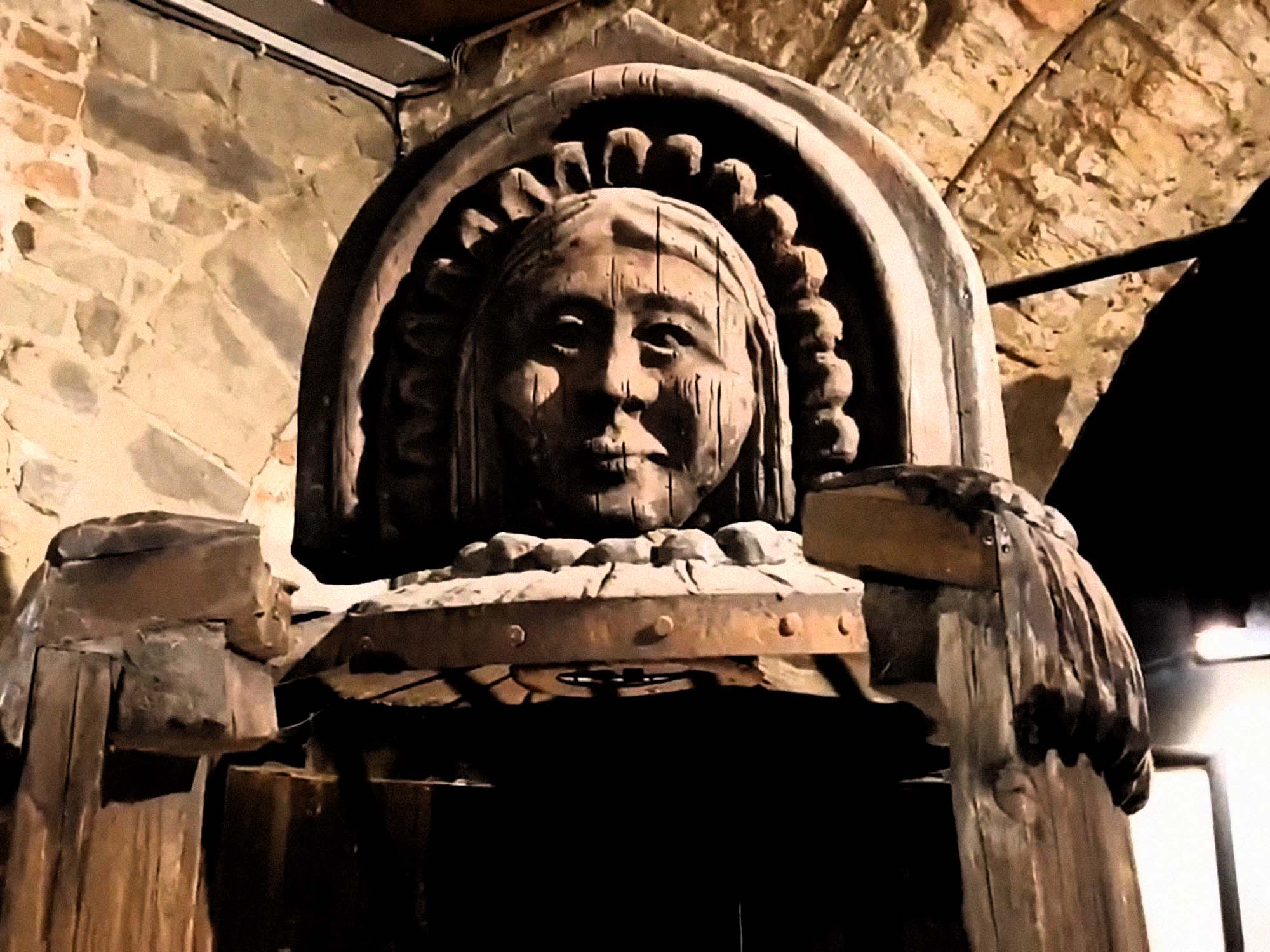
A torture and punishment museum housed in the medieval cellar of De Oude Steen, the oldest securely dated surviving house in Bruges, displaying historical torture instruments, execution equipment and lifelike wax reconstructions of judicial punishment.
Torture Museum Oude Steen is a museum of torture, punishment and legal history in the historic centre of Bruges. It occupies the cellar of De Oude Steen at Wollestraat 29, a building long regarded as one of the oldest stone structures in the city. Scientific investigation of its surviving medieval timbers has since established that parts of the cellar date from approximately 1177–1205, making it the oldest securely dated surviving residential structure in Bruges and the oldest absolutely dated standing remains of a medieval house currently known in Flanders.
The surviving medieval cellar measures approximately 17.5 by 8.8 metres internally and retains walls constructed from local fieldstone together with sections of its original oak beam ceiling. Architectural evidence shows that the building originally stood independently, with narrow light openings, wall niches and access from Wollestraat. Doorways at the rear connected the property towards the former Kraanrei waterfront. Recent heritage research suggests that the cellar originally functioned as a storage space, reflecting the commercial importance of Wollestraat when Bruges was developing into one of medieval Europe’s principal trading centres.
De Oude Steen has nevertheless long been associated with imprisonment, and the museum presents the cellar as Bruges’ oldest prison. The precise chronology of this use is less certain than the history of the building itself. The name De Oude Steen, meaning “The Old Stone”, was already associated with the property historically, and later tradition connected the substantial stone cellar with detention and punishment. The present upper storeys are considerably younger than the medieval cellar: much of the above-ground structure dates from the 17th century, while the current Neoclassical street façade was constructed in 1889.
The torture museum opened in 2015 after the historic cellar had been restored and adapted for exhibition use. Its collection concentrates on European methods of interrogation, corporal punishment and execution from antiquity through the medieval and early modern periods. Approximately one hundred torture and punishment devices are displayed. The museum states that many are historical originals preserved over the centuries, while objects that no longer survive in usable form are represented by carefully constructed reproductions.
The collection includes devices associated with stretching, crushing, restraint, public humiliation and execution. Among the exhibits are racks, thumbscrews, restraint chairs, wooden horses, cages, gallows and a guillotine, together with less familiar devices intended to demonstrate the variety of punishments developed by European judicial authorities. Text panels explain their supposed or documented functions and place them within changing systems of criminal law and interrogation.
Dozens of life-sized wax figures are positioned among the instruments to demonstrate how particular devices were used. The figures wear period-style clothing and recreate interrogations, imprisonment and physical punishment. Some scenes are deliberately graphic, showing restrained prisoners together with executioners, guards or interrogators. One section of the medieval cellar has been arranged as a dungeon, using lighting and sound effects alongside the surviving stone architecture.
The museum also addresses the relationship between torture and the judicial system. Physical coercion was historically used not only as punishment but as a regulated method of interrogation intended to obtain confessions. In different periods, accusations involving theft, heresy, witchcraft and other offences could result in imprisonment and physical coercion, although the legality and application of individual methods differed considerably between jurisdictions and centuries. The exhibition also reflects the later abolition of judicial torture and the development of legal protections governing interrogation and punishment.
Since the opening of the neighbouring Museum of Witchcraft, both museums have operated from the same Wollestraat address and can be visited separately or together. The witchcraft museum extends the subject into European witch persecutions, magic and related beliefs, while Torture Museum Oude Steen remains focused primarily on criminal justice, punishment and the physical mechanisms used to inflict pain or death.
The historic setting is an important part of the museum. Unlike many collections of reconstructed medieval punishment equipment housed in modern exhibition spaces, the displays here occupy a genuine late-12th- or early-13th-century cellar. The combination of the preserved medieval building, instruments of punishment and graphic wax reconstructions makes Oude Steen one of Bruges’ principal sites concerned specifically with the darker history of law and punishment.
Location: In the medieval cellar of De Oude Steen on Wollestraat, close to the Markt and Burg squares.
Address: Wollestraat 29, 8000 Bruges, Belgium
Category: museum, torture
Tags: torture, crime and punishment, medieval justice, corporal punishment, executions, interrogation, dungeon, wax figures, historic prison, medieval architecture
Darkness Level: ☠ ☠ ☠ ☠ ☠ ☠ ☠ ☠ ☠
Homepage: torturemuseum.be
Map: Open in Google Maps
Gallery