The Sedlec Ossuary – The Bone Church
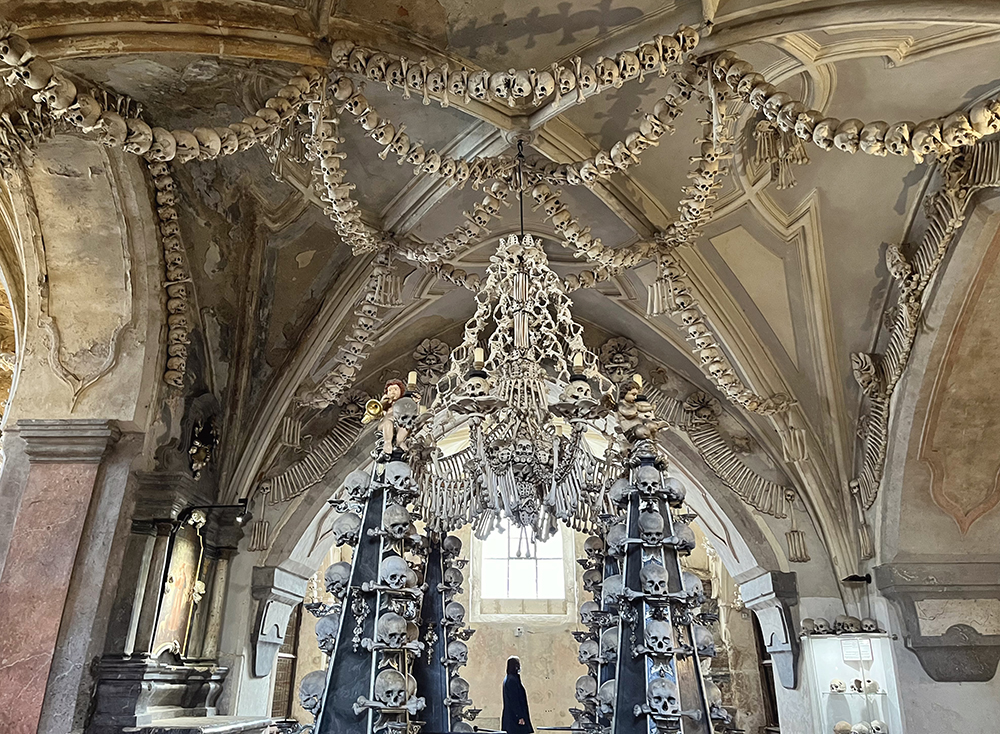
A small chapel in the Czech Republic, decorated entirely with human bones, said to be haunted by the spirits of the dead.
Beneath the small Cemetery Church of All Saints in Sedlec, on the outskirts of Kutná Hora, are the remains of roughly 60,000 people. Skulls stare from enormous pyramids, femurs form crosses and garlands, and a huge chandelier made from more than a thousand human bones hangs above the centre of the chapel. This is the Sedlec Ossuary, better known simply as the “Bone Church”. It is one of those rare places where photographs can make you think you know what to expect, only for the sheer quantity of human remains to feel completely different when they are actually surrounding you.
The story begins long before anyone thought of turning bones into chandeliers. Sedlec was home to a Cistercian monastery founded in the 12th century, and its cemetery eventually became one of the most sought-after burial grounds in Central Europe. According to an old tradition, an abbot named Heidenreich returned from the Holy Land with a handful of earth from Hakeldama, the Field of Blood in Jerusalem, and scattered it across the cemetery. Whether the story happened exactly that way is impossible to prove, but medieval Christians came to believe that burial at Sedlec placed them in especially sacred ground.
Then far more people began arriving than anyone could reasonably accommodate. Kutná Hora grew enormously after silver was discovered nearby, becoming one of the great medieval cities of Bohemia. With prosperity came an equally large population vulnerable to disease, famine, mining accidents and war. In 1318, a catastrophic famine is believed to have killed as many as 20,000 inhabitants. Around thirty years later, the Black Death claimed roughly another 30,000 in the region. Thousands more died during the Hussite Wars in the early 15th century.
Many of those bodies ended up at Sedlec. By the end of the 14th century, the cemetery covered around 3.5 hectares and could expand no further. Older graves were opened and the bones removed to make room for new burials. This was not originally intended as macabre decoration. Christian practice required the disturbed remains to be treated with respect and reburied, so they were transferred into and around the lower level of the Cemetery Church of All Saints.
The church itself was constructed during the first half of the 14th century as a two-storey cemetery chapel. The upper floor was intended for prayers and services for the dead, while the lower chapel functioned as an ossuary. The arrangement was deliberate: above was light, prayer and the promise of resurrection; below were the physical remains waiting for the Last Judgment. The message was not supposed to be “look how frightening death is”, but rather the old Christian reminder memento mori – remember that you must die.
Over time the bones accumulated in enormous quantities. There is an old story that a half-blind monk arranged the remains into pyramids during the 16th century, but the history of the decorations is less tidy than the legend suggests. What we know more securely is that architect Jan Blažej Santini-Aichel worked on the church during its Baroque restoration in the early 18th century and is considered responsible for the basic concept of the first formal skeletal decoration.
The Sedlec Ossuary that people recognise today, however, owes much of its appearance to a woodcarver named František Rint. After the Cistercian monastery was dissolved in 1783, the Schwarzenberg family became patrons of the church. During the 19th century they financed another major restoration and brought Rint to Sedlec to reorganise and expand the bone decorations. His work was completed around 1870.
Rint was considerably less restrained than the earlier Baroque designers. Skulls and long bones became hanging garlands, chalices, crosses and other elaborate arrangements. The chapel's enormous chandelier is traditionally said to contain at least one example of every type of bone found in the human body. During modern restoration it was dismantled and examined properly: the decoration contains 1,041 individual bones, and the complete chandelier weighs around 150 kilograms. Apparently even a chandelier made from dead people eventually needs structural maintenance.
The most extraordinary piece may be the Schwarzenberg coat of arms, created almost entirely from human remains. Bones form the shield, crown and surrounding decoration, while one small detail is particularly difficult to overlook: a raven made from bones pecks at the eye of a severed Turkish head. The image comes from the Schwarzenberg family heraldry and commemorates their role in the capture of the Ottoman-held fortress of Győr in 1598. Even among thousands of arranged skeletons, somebody apparently decided the display needed one additional act of violence.
Four enormous pyramids of bones dominate the corners of the lower chapel. They may initially look like decorative stacks, but their religious meaning is important. According to the church, the pyramids symbolise the heavenly mountain, while crowns above them represent the entrance to the Kingdom of Heaven. Skull-and-crossbone figures suspended overhead are intended as angels accompanying the dead towards divine judgement. The only purely secular decoration in the chapel is the Schwarzenberg coat of arms.
Modern archaeology has made the human story beneath all this decoration considerably more tangible. Major restoration work begun in 2014 led to excavations around the church between 2016 and 2018. Archaeologists uncovered 1,817 skeletons and 32 mass graves. Several could be dated specifically to the famine of 1318, while others belonged to victims of the plague epidemics of 1348–1350. The discovery confirmed that the enormous medieval death toll described in the historical record had quite literally been buried around the church.
The skeletons have also allowed researchers to study the people of medieval Kutná Hora in unusual detail. Their remains can reveal age, sex, disease, injuries and the physical stresses of daily life. That matters because almost none of the people whose bones fill the ossuary can now be identified by name. They have become anonymous skulls and femurs, but they were miners, craftspeople, merchants, children, monks and families who once lived in the surrounding town.
The ossuary is currently undergoing another enormous restoration programme that began in 2014 and is expected to continue until at least 2030. Humidity had damaged both the building and the skeletal decorations, while structural problems had caused the church itself to lean almost half a metre away from its vertical axis. The bone pyramids are being dismantled, cleaned and carefully reconstructed around new internal supports so that air can circulate through them. Restoring a pile containing thousands of human bones is, unsurprisingly, not a quick job.
Despite its nickname and extraordinary appearance, the Bone Church is still exactly that: a church. Catholic services continue to be held here, and the bones are regarded as the remains of the dead rather than museum props. Photography inside the ossuary is now prohibited, partly because the parish wants people to remember that they are entering a tomb rather than a Gothic photo set.
Location: The Sedlec Ossuary is located in Kutná Hora, Czech Republic.
Address: Zámecká, 284 03 Kutná Hora, Czech Republic
Category: ossuary, haunted site, church
Tags: haunted, human bones, ossuary, Czech Republic
Darkness Level: ☠ ☠ ☠ ☠ ☠ ☠ ☠ ☠ ☠
Homepage: sedlecossuary.com
Map: Open in Google Maps
Gallery