The Hellfire Caves
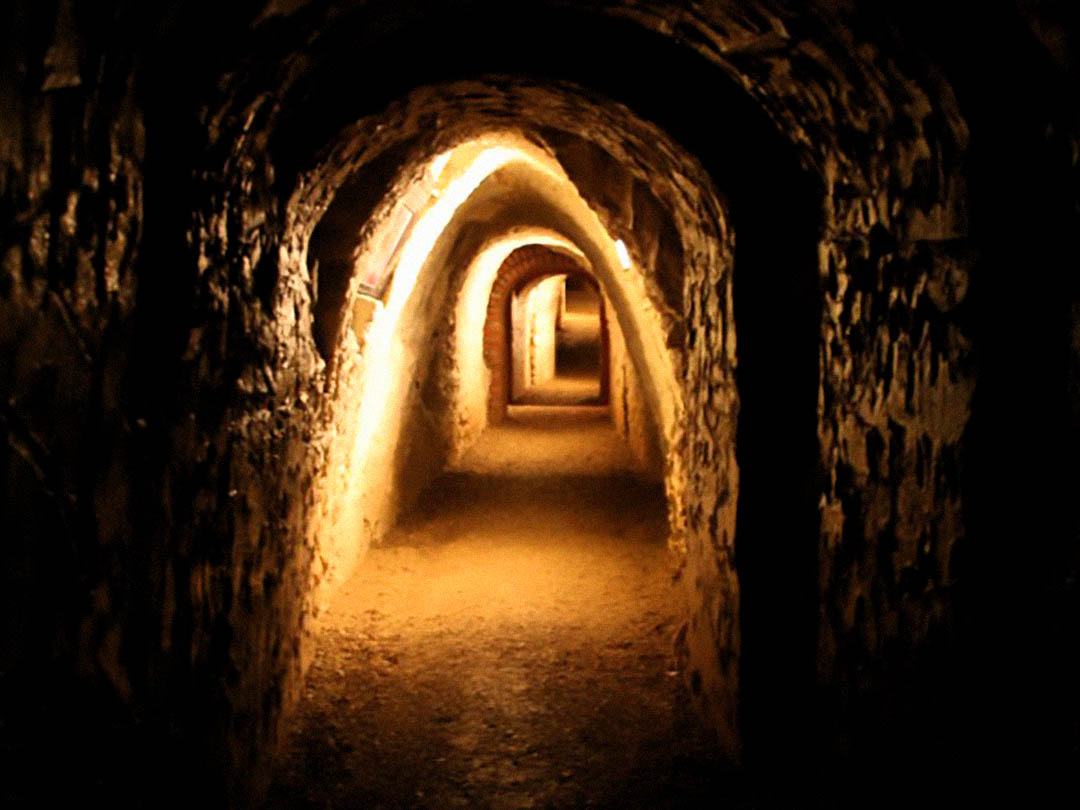
An underground network of caves once used by the infamous Hellfire Club for secret rituals, occult gatherings, and rumored satanic ceremonies.
Deep inside West Wycombe Hill in Buckinghamshire runs a quarter-mile network of tunnels with names such as the Banqueting Hall, the River Styx and the Inner Temple. They are known today as the Hellfire Caves, and for more than two centuries they have been associated with secret meetings, aristocratic debauchery, mock religious ceremonies and rumours of Satanism. The truth is slightly less supernatural, but considerably stranger. These caves were created by one of 18th-century Britain's most eccentric aristocrats, and the men associated with them included politicians, poets, members of Parliament and the Earl of Sandwich. Apparently respectable Georgian society had an interesting private life.
The man behind it all was Sir Francis Dashwood, an enormously wealthy landowner, politician and enthusiastic traveller whose estate stood directly across the valley at West Wycombe Park. Dashwood had spent years travelling through Italy, Greece, the Ottoman Empire and other parts of Europe and returned home with strong interests in classical architecture, pagan mythology and making fun of the Catholic Church. Portraits show him dressed as a Franciscan friar while admiring the naked Venus, and he filled his estate with classical temples, suggestive statues and architectural jokes.
The caves themselves were not originally dug simply to provide somewhere for secret occult ceremonies. Beginning around 1748, three consecutive failed harvests had created serious unemployment and hardship around West Wycombe. Dashwood hired local labourers to excavate chalk from the hillside, paying them roughly a shilling a day. The chalk was then used to construct a much-needed new road between West Wycombe and High Wycombe. Digging an ordinary quarry would have achieved the same result, but ordinary was apparently not really Dashwood's style.
Instead, the workers carved a long twisting passage deep into the hill, adding chambers, side tunnels and an enormous underground hall. By the time the project was finished, the excavation extended roughly a quarter of a mile underground. Dashwood had effectively turned a public works project into one of the largest artificial cave systems in Britain. Nobody knows exactly why he chose such an elaborate design, although his travels and fascination with the mystery religions of classical Greece almost certainly provided inspiration.
Dashwood had meanwhile created his own private society. It went by names including the Knights of St Francis of Wycombe and the Franciscans of Medmenham; history remembers it simply as the Hellfire Club. The group initially met at Medmenham Abbey, a former Cistercian monastery beside the Thames that Dashwood transformed into a luxurious private retreat. Above its entrance were the words Fay ce que voudras – “Do what thou wilt”.
The phrase was not invented by Dashwood and certainly not by Aleister Crowley. It came from François Rabelais' fictional Abbey of Thélème in the 16th-century Gargantua and Pantagruel. Nearly two hundred years after Dashwood put the words above Medmenham Abbey, Crowley adopted the same idea for his own religion of Thelema and his Abbey of Thelema in Sicily. Occult history occasionally has a surprisingly long memory.
What actually happened at Hellfire Club meetings has become thoroughly buried beneath later scandal. Surviving letters and accounts certainly describe heavy drinking, bawdy songs, sexual relationships and mock religious ceremonies. Members dressed as monks, elected an “Abbot” and performed irreverent parodies of Christian ritual. Women were invited to meetings, and contemporary descriptions make it fairly obvious that strict vows of chastity were not part of the programme.
That is a long way from proving the later stories about black masses, human sacrifice or genuine Devil worship. Dashwood seems to have been far more interested in ridiculing organised religion than serving Satan. The secrecy, costumes and deliberately blasphemous humour naturally produced rumours, and later writers enthusiastically filled in the gaps. The Hellfire Club acquired such a satanic reputation that separating what the members actually did from what horrified outsiders imagined they did has become almost impossible.
One famous story captures the club rather well. Member John Wilkes supposedly smuggled a baboon into a ceremony and dressed it to resemble a demon. He hid the animal in a chest and released it at the appropriate dramatic moment. The terrified Lord Sandwich apparently became convinced that the Devil himself had answered their summons and begged the creature to spare him, insisting that he had never really been as wicked as he had pretended to be. Whether every word of the story is true is impossible to know, but an aristocratic Satanic ritual accidentally turning into a fight with a baboon feels entirely appropriate for the Hellfire Club.
The club's best-documented meetings took place at Medmenham Abbey, not in the caves. By the mid-1760s, however, the Medmenham group was falling apart, and later accounts place occasional gatherings inside the West Wycombe caves. A visitor writing in 1796 was already being told that the deepest chamber had once been used for Hellfire Club meetings. Whatever happened there, the layout was perfect for creating a sense of ritual descent.
The tunnels lead gradually farther beneath the hill through narrow passages and chambers before reaching the Banqueting Hall, a vast chalk cavern. Beyond it lies a small underground pool known as the River Styx. In Greek mythology, Styx separated the world of the living from the realm of the dead. Visitors once crossed the water by boat and later by stepping stones; today there is a bridge. On the other side waits the final chamber, the Inner Temple, roughly 300 feet beneath the church of St Lawrence on the hill above.
The symbolism is almost too good. Above ground stands a Christian church. Directly beneath it, after crossing a river named for the entrance to the underworld, is a secret chamber associated with men dressed as monks performing mock religious ceremonies. Whether Dashwood deliberately planned every part of this “Heaven above, Hell below” arrangement remains debated, but he certainly had the sense of humour for it.
Another man closely associated with the club was poet Paul Whitehead, who acted as its steward. When Whitehead died in 1774, he left his heart to Dashwood. This was not metaphorical. The actual organ was placed in an elaborate marble urn and carried in procession to the Dashwood Mausoleum above the caves, accompanied by soldiers, musicians and ceremonial gunfire. For years the heart was apparently removed from the urn and shown to curious visitors until, according to the Dashwood family history, somebody stole it in 1829.
Naturally, Whitehead is now said to haunt the caves searching for the missing organ. He is joined in local ghost lore by Suki, or the White Lady, supposedly a young woman lured into the tunnels by men playing a cruel practical joke. According to the legend, she believed she was meeting a lover to elope, arrived dressed for marriage and was fatally injured when stones were thrown during the confrontation. Her white figure is now said to appear in the passages. There is little documentary evidence for the story, so Suki belongs firmly to the folklore of the caves rather than their established history.
Reported footsteps, whispers, moving shadows and sudden cold areas have accumulated around the caves ever since. Paranormal investigations are still held here, and the tunnels have appeared on programmes such as Most Haunted. The present operators quite happily tell the ghost stories but, sensibly, stop short of guaranteeing that anything supernatural will actually turn up. Ghosts have always been rather unreliable employees.
The caves themselves nearly found a much more practical purpose during the Second World War. They were prepared for use as an air-raid shelter, and part of the elaborate Gothic entrance was dismantled to create protection against bomb blasts. In the event, the shelter was never seriously needed. By the post-war years the tunnels were damp, partly blocked by fallen chalk and largely forgotten.
They were formally reopened to the public in 1951 by another Sir Francis Dashwood. The local vicar did his part for publicity by announcing that his stomach “wobbled like a jelly” whenever he passed the entrance and preaching about the evil influence supposedly emerging from underground. Dashwood responded that if there really was evil inside, crowds of sceptical tourists were probably the best way to get rid of it. Almost 10,000 people visited during that first summer.
Today, the Hellfire Caves are an odd mixture of genuine 18th-century history and several generations of storytelling. The tunnels are real. Dashwood was real. The drinking, sexual behaviour, mock ceremonies and deliberately blasphemous humour of his club are well documented. The black masses, demons and satanic rituals are considerably less certain, while the ghosts naturally refuse to provide written statements.
Perhaps the reality suits the place better anyway. A wealthy politician responded to a local economic crisis by paying unemployed villagers to dig an unnecessarily elaborate tunnel deep beneath his estate, then became associated with a secret society of powerful men who dressed as monks, drank heavily, mocked religion and occasionally frightened each other with baboons. The Hellfire Caves really do not need demons to have a good story.
Location: The Hellfire Caves are located in West Wycombe, England.
Address: Church Ln, West Wycombe, High Wycombe HP14 3AH, United Kingdom
Category: occult, haunted, caves
Tags: Hellfire Club, "occult, haunted, underground
Darkness Level: ☠ ☠ ☠ ☠ ☠ ☠ ☠ ☠
Homepage: hellfirecaves.co.uk
Map: Open in Google Maps
Gallery