The Fallen Angel Statue
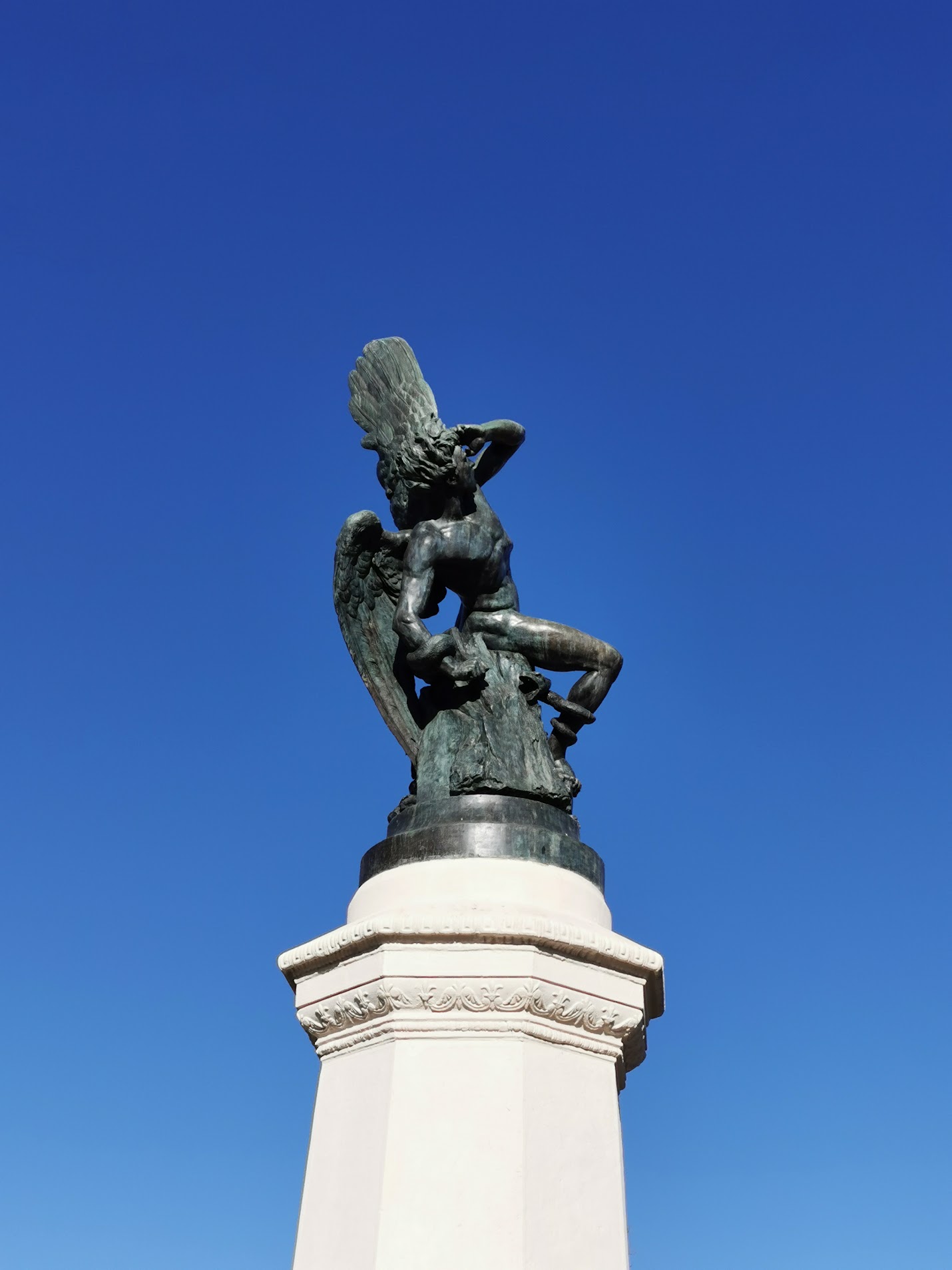
One of the world's only public monuments dedicated to Lucifer, the Fallen Angel Statue in Madrid is shrouded in mystery, legend, and controversy.
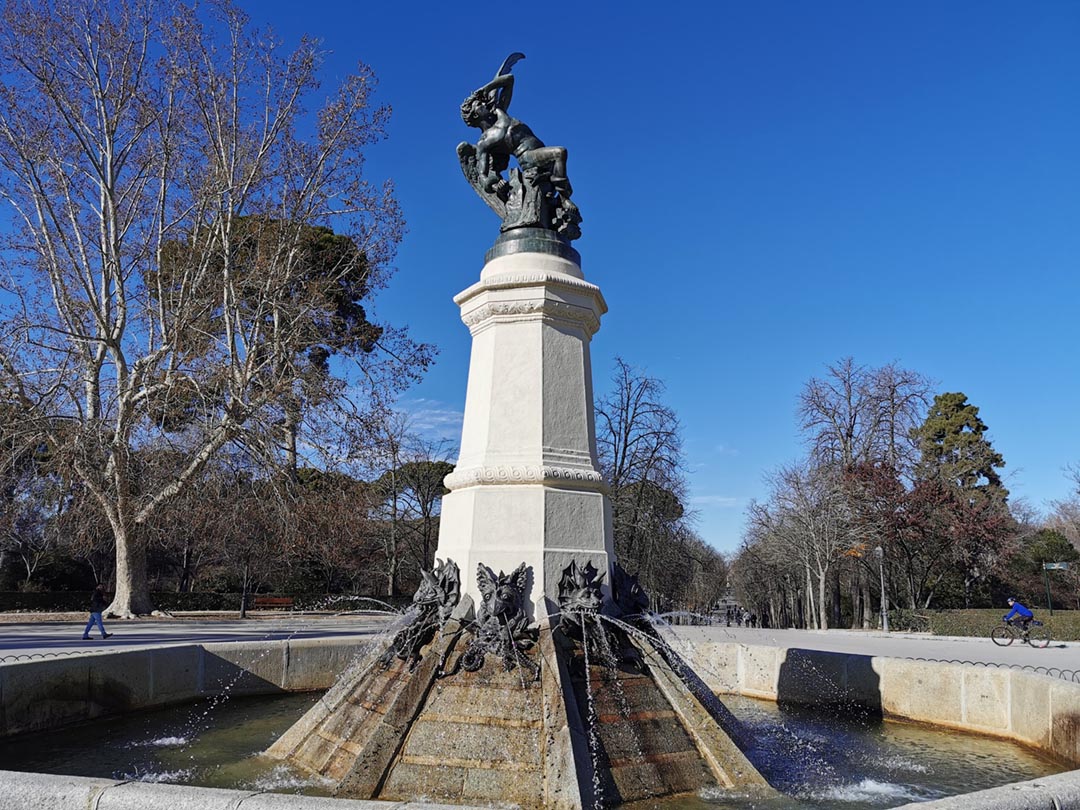
In the middle of Madrid's beautiful Retiro Park, surrounded by trees, fountains and people out for an afternoon walk, Lucifer is being thrown out of Heaven. The Fuente del Ángel Caído – Fountain of the Fallen Angel – depicts the precise moment when the rebellious angel falls from Paradise, his body twisting in pain as a serpent coils around him. Public monuments to kings, saints and military heroes are easy enough to find. A large bronze Lucifer occupying his own roundabout is a little less conventional.
The sculpture was created by Madrid-born artist Ricardo Bellver while he was studying in Rome. Bellver modelled the original version in plaster in 1877, taking his inspiration from John Milton's Paradise Lost. More specifically, he chose the passage in which Lucifer and his rebel angels have been expelled from Heaven after challenging God. The figure Bellver created is not yet the horned monster of later popular imagination. He is beautiful, athletic and unmistakably angelic, but his face is caught somewhere between agony, hatred and wounded pride.
Bellver also borrowed from much older art. The twisting body and serpent wrapped around Lucifer show a clear debt to the famous ancient Greek sculpture Laocoön and His Sons, in which a priest and his children struggle helplessly against enormous snakes. The result makes Lucifer look less like a traditional medieval Devil and more like a classical hero experiencing the worst moment of his existence. That was a fairly daring subject for a public sculpture in deeply Catholic 19th-century Spain.
The gamble paid off professionally. Bellver's work received a First Class Medal at Spain's National Exhibition of Fine Arts in 1878. The sculpture was then cast in bronze so it could be displayed at the Universal Exposition in Paris that same year. The Spanish state acquired it for 4,500 pesetas and eventually donated it to the city of Madrid, on the condition that a suitably impressive pedestal was created for it.
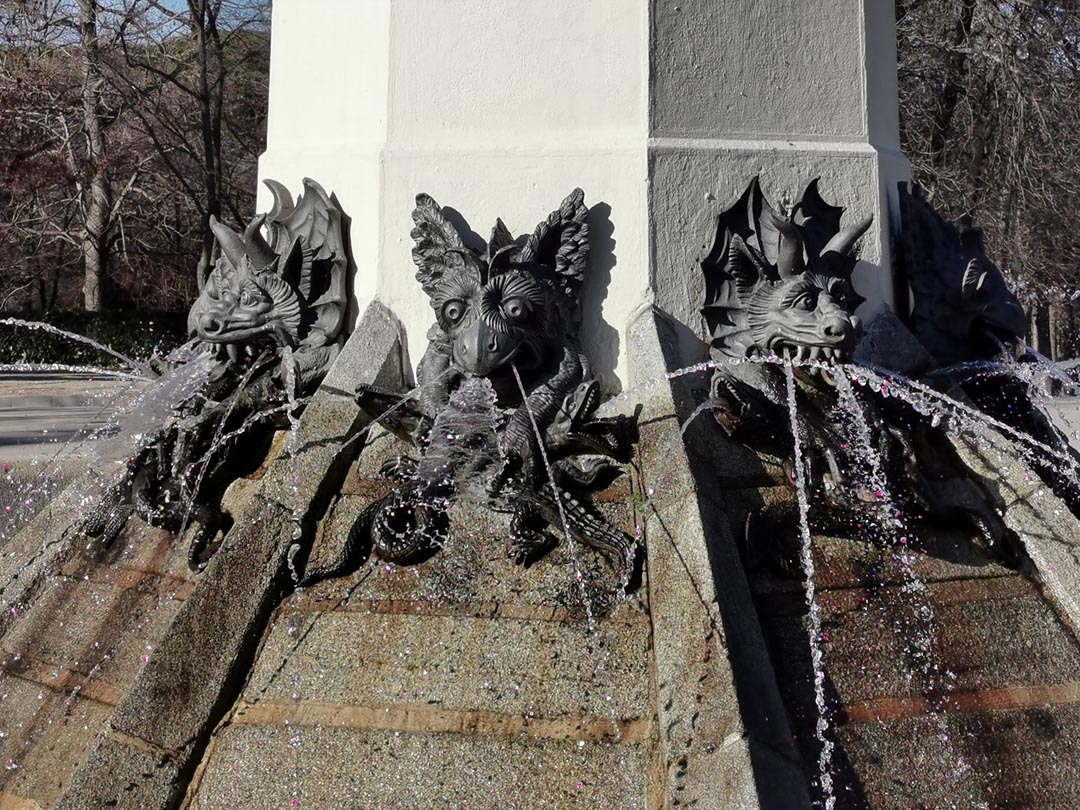
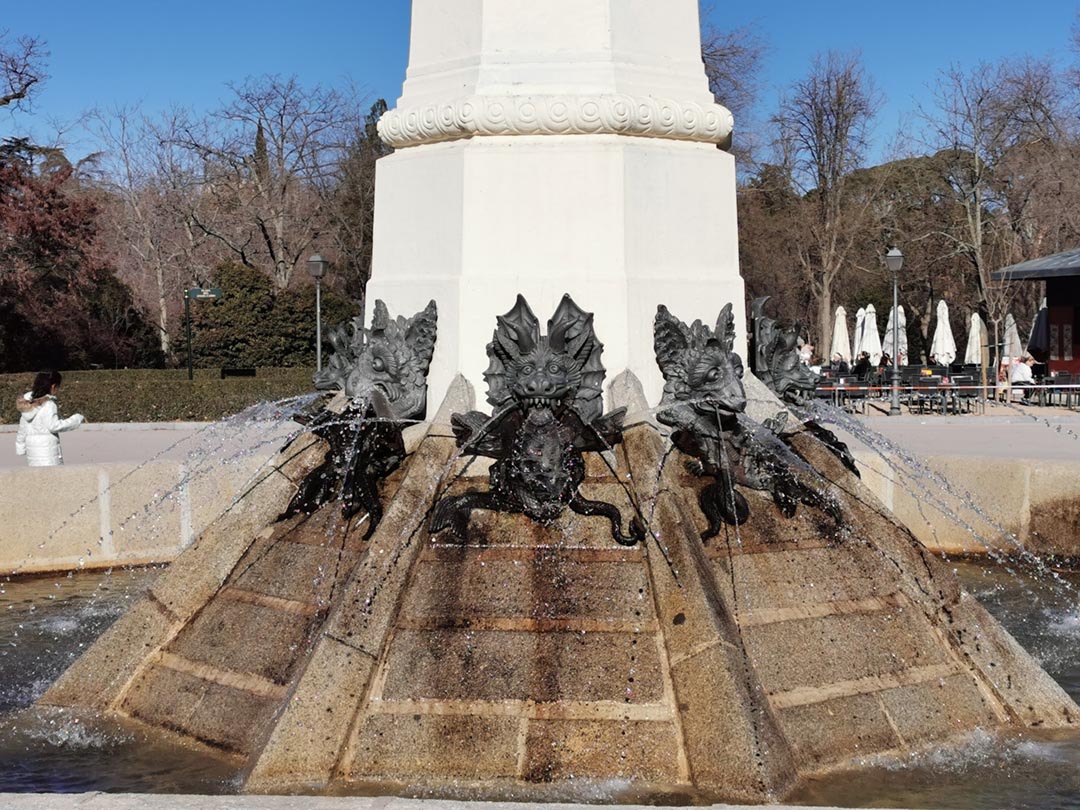
Architect Francisco Jareño was given that job in 1880, and apparently decided that Lucifer should not suffer alone. The resulting fountain stands on an octagonal pedestal decorated with monstrous faces and demonic creatures gripping lizards, serpents and fish. Water pours from their mouths into the basin below. Bellver's fallen angel rises above the whole arrangement, giving the monument the strange appearance of a public fountain that has somehow been taken over by the inhabitants of Hell.
The complete monument was inaugurated in 1885. Its location had no known satanic significance. The site had previously been occupied by the Royal Porcelain Factory of Buen Retiro, which was destroyed during the Peninsular War in the early 19th century. Lucifer simply inherited the empty space several decades later. Madrid's more conservative voices were not universally enthusiastic about placing him in a public park, but the statue remained, and eventually became one of Retiro's most recognisable monuments.
Then somebody noticed the altitude.
The roundabout of the Fallen Angel is commonly recorded at approximately 666 metres above sea level. According to the Book of Revelation, 666 is the “number of the Beast”, and it did not take long for the coincidence to become part of Madrid's occult folklore. Stories now regularly claim that the statue was deliberately positioned at exactly 666 metres as some sort of hidden satanic tribute.
There is no evidence for that. Nothing in the history of Bellver's sculpture, Jareño's pedestal or the decision to place it in Retiro suggests that anyone involved was secretly surveying Madrid in search of the Devil's favourite elevation. Madrid itself sits at roughly this altitude, so finding a location around 666 metres is considerably less miraculous than it first sounds. The number is real enough to be amusing; the satanic planning behind it appears to have arrived later. Even Madrid's own tourism material treats the 666 story as one of the legends that has grown around the monument.
Another frequently repeated claim is that the Fallen Angel is the only public monument to Lucifer in the world. That makes a good headline but does not survive much investigation either. Other sculptures depicting Lucifer or rebel angels exist in places including Turin and Havana. What is genuinely unusual about Madrid's example is how openly it places Lucifer at the centre of a large public fountain, not as a minor defeated figure beneath the feet of an archangel, but as the entire reason the monument exists.
The statue has picked up a few scars of Madrid's own history as well. Small marks visible on the bronze have been identified as damage from the Spanish Civil War. Even Lucifer apparently failed to get through the fighting in Madrid completely untouched.
Over the years the monument has naturally attracted occult stories, satanic associations and people looking for hidden meaning in its location. There are occasional claims about strange sensations or an ominous atmosphere around the fountain, but these belong to modern folklore rather than the documented history of the statue. Bellver did not need supernatural activity to make the sculpture unsettling. His Lucifer is already frozen at the instant everything has been lost – Heaven above him, a serpent around his body and Hell waiting below.
And then there is that number. Of all the places in Madrid where a statue of Lucifer could have ended up, it happens to stand at roughly 666 metres above sea level. Almost certainly coincidence. Still, if you were inventing the story afterwards, you probably would not change a thing.
Location: The Fallen Angel Statue is located in Retiro Park, Madrid, Spain.
Address: Retiro Park, Paseo Fernán Núñez, 28009 Madrid, Spain
Category: monument, statue, occult, devil
Tags: Satan, Lucifer, Madrid, dark art, devil, demon
Darkness Level: ☠ ☠ ☠ ☠ ☠ ☠ ☠ ☠
Homepage: esmadrid.com
Map: Open in Google Maps
Gallery