The Devil's Bridge – Rakotzbrücke
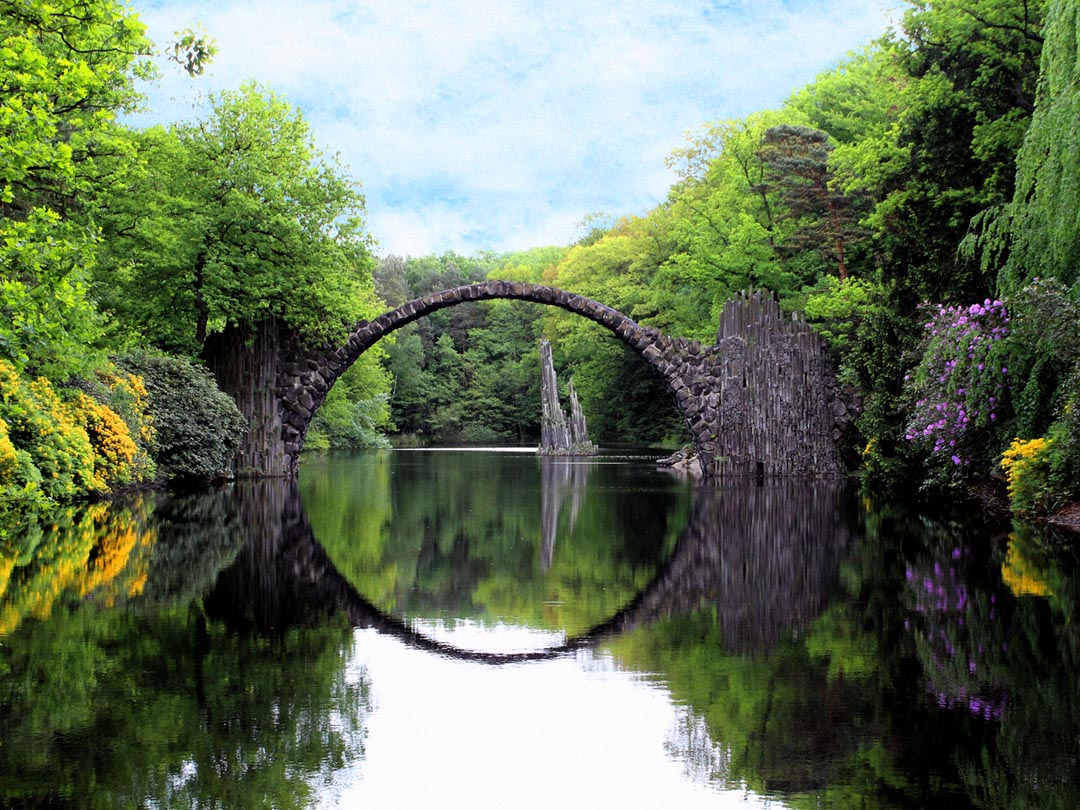
A remarkably steep 19th-century stone bridge in Saxony, designed so that its reflection forms an almost perfect circle in the water below. Known as the Devil's Bridge, Rakotzbrücke has acquired the familiar European legend of a builder bargaining with the Devil – but its documented history contains a real death, when a carpenter drowned while removing the bridge's wooden supports in 1882.
Rakotzbrücke is an ornamental stone bridge spanning the Rakotzsee in Kromlau's extensive landscape park in eastern Saxony, close to the Polish border. Its narrow arch rises so steeply above the water that, when the lake is still and viewed from the correct angle, the bridge and its reflection form an almost complete circle. Dark basalt columns surround both ends of the structure, giving the bridge an appearance considerably older and stranger than its actual 19th-century origins.
The bridge was created as part of the transformation of the Kromlau estate by landowner Friedrich Hermann Rötschke. Rötschke acquired the property in 1842 and began laying out an ambitious landscape park around 1844, taking inspiration from the nearby park at Muskau associated with Prince Hermann von Pückler-Muskau. Ponds were excavated, hills created, unusual trees planted and the landscape filled with statues, grottoes and deliberately theatrical stone structures.
Rakotzbrücke became the most extraordinary of these constructions. Modern heritage records date it broadly to the 1860s, while more detailed research places its creation during the 1860s and 1870s. It was never conceived primarily as a practical route across the water. Instead, it formed part of a carefully composed Romantic landscape in which architecture, artificial rock formations, vegetation and their reflections were intended to create dramatic views.
The bridge was constructed predominantly from basalt and fieldstone. Basalt columns were also arranged around the lake in deliberately unnatural formations, including the group rising directly from the water known as the Basaltorgel – the Basalt Organ. Rötschke reportedly had basalt transported considerable distances to Kromlau specifically to produce these jagged architectural effects. The result imitates natural volcanic formations while remaining entirely artificial.
The wider Rakotz ensemble reinforced the illusion. Beside the bridge stood a decorated grotto, while stone staircases, bizarre rock formations and classical sculpture were positioned around the lake. Among them is a reproduction of the Farnese Hercules. Elsewhere in the park Rötschke created structures with names such as the Pulpit, Judge's Seat and, appropriately, Heaven and Hell. Part of the original grotto beside Rakotzsee collapsed in 1956, leaving only fragments of what had once been an even more elaborate artificial landscape.
The bridge's extreme arch required wooden supports during construction, and these remained in place for years afterwards. Their eventual removal produced the only securely documented death associated with Rakotzbrücke. On 11 September 1882, carpenter Traugott Wolsch of Gablenz was working on the removal of the timber supports when he fell into Rakotzsee and drowned. A memorial plaque near the bridge still records his death.
The accident became part of the bridge's early history. Writing in 1909, local chronicler Adolf Aisch summarised Rakotzbrücke's cost as “50,000 thalers and one human life.” The phrase is considerably more concrete than the supernatural stories later attached to the structure: whatever the Devil's supposed involvement, Rakotzbrücke really did cost someone his life.
Its alternative name, Teufelsbrücke – Devil's Bridge, connects Rakotzbrücke with a much older European tradition. Dozens of unusually steep or technically ambitious stone bridges have acquired similar names, particularly when their construction appeared difficult enough to inspire stories that ordinary human builders could not have completed them without supernatural assistance. Most are considerably older than Rakotzbrücke.
The familiar legend says that a builder unable to complete a bridge makes a bargain with the Devil. In return for supernatural assistance, the Devil demands the soul of the first living creature to cross the finished structure. The builder then cheats him by sending an animal across instead. Versions use a dog, goat, rooster or other animal, depending on where the story is told.
This story is frequently repeated specifically about Rakotzbrücke, sometimes naming Rötschke as the man who made the bargain. The details vary considerably: in one version an animal is sacrificed, while another claims that the builder himself becomes the Devil's payment. There is little evidence that any of these versions belonged to the original 19th-century history of Kromlau. They appear instead to have been attached to Rakotzbrücke through the much broader European tradition surrounding bridges called Teufelsbrücken.
The bridge's appearance made that association particularly effective. Its arch is unusually thin and steep, and its dark basalt construction gives the ends the appearance of jagged natural cliffs. When the lake is calm, the reflection closes the semicircle beneath the bridge and produces the image for which Rakotzbrücke is now famous: an apparently perfect stone ring suspended among the trees.
Time was less kind to the structure than legend. By the early 21st century the Rakotz ensemble had deteriorated badly, and authorities considered the bridge and surviving grotto to be at serious risk of collapse. In 2017, Saxony announced approximately €2.4 million in federal and state funding for restoration of the bridge, Basalt Organ, grotto and surrounding landscape. A major conservation programme followed between 2018 and 2021.
The bridge itself remains protected as a historic monument and walking across it is prohibited. This restriction has sometimes been transformed online into another part of its supposedly sinister reputation, but the explanation is considerably simpler: Rakotzbrücke is a fragile 19th-century ornamental structure, not a modern pedestrian bridge. Keeping people off it protects both the masonry and the people who might otherwise attempt to cross its steep, narrow arch.
Rakotzbrücke has also escaped the confines of Kromlau through film and popular culture. It appears as a magical gateway in the German television film Der Zauberlehrling (2017), while the bridge can also be seen in The Matrix Resurrections (2021) during the training sequence involving Neo and Morpheus. Its circular form additionally inspired the Everdoor in the video game Spiritfarer (2020), where another arch and its reflection form a complete circle over the water.
Rakotzbrücke therefore has an unusual relationship with its own mythology. The Devil probably had nothing to do with its construction, and stories of supernatural shadows or an evil presence around the lake have no meaningful historical basis. The real bridge was the deliberate creation of a wealthy 19th-century landowner who wanted his landscape to appear dramatic, mysterious and almost impossible. He succeeded so well that a conventional European Devil's Bridge legend eventually fitted it perfectly. The memorial to Traugott Wolsch beside the lake is a reminder that behind that invented supernatural history lies one genuine tragedy.
Location: Rakotzbrücke is located in Kromlau Park, Saxony, Germany.
Address: Kromlauer Park, 02953 Gablenz, Germany
Category: occult, bridge, satan
Tags: Devil, haunted, mystical, Germany, occult, bridge, satan
Darkness Level: ☠ ☠ ☠ ☠ ☠ ☠ ☠
Homepage: kromlau-online.de
Map: Open in Google Maps
Gallery