The Devil Heads
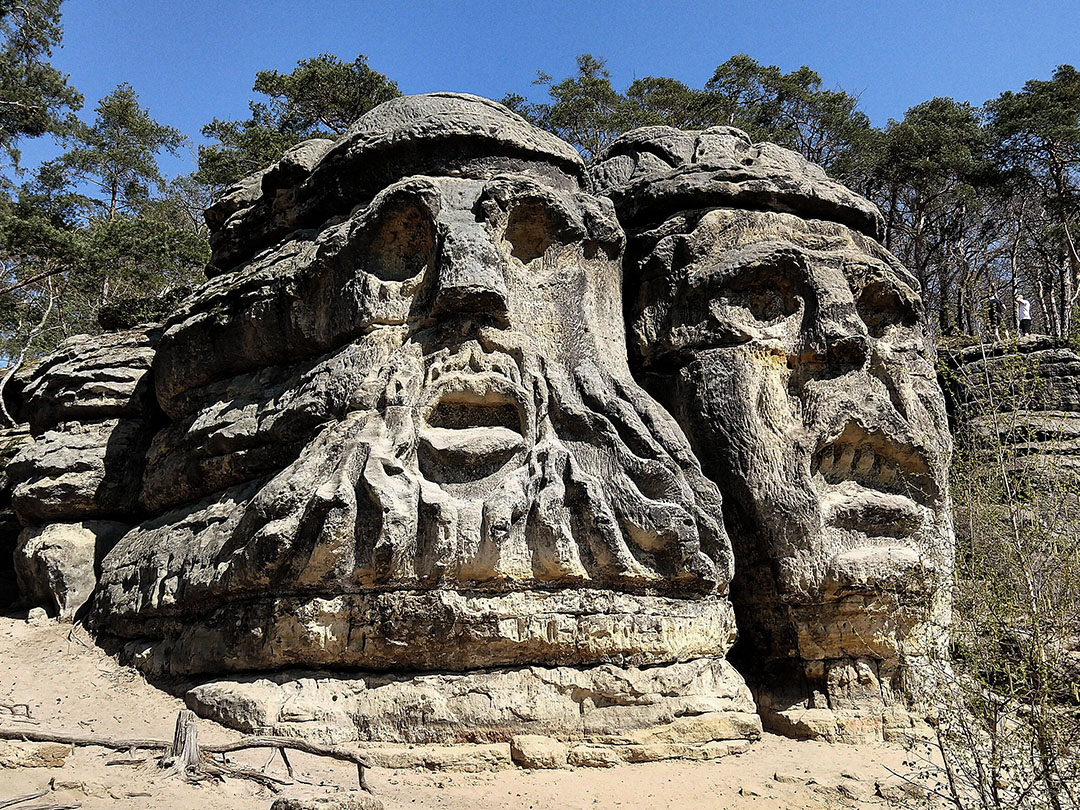
Two enormous faces carved directly into sandstone cliffs above the Czech village of Želízy in the 1840s. Known as the Devil Heads, their true identity has never been established: interpretations range from demons and mythological figures to caricatures of local people. They were among the extraordinary early works of Václav Levý, who transformed the surrounding forests into a landscape of giant heads, serpents, strange figures and artificial caves.
The Devil Heads, known in Czech as Čertovy hlavy, are two monumental faces carved directly into sandstone cliffs above the village of Želízy in Central Bohemia. Each rises approximately nine metres, with heavy brows, broad noses and deep-set features emerging from two neighbouring masses of rock. Created between 1841 and 1846, they are the best-known surviving works from an extraordinary group of sculptures scattered through the forests around Želízy and nearby Liběchov.
Their creator, Václav Levý, had not yet received the formal artistic education that would later establish him as one of the important Czech sculptors of the 19th century. Born in 1820, Levý had trained as a cabinetmaker and worked for a period as a cook at Liběchov Castle. In his spare time he carved wood and began cutting figures directly into the soft sandstone outcrops surrounding the estate. His talent attracted the attention of the estate's owner and cultural patron Antonín Veith, who eventually supported Levý's studies under Ludwig Schwanthaler in Munich.
The Devil Heads belong to this early and unusually experimental period. Levý worked directly with the natural rock rather than creating sculptures intended for a gallery or church. Existing cracks, contours and irregularities became part of the faces, giving them a roughness absent from his later academic work. The result sits somewhere between sculpture and landscape: the heads are not objects placed in the forest, but enormous sections of the forest itself given human form.
Despite their familiar name, it is not known with certainty whom the two faces were intended to represent. Their severe expressions probably encouraged the popular interpretation of them as devils, and the name Čertovy hlavy became established even in later art-historical literature. Other suggestions have included Greek gods, legendary strongmen such as Hercules and Samson, or even caricatures of two residents of Liběchov against whom Levý supposedly held a grudge. None of these identifications has been convincingly proven.
This uncertainty makes the sculptures considerably stranger than a straightforward pair of carved demons. There are no surviving horns, hooves or other clear attributes identifying the figures with the Christian Devil. What remains are two gigantic, unsmiling human-like faces looking out from the hillside, their original meaning gradually disappearing along with the details of the sandstone from which they were carved.
The Devil Heads were not an isolated experiment. During the same period Levý turned the countryside around Liběchov into what amounts to an open-air world of rock sculpture. Along forest paths he created the Harfenice – the Harpist, enormous human faces, a sphinx-like figure and the long relief known as Had – the Snake, whose body winds across the sandstone before being symbolically cut by an axe.
His most elaborate project nearby was Klácelka, an artificial cave named after philosopher and writer František Matouš Klácel. Its interior and surrounding rock court contain an extraordinary mixture of carved animals, grotesque figures and characters inspired by literature. The adjoining section known as Blaník incorporates monumental figures from Czech history and legend, including the Hussite commanders Jan Žižka and Prokop Holý and imagery connected with the mythical army said to sleep beneath Mount Blaník until the Czech lands face their greatest danger.
Taken together, these works reveal a considerably stranger artistic landscape than the Devil Heads alone suggest. Historical heroes exist beside legendary warriors, animals, enormous disembodied heads and creatures taken from allegory and imagination. Much of this work was produced before Levý had become a professionally trained sculptor, when the forests around Liběchov effectively served as his workshop.
After studying in Munich, Levý developed a much more conventional professional career. He later worked in Rome and Prague and produced religious, historical and portrait sculpture, including works for St. Vitus Cathedral. He also became the first teacher of Josef Václav Myslbek, who would become one of the most important Czech sculptors of the following generation and create the famous equestrian monument to Saint Wenceslas in Prague. The grotesque sandstone faces above Želízy therefore belong to the formative years of an artist whose later career looked very different.
The sandstone that made Levý's enormous carvings possible is also slowly destroying them. More than 180 years of rain, frost, erosion and biological growth have softened the faces and erased much of their original surface detail. Human damage has contributed as well. Levý's rock sculptures around Liběchov are now protected cultural monuments, but their exposure to the weather means that deterioration cannot be completely stopped.
For many years trees partly concealed the heads, making them appear to emerge unexpectedly from dense woodland. Extensive clearing around the sculptures in 2011 exposed them more fully and made the faces visible from greater distances. Their setting has consequently changed, but the scale remains difficult to appreciate until standing beneath them: features that appear almost ordinary in photographs become huge depressions and projections cut across several metres of cliff face.
Location: In the forest above Želízy, Central Bohemia, Czech Republic.
Address: Čertovy hlavy, 277 21 Želízy, Czech Republic
Category: sculptures, folklore, nature
Tags: Devil Heads, Čertovy hlavy, Václav Levý, Želízy, Central Bohemia, sandstone, rock carving, eerie landscape
Darkness Level: ☠ ☠ ☠ ☠ ☠ ☠ ☠
Map: Open in Google Maps
Gallery