The Alamo
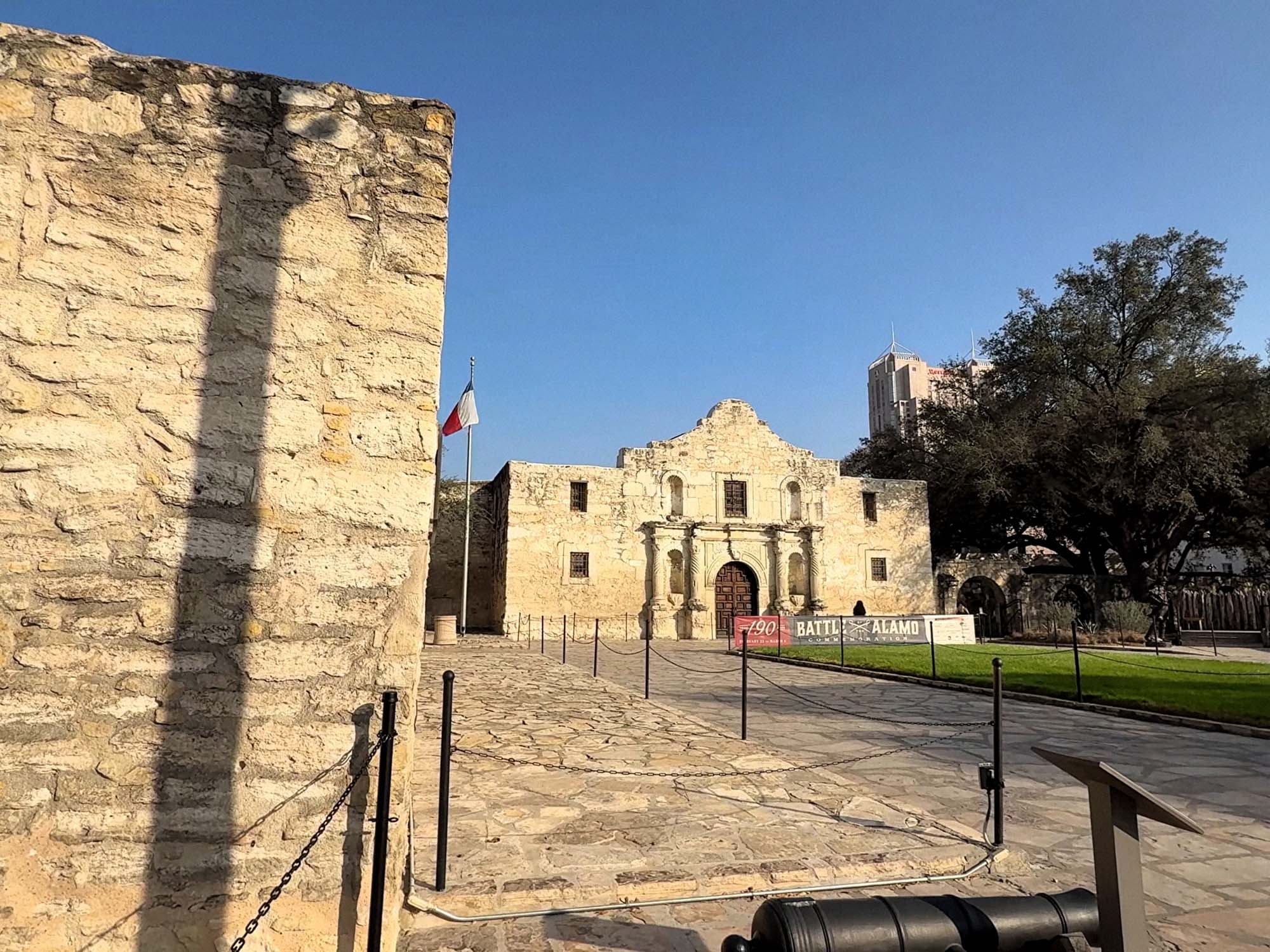
A former Spanish mission and fortress in San Antonio where almost the entire Texian garrison was killed during a thirteen-day siege in 1836. The dead included William B. Travis, James Bowie, David Crockett and several Tejano defenders; their bodies were burned in funeral pyres after the battle. The small church that became the symbol of the Alamo is only a fragment of the original compound, and even its famous curved façade was added years after the fighting.
The Alamo stands in the centre of San Antonio, Texas, surrounded today by streets, hotels and commercial buildings. The surviving church and Long Barrack are remnants of a much larger fortified mission compound that once covered much of present-day Alamo Plaza. Its name has become inseparable from the bloody battle fought here in 1836, but the site was already more than a century old when Mexican troops surrounded it.
The site began as Mission San Antonio de Valero, founded by Franciscan missionaries in 1718 as part of Spain's effort to strengthen its hold over northern New Spain and convert Indigenous peoples to Catholicism. After occupying two earlier locations, the mission moved to its present site in 1724. Construction of the stone complex followed during the 18th century, including a convento, workshops, storerooms, dwellings and the unfinished church whose remains survive today.
The mission was not an empty religious outpost. Indigenous people including members of the Payaya, Jarame and Pamaya communities lived and worked there, farming irrigated fields, raising livestock and practising trades such as weaving, masonry and blacksmithing. Some entered the mission partly seeking protection from raids, while Spanish authorities regarded conversion as inseparable from transforming Indigenous inhabitants into subjects of the Crown. Disease, warfare and population displacement took a severe toll on the communities living there.
Human remains discovered during modern archaeological work are a reminder that the Alamo was a place of burial long before 1836. Graves from the mission period have been identified within and around the surviving church, and preservation projects have required formal procedures for handling and reburying human remains. The ground beneath one of America's most famous battle sites therefore also contains people connected with the much earlier Indigenous and Spanish history of Mission Valero.
The Spanish Crown secularised the mission in 1793, distributing its lands and ending its formal religious function. A decade later, the abandoned complex acquired the name by which it would become famous. In 1803, a Spanish cavalry unit called the Second Flying Company of San Carlos de Parras moved into the former mission. The soldiers were commonly known as the Alamo Company because they had previously been stationed at Alamo de Parras in Coahuila, and their nickname gradually became attached to the old mission itself.
The military converted the convento into barracks and established what is generally regarded as the first hospital in Texas on its upper floor. The Alamo subsequently passed from Spanish to Mexican control following Mexican independence in 1821. By then the former religious settlement had effectively become a frontier fort overlooking San Antonio de Béxar.
The conflict that eventually reached the Alamo was the product of several overlapping disputes. Anglo-American immigration had dramatically changed the population of Mexican Texas, while colonists clashed with authorities over immigration restrictions, political representation, customs enforcement and the increasing centralisation of power under President Antonio López de Santa Anna. Slavery was another underlying issue. Thousands of enslaved Black people had been brought into Texas by settlers from the United States, while Mexican governments repeatedly attempted to restrict the institution. Historians continue to debate the relative importance of these causes, but the replacement of Mexico's federal system with Santa Anna's centralist government in 1835 helped turn long-running tension into open rebellion.
Fighting began at Gonzales in October 1835. Texian and Tejano rebel forces subsequently captured San Antonio after the Siege of Béxar, forcing Mexican general Martín Perfecto de Cos to surrender in December. The rebels then occupied the Alamo, using its old mission walls, buildings and artillery to defend the eastern approaches to the town.
The decision to remain there was controversial. Commander Sam Houston considered the Alamo difficult to defend and recommended destroying the fortifications and removing the artillery. The available men lacked sufficient animals to transport the heavy cannon, however, and the post remained occupied. By February 1836 command was divided between young regular army officer William Barret Travis and volunteer leader James Bowie.
On 23 February 1836, Santa Anna's army arrived unexpectedly in San Antonio and surrounded the Alamo. Mexican commanders demanded surrender at discretion, leaving the fate of the defenders entirely in Santa Anna's hands. Travis answered with a cannon shot. A red flag was raised from San Fernando Church to signal that the Mexican army intended to give no quarter, and the siege began.
The following day Travis wrote the document that would become the most famous surviving text associated with the Alamo. Addressed to “the People of Texas and All Americans in the World”, it appealed desperately for reinforcements and declared that he would never surrender or retreat. He ended with two words that became permanently associated with the siege: “Victory or Death.”
Help came, but not enough. On 1 March, thirty-two men from Gonzales entered the Alamo, bringing its strength to roughly two hundred. The exact final number remains uncertain because no complete muster roll from the last day survives. The current official list contains 189 known defenders, while continuing historical research allows for the possibility that the true number was higher.
The garrison was also more diverse than the simplified image of American settlers fighting Mexicans sometimes suggests. Several defenders were Tejanos – native Texans of Mexican heritage, including José Toribio Losoya, Gregorio Esparza, Juan Abamillo, Antonio Fuentes and others. Juan Seguín had entered the Alamo with his Tejano company before Travis sent him through the Mexican lines as a courier seeking reinforcements, inadvertently saving his life.
There were also women, children and enslaved people inside the fort. Among them were Susanna Dickinson and her infant daughter Angelina, members of the Esparza and Losoya families, Juana Navarro Alsbury and Joe, an enslaved Black man owned by William Travis. Joe participated in the fighting during the final assault and later provided one of the most important eyewitness accounts of what happened inside the Alamo.
James Bowie played little role in the final days of command. He became seriously ill shortly after the siege began and spent much of it confined to a cot. Older stories frequently identify his illness as typhoid or pneumonia, but historians have also suggested advanced tuberculosis. Whatever the diagnosis, he was unable to command by the time Mexican troops made their final attack.
Before dawn on 6 March 1836, approximately 1,800 Mexican assault troops advanced against the Alamo from several directions. The defenders initially inflicted heavy casualties with cannon and rifle fire, but the attackers regrouped and eventually crossed the walls. Fighting then moved into the rooms of the compound, where defenders were forced into increasingly confined positions.
Travis was among the first defenders killed, dying near the north wall. Bowie was killed while still seriously ill inside one of the rooms. Some of the bloodiest fighting occurred in the Long Barrack, where defenders barricaded themselves inside rooms and Mexican soldiers fought their way through the building. The church became one of the last positions to fall. The entire assault probably lasted no more than about ninety minutes.
The exact manner of David Crockett's death remains one of the enduring controversies of the battle. Early reports offered contradictory versions. Some claimed that the former Tennessee congressman died fighting, while others stated that he was among a small number of defenders captured alive and then executed on Santa Anna's orders. Evidence exists for both traditions, and historians have never reached a universally accepted conclusion. What is certain is that Crockett did not survive the morning.
The number of Mexican casualties is similarly uncertain. Santa Anna's first official report admitted 70 killed and 300 wounded, while later accounts produced substantially higher totals. Claims that hundreds or even more than a thousand Mexican soldiers were killed are still repeated, but surviving evidence does not allow a precise figure to be established. The defender total is clearer: almost every man who fought within the Alamo was dead by the end of the morning.
The often repeated statement that there were “no survivors” is nevertheless wrong. Around twenty noncombatants, principally women and children, survived. Joe also escaped death despite having taken part in the fighting. Santa Anna released Susanna Dickinson and her daughter and sent them east carrying a warning that other rebels could expect the same fate if resistance continued.
The treatment of the dead added another grim chapter. Santa Anna ordered the bodies of the defenders collected and burned on funeral pyres outside the fort. Joe later described seeing the dead piled together and burned. Juan Seguín subsequently organised burial ceremonies for remains associated with the defenders, but exactly what happened to all of the ashes remains uncertain. The long-standing claim that the remains of Travis, Bowie and Crockett now lie inside San Fernando Cathedral is regarded by modern historians as highly doubtful.
One of the most famous scenes associated with the Alamo may never have happened. According to later tradition, Travis assembled the defenders shortly before the final assault, drew a line in the ground with his sword and invited everyone willing to die with him to cross it. Only Louis “Moses” Rose supposedly refused, escaping the fort before the attack. The story ultimately rests on recollections attributed to Rose and repeated decades after the battle. No contemporary account records the scene, and the Alamo itself now treats the incident as part of the mythology surrounding the siege rather than established fact.
The Alamo's defenders probably died without knowing that Texas had formally declared independence from Mexico on 2 March 1836, four days before the final assault. They nevertheless expected independence to be declared and had sent representatives to the convention at Washington-on-the-Brazos with instructions supporting it. Their defeat quickly became a rallying symbol. The words “Remember the Alamo” were used by Texian forces before Santa Anna was defeated and captured at San Jacinto on 21 April.
The building now recognised throughout the world as “the Alamo” did not look the same during the battle. The mission church had never been completed as originally planned and possessed no roof in 1836. Its famous raised, curved parapet was not part of the battlefield structure either. After Texas joined the United States, the U.S. Army converted the Alamo into a quartermaster depot and added a roof and altered façade around 1850. The distinctive silhouette now synonymous with the battle is therefore partly a post-war creation.
The Army also repaired the Long Barrack and altered other surviving structures. During the American Civil War the Alamo was taken over by Confederate forces before returning to U.S. military control in 1865. The Army finally left in 1877, after which commercial development swallowed much of the old battlefield. Streets and businesses were built over former walls and courtyards until only the church and Long Barrack remained recognisably intact.
The Long Barrack itself came close to disappearing beneath commercial construction. It was incorporated into a general store during the late 19th century, with wooden façades and galleries concealing much of the original Spanish masonry. Preservation campaigns eventually rescued both surviving structures. The State of Texas acquired the church in 1883, while the Daughters of the Republic of Texas obtained the Long Barrack in 1905.
Modern archaeology continues to complicate the familiar image of the Alamo as a single heroic battlefield frozen in 1836. Excavations have uncovered traces of the original mission walls, Indigenous ceramics, military occupation and human burials from different periods. The site therefore contains overlapping histories of Spanish colonialism, Indigenous life, Mexican military occupation, revolution, death and later American commemoration rather than one isolated thirteen-day siege.
The Alamo became a National Historic Landmark in 1960 and in 2015 was included with the other San Antonio missions in a UNESCO World Heritage Site. Major conservation and archaeological projects continue around Alamo Plaza, partly intended to recover the scale of the original mission and battlefield that disappeared beneath later San Antonio.
Location: On Alamo Plaza in the centre of San Antonio, on the surviving portion of the former Mission San Antonio de Valero and 1836 battlefield.
Address: 300 Alamo Plaza, San Antonio, TX 78205, United States
Category: battlefield, war, western
Tags: Alamo, Mission San Antonio de Valero, Texas Revolution, Battle of the Alamo, siege, battlefield, William B. Travis, James Bowie, David Crockett, Davy Crockett, Antonio López de Santa Anna, Tejano defenders, Juan Seguín, Joe, Susanna Dickinson, Spanish mission, Indigenous history, Mexican Army, execution, funeral pyres, western, military fortress, Long Barrack, Texas independence
Darkness Level: ☠ ☠ ☠ ☠ ☠ ☠ ☠ ☠ ☠
Homepage: thealamo.org
Map: Open in Google Maps
Gallery