Terracotta Army
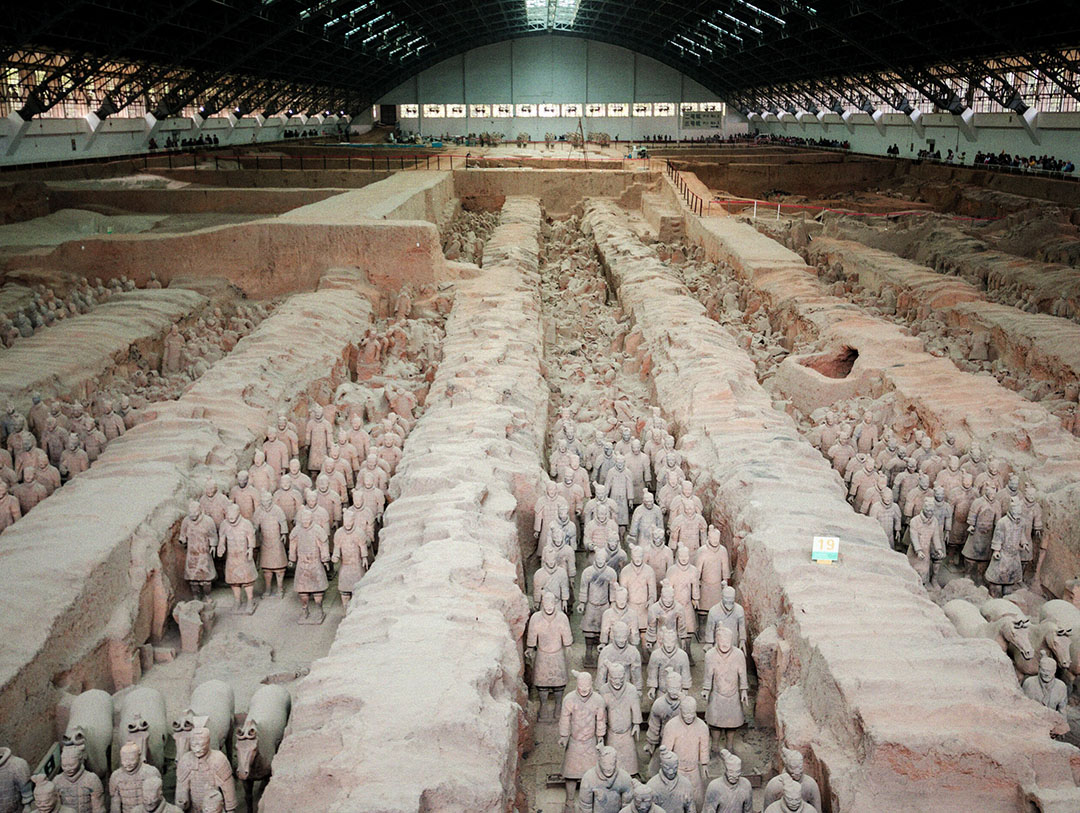
A vast underground army of life-sized clay soldiers guarding the tomb of China’s first emperor—an archaeological marvel and a chilling testament to absolute power.
The Terracotta Army is one of the most extraordinary archaeological discoveries of the 20th century. Discovered in 1974 by local farmers near Xi’an, China, the site revealed thousands of life-sized clay warriors buried in battle formation, intended to guard the tomb of Qin Shi Huang, the first Emperor of a unified China.
Constructed over 2,000 years ago around 210 BCE, the necropolis contains an estimated 8,000 soldiers, 670 horses, and 130 chariots—each figure uniquely crafted with individual facial features, hairstyles, and armour. They were meant to accompany the emperor into the afterlife, reflecting his obsession with immortality and power even in death.
The site spans several massive pits, with many figures still buried or undergoing restoration. Visitors can explore the vast underground chambers through walkways and exhibitions, witnessing the eerie scale of the army and the emperor’s sprawling mausoleum complex, which remains partially unexplored. The air of solemnity and mystery makes this not just an archaeological site, but also a striking dark tourism destination.
Location: Located near the city of Xi’an, Shaanxi Province, China.
Address: Lintong District, Xi'an, Shaanxi, China
Category: archaeological site, mausoleum, imperial tomb, unesco
Tags: Terracotta Army, Qin Shi Huang, Xi’an, Chinese history, mausoleum, necropolis, underground army, unesco
Darkness Level: ☠ ☠ ☠ ☠ ☠ ☠ ☠
Homepage: bmy.com.cn
Map: Open in Google Maps
Gallery