Svenskemuren
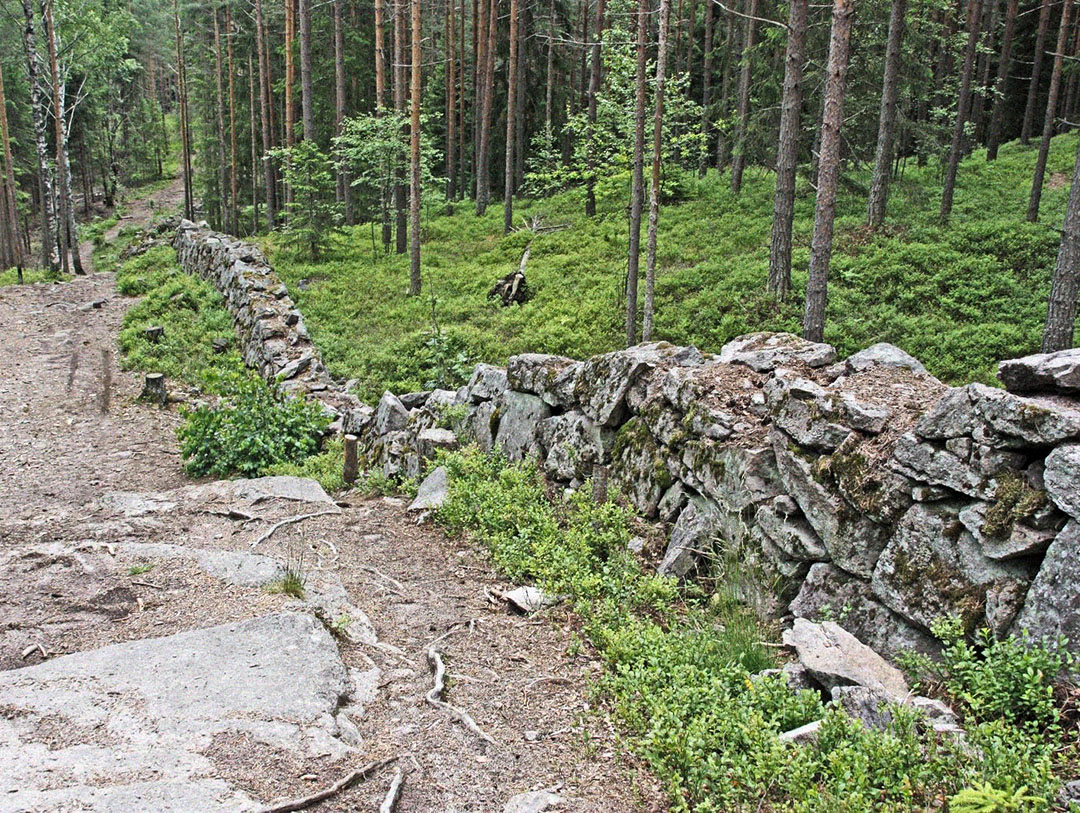
Svenskemuren is a historical series of stone walls in Oslo, built by Swedish prisoners of war during the 1808-1809 war between Norway and Sweden.
Scattered around Oslo are remnants of stone walls with a rather unusual history. Known collectively as Svenskemurer, or “Swedish Walls”, they are associated with Swedish prisoners of war captured during the fighting between Norway and Sweden in 1808–1809. At first glance there is nothing particularly remarkable about them – they look like old boundary walls of roughly stacked stone. Their history is considerably darker. The men who built at least some of them had entered Norway as soldiers and ended up doing hard physical labour for their enemy.
The story begins with the Napoleonic Wars. Denmark–Norway and Sweden found themselves on opposing sides, and in the spring of 1808 Swedish forces crossed the Norwegian border. The invasion did not go according to plan. Norwegian forces defeated or captured substantial Swedish units at several engagements, including Toverud, Trangen and Prestebakke. Around 120 men were captured at Toverud on 19 April, approximately 400 at Trangen six days later and another 360 at Prestebakke in June. Within only a few months, the Norwegians had taken at least 880 Swedish soldiers prisoner.
Keeping that many enemy soldiers created a problem. They could not simply be released while the war continued, and Norway was already suffering badly from shortages and the British blockade of Denmark–Norway. Prisoners were therefore distributed to places where they could be guarded and put to work. Many were held in and around Christiania, as Oslo was then known, while others were sent elsewhere in eastern Norway and eventually as far away as Bergen. Contemporary arrangements allowed Swedish prisoners to be hired out for labour under Norwegian supervision. They dug, repaired roads, worked on farms and estates and performed the kind of heavy manual work that would otherwise have required paid local labour.
The best-known surviving result in Oslo is the Svenskemuren connected with Nordberg gård in what is now Nordre Aker. The stone wall marked the boundary of the farm's outlying land and originally stretched for several kilometres through an area that today consists of residential neighbourhoods and forest. Large sections have disappeared, but the wall can still be followed from around Havnabakken and Grinda northwards towards the woodland near Svartkulp. In places it is little more than a broken line of stones beneath vegetation; elsewhere surprisingly substantial sections remain.
For generations, local tradition maintained that Swedish prisoners had built the wall during the war, but there was one problem: nobody could actually prove it. Historians found no surviving farm accounts from the crucial years, and the story rested largely on the name of the wall and memories handed down through families connected with Nordberg. That changed when historian Oskar Aanmoen found an entry in the accounts of Akershus Fortress from 1808–1809 referring to a number of Swedes being sent to work on “house and wall at Lille Sogn”. Lille Sogn was the old name of the property that became Nordberg gård in 1810. It does not document every surviving metre of stone, but it gives the old story considerably more weight than it once had.
The wall may also have been intended as something more than a practical boundary. A substantial stone wall required an enormous amount of labour and could serve as a visible sign of a farm owner's wealth and status. With prisoners available as relatively cheap labour, projects that would otherwise have been expensive suddenly became possible. That uncomfortable combination – prestige for the landowner and forced labour for the prisoners – is still physically visible in the landscape more than two centuries later.
Another Svenskemur survives in a much more urban setting near Solli plass. It once formed part of the boundary of the Petersborg estate along Drammensveien. The property was inherited in 1808 by Jacob Nielsen, one of Christiania's leading merchants, who constructed a large new main house and a substantial stone wall along the road. Historical accounts state that Swedish prisoners of war were used in its construction, together with prisoners hired from the forced-labour institution at Akershus Fortress. The wall may originally have extended for 300–350 metres. Today, only around 90 metres remain, easily passed without giving much thought to who put the stones there.
The Swedish prisoners left traces far beyond these walls. Around 200 were reportedly sent to Bærums Verk to repair damage caused by flooding, while others worked on farms and estates across eastern Norway. Another 235 prisoners were transferred all the way to Bergen, where they were used to improve the city's roads. Skilled prisoners could be put to more specialised work: at Akershus Fortress, dozens of Swedish shoemakers and tailors were employed in military workshops. The system was practical for the Norwegian authorities, but for the prisoners it meant that capture on the battlefield was followed by months of confinement and compulsory labour far from home.
Conditions could be miserable. With hundreds of prisoners arriving in a relatively short period, proper accommodation was limited. Men were housed not only at Akershus but in barns, outbuildings and temporary quarters around Christiania. Some developed surprisingly friendly relationships with the Norwegians they worked for, and there are documented cases of local people helping Swedish prisoners escape and find their way back towards Sweden. Doing so was a serious offence and could result in prosecution for treason.
That makes Svenskemuren an unusual kind of war memorial. There are no statues, heroic inscriptions or lists of names. In many places there is barely anything to tell you what you are looking at. It is simply a line of old stones disappearing into the forest or running beside a modern Oslo street. Yet those stones connect the present-day city directly with a largely forgotten episode of the Napoleonic Wars, when captured Swedish soldiers were turned into a workforce and left pieces of their captivity embedded in the landscape.
Location: Located in various spots throughout Oslo, including Nordberg and Solli Plass, these stone walls serve as historical markers of Norway’s past conflicts with Sweden.
Address: Various locations, Oslo
Category: historical site, landmark, war
Tags: historical site, landmark, military history, Napoleonic Wars
Darkness Level: ☠ ☠ ☠ ☠ ☠ ☠
Map: Open in Google Maps
Gallery