Steilneset Memorial – The Vardø Witch Trials Memorial

A stark memorial on the Arctic shore of Vardø, dedicated to the 91 people who lost their lives during the Finnmark witch trials between 1600 and 1692. Created by Peter Zumthor and Louise Bourgeois near the old execution ground at Steilneset, the memorial combines individual court records with an installation of fire, mirrors and an empty chair, returning names and identities to people once condemned as servants of the Devil.
Steilneset Memorial stands on the exposed southern shore of Vardøya in Finnmark, close to the area believed to have served as Vardø's execution ground during the 17th century. Created by Swiss architect Peter Zumthor and French-American artist Louise Bourgeois, the memorial commemorates the 91 people sentenced to death during the Finnmark witch trials between 1600 and 1692. Its location is deliberate: many of those condemned in the Vardø proceedings were taken from imprisonment at Vardøhus to Steilneset and executed here.
The scale of the persecution was extraordinary. Historical research has identified approximately 135 people accused of witchcraft in Finnmark, of whom 91 were condemned to death. Seventy-seven were women and fourteen were men. Both Norwegian and Sámi people were prosecuted, although the pattern differed by gender: most of the women sentenced to death were Norwegian, while Sámi men formed a particularly large proportion of the male victims.
These numbers become even more striking when compared with the population. Finnmark had only around 3,200 inhabitants towards the end of the 17th century. In proportion to its population, the region experienced not only the most severe witchcraft persecutions in Norway but some of the most intense recorded anywhere in Europe. The worst outbreaks occurred in the small fishing communities around Vardø, Vadsø and the Varangerfjord, where a single accusation could develop rapidly into a chain of new arrests.
The first major wave followed the catastrophic storm of Christmas Eve 1617, when ten fishing boats were lost and around forty men drowned off the coast of eastern Finnmark. Several years later, women were accused of having created the storm by magical means. In 1621, ten women were condemned during the first large Vardø prosecution. Their supposed crimes included manipulating the weather, transforming into animals, making pacts with the Devil and attending supernatural gatherings.
The trials became even more extreme during the winter of 1662–1663. Prisoners were held at the old Vardøhus fortress, and some were subjected to the water ordeal, in which a suspect was bound and thrown into the sea. Floating could be interpreted as evidence of guilt because water, understood as a sacred element, was believed to reject the impure. Torture and intense interrogation could then produce confessions naming further suspects, allowing the prosecutions to spread through families and neighbouring settlements.
The surviving court records contain extraordinary descriptions of witches flying through the Arctic night, transforming themselves into birds and animals, causing storms at sea and meeting Satan on nearby Domen. The mountain became the imagined centre of the witch conspiracy, where accused women supposedly danced while the Devil played music and from where some claimed to have travelled directly into Hell. These stories were not harmless folklore. Once entered into the judicial record, they could help send real people to prison and ultimately to the stake.
Steilneset represents the other end of that process. Domen existed in the accusations; Vardøhus was where prisoners were confined and interrogated; Steilneset was where punishment became physical. Contemporary documentation does not allow every execution in Finnmark to be located precisely, but Steilneset was Vardø's established execution ground and many of the victims of the eastern Finnmark trials were burned in this area.
The persecutions finally declined after the catastrophic trials of 1662–1663, although witchcraft cases continued in Finnmark for several more decades. The final person to lose his life in the Finnmark trials was the Sámi noaidi Anders Poulsen in 1692. He did not reach a formal execution: while being held at Vadsø, he was murdered with an axe by a fellow prisoner who claimed Poulsen was a witch and deserved to die. His death brought the known number of people who lost their lives during the Finnmark persecutions to 91.
For centuries there was little at Steilneset to identify what had happened there. The modern memorial emerged from the Norwegian Scenic Routes programme and was developed through an unusual collaboration between Peter Zumthor and Louise Bourgeois. It was officially opened by Queen Sonja on 23 June 2011, appropriately on the eve of St John's Day – a date that had itself featured repeatedly in 17th-century descriptions of witches' gatherings.
Zumthor's principal structure is a long, narrow memorial hall suspended within an exposed wooden framework. A fabric enclosure stretches for roughly 125 metres along the shoreline, moving slightly in the strong coastal wind rather than behaving like a conventional solid building. Inside, a dark wooden walkway leads through a succession of small illuminated spaces.
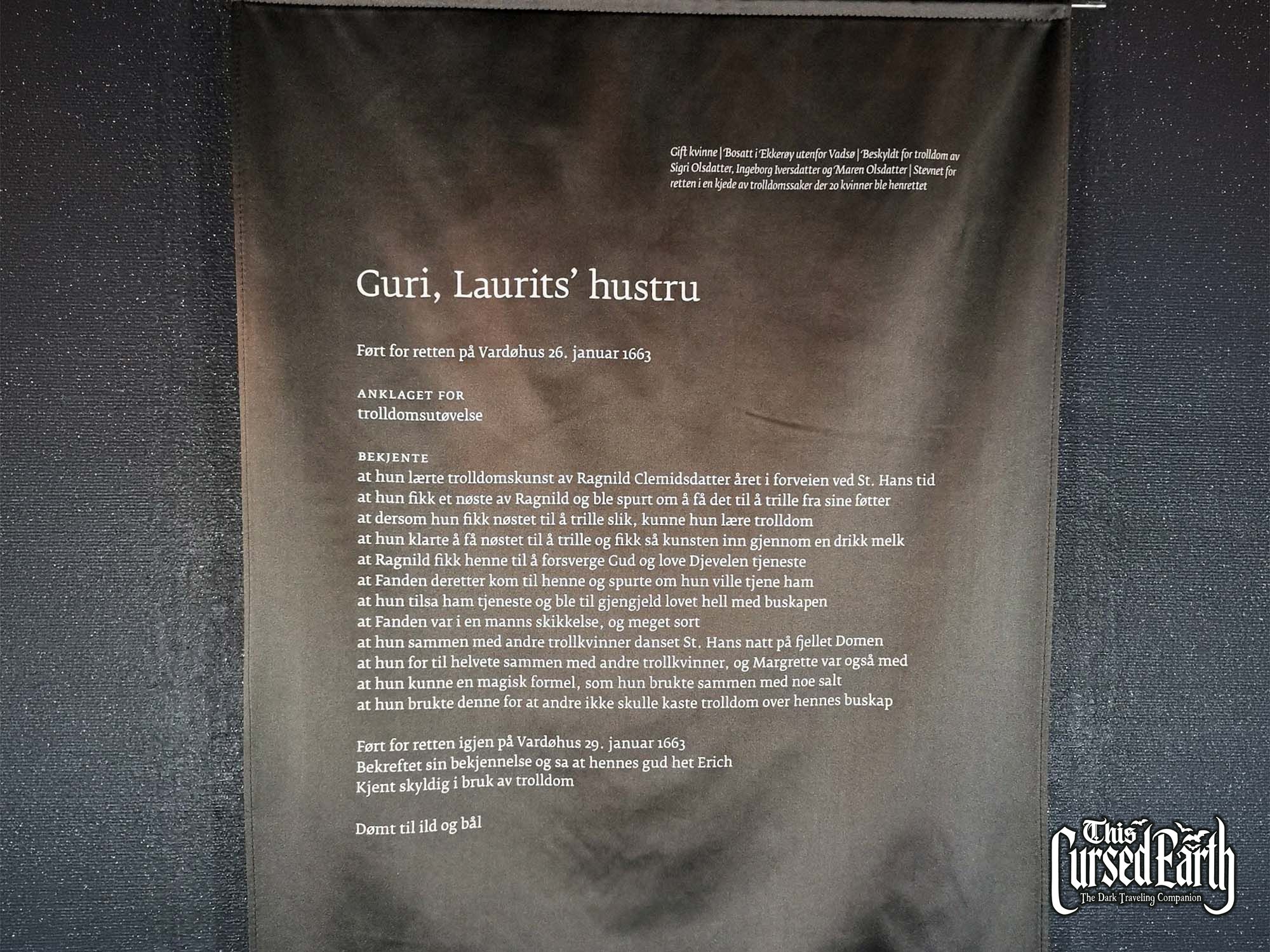
Along the walls are 91 individual memorial texts, one for each person condemned during the Finnmark witch trials. Historian Liv Helene Willumsen prepared the texts directly from the surviving court records. Each gives the victim's name together with details of the accusation, confession, court proceedings and sentence. Beside every text is a single small window and an exposed light bulb, giving each person an individual place within the otherwise repetitive corridor.
This structure changes the way the trials are presented. The victims are not reduced to the collective label of “witches.” One after another they appear as named individuals whose surviving records describe specific accusations and deaths. The repetition also demonstrates the scale of the persecution: the visitor passes not one symbolic victim but 91 separate lives, each represented by the same small light.
A short distance away stands the second part of the memorial, a square pavilion of dark glass and steel designed by Zumthor to contain Bourgeois' installation The Damned, the Possessed and the Beloved. The contrast with the long timber hall is immediate. The first structure is narrow and subdued; the second surrounds the visitor with glass, fire and reflected light.
At its centre stands an empty metal chair. Five gas flames burn around it, while seven large oval mirrors suspended in a circle repeatedly reflect the chair and the fire. The flames evoke the executions without attempting to reconstruct a stake or historical burning. The empty chair instead leaves the victim absent, while the mirrors reproduce the scene from multiple directions and inevitably include the viewer among the reflections.
The work acquired an additional significance because it became Louise Bourgeois' final major installation. She died in 2010, the year before Steilneset opened. Much of her career had explored memory, trauma, family, confinement and violence, making the collaboration unusually appropriate to a memorial concerned with people destroyed by accusation and institutional power.
The landscape is an essential part of the monument. Nothing separates Steilneset from the weather of the Barents Sea: wind passes through the exposed timber frame, the fabric structure moves, and winter darkness or the continuous light of summer completely alters the appearance of the memorial. Across the surrounding landscape lie the other principal sites of the story. Vardøhus represents imprisonment and judicial authority, while Domen can be seen towards the mainland, the mountain repeatedly transformed into Satan's meeting place in the prisoners' confessions.
Steilneset therefore avoids presenting the witch trials as supernatural history. There are no reconstructed witches, demons or instruments of torture. Instead, the memorial returns repeatedly to names, court records and the mechanisms by which ordinary people were transformed into supposed servants of the Devil. The flames in Bourgeois' installation refer to something that was painfully real, while the fantastic crimes for which the victims died existed primarily in accusations and confessions produced by the legal system itself.
The Salem witch trials of 1692 are considerably more famous internationally, but the scale of the Finnmark persecution was different. Twenty people were judicially executed during the Salem crisis, while 91 people lost their lives in the Finnmark witch trials between 1600 and 1692. The periods cannot be compared directly – Salem was an intense episode concentrated largely within a single year, while the Finnmark cases unfolded across several generations – but relative to Finnmark's tiny population the northern Norwegian persecutions rank among the most severe witch hunts recorded in Europe.
Location: Located in Vardø, Norway, not far from Vardøhus Fortress.
Address: Steilneset, Vardø, Norway
Category: witch, memorial, historical site, witch trials
Tags: Steilneset Memorial, witch trials, Vardø, Norway, witch
Darkness Level: ☠ ☠ ☠ ☠ ☠ ☠ ☠ ☠ ☠
Homepage: varangermuseum.no
Map: Open in Google Maps
Gallery