Salem Witch Board Museum
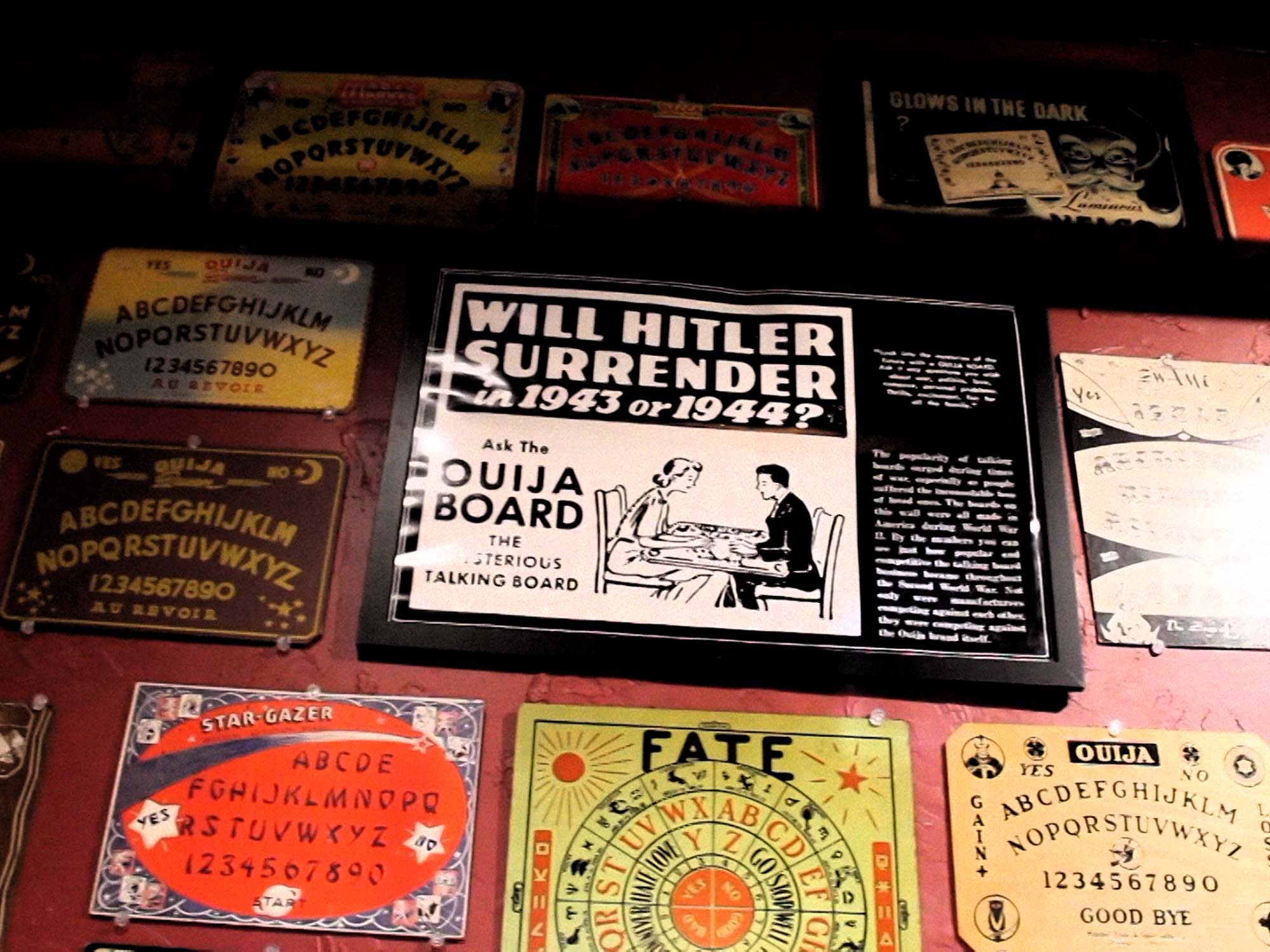
A small museum devoted entirely to Ouija boards and their predecessors, tracing their origins in 19th-century Spiritualism through more than a century of séance culture, strange deaths, alleged hauntings, murder cases and horror films. The collection includes rare antique talking boards, planchettes, unusual variations and pop-culture material, while examining how a once-common parlour game acquired its modern reputation as a dangerous doorway to the dead.
Salem Witch Board Museum is a specialist museum on Essex Street in Salem, Massachusetts, devoted to the history, folklore and cultural impact of Ouija boards and other talking boards. Despite its location in a city synonymous with the Salem witch trials, the museum is not primarily concerned with the events of 1692. Its subject is a much later form of supernatural belief: the attempt to communicate with spirits by placing the hands on a movable pointer and allowing it to spell messages across a board of letters and numbers.
The museum opened in 2019 and was founded by collector and researcher John Kozik, a founding member of the Talking Board Historical Society. Kozik's interest began with the heavily used Ouija board belonging to his grandmother, which he inherited after her death. Over the following years he assembled hundreds of talking boards and related objects. The museum developed from that personal collection, supplemented by donations, photographs, documents and other material associated with the history of spirit communication.
The collection is considerably broader than the familiar Parker Brothers Ouija board. Talking boards appeared in an extraordinary variety of forms and under names including Oriole, Espirito, Volo, Igili, Witch-E, Weird-A and Mystifying Oracle. Some were intended to contact spirits, while others claimed to predict the future, read minds or communicate with past lives. The museum displays boards dating from the late 19th century through modern examples, alongside planchettes, advertising, packaging and memorabilia showing how manufacturers repeatedly redesigned essentially the same mysterious idea.
The story begins with the rise of Modern Spiritualism in the United States during the mid-19th century. After the movement emerged in the late 1840s, séances, table-turning, automatic writing and other methods of supposed communication with the dead became increasingly popular. Early planchettes could hold pencils and produce automatic writing, while alphabet boards allowed sitters to select letters. By 1886, American newspapers were reporting a craze for a device recognisably similar to the later talking board, several years before the product called Ouija appeared.
The commercial Ouija board emerged in Baltimore in 1890. The Kennard Novelty Company was formed that year to manufacture the device, and attorney Elijah J. Bond applied for a patent describing it simply as a “toy or game.” The patent, number 446,054, was granted on 10 February 1891. Its basic arrangement remains immediately familiar: letters and numbers on a flat board and a movable indicator operated through the light touch of two or more participants.
Even the name Ouija has its own piece of folklore. According to accounts later recovered by talking-board historians, Elijah Bond's sister-in-law Helen Peters, who had a reputation as a medium, participated in a session on 25 April 1890 in which the unnamed board was asked what it wished to be called. The pointer supposedly spelled O-U-I-J-A and, when asked what the word meant, answered “good luck.” This contradicts the frequently repeated explanation that “Ouija” was deliberately constructed from the French oui and German ja, both meaning “yes.” Peters also accompanied Bond during the effort to secure the patent, giving her an unusually important but long-overlooked place in the board's history.
Manufacture subsequently became closely associated with William Fuld, whose name appeared on Ouija boards for decades. Fuld did not invent the device, despite later advertising that helped create that impression, and he reportedly described himself as a Presbyterian rather than a Spiritualist. He nevertheless proved exceptionally successful at selling an object associated with communication from beyond the grave. Following his death, his children continued the business until the family company was sold to Parker Brothers in 1966.
Fuld's own death supplied the Ouija story with one of its more macabre episodes. In 1927, he climbed onto the roof of his three-storey Baltimore factory while supervising work on a flagpole. An iron support gave way and he fell from the building. Fuld initially survived the fall with several broken ribs, but during transport to hospital one of the fractures punctured his heart and he died. The accident later became entangled with Ouija folklore, particularly because Fuld had previously claimed that the board itself advised him to construct the factory. There is no evidence that his death involved anything supernatural.
The sale to Parker Brothers in 1966 created the direct connection between Ouija and Salem. Parker Brothers was based in the city and transferred manufacture of the board there after purchasing William Fuld Inc. The timing coincided with another surge in fascination with the paranormal. Approximately two million Ouija boards were reportedly sold during the following year, enough for the product to outsell Parker Brothers' perennial giant Monopoly. For a time, therefore, one of America's most famous supposed instruments for contacting the dead was being commercially manufactured in the city already infamous for witchcraft accusations.
Ouija's sinister reputation was not always as dominant as it is today. During the early 20th century the board could be treated as entertainment, a family novelty or even a courting game. Norman Rockwell illustrated a young couple using one for the cover of The Saturday Evening Post in 1920, their knees touching as they leaned over the board. Periods of war, epidemic and mass bereavement also increased interest in Spiritualism, as families searched for ways of communicating with people who had died far from home.
Some Ouija users became famous in their own right. Beginning in 1913, St Louis housewife Pearl Curran claimed that her board had established communication with a 17th-century woman calling herself Patience Worth. Curran subsequently produced novels, plays, poems and other writings attributed to the supposed spirit, eventually amounting to millions of words. The material attracted serious literary attention, although no historical person matching Patience Worth's claimed biography has ever been conclusively identified. The case remains an unusual example of the Ouija board moving beyond séance entertainment into literature and popular culture.
The board also accumulated darker associations through contemporary crime reporting. Newspapers repeatedly connected Ouija sessions with mental breakdowns, disappearances, suicide fears and violent acts. One particularly notorious case occurred in Buffalo in 1930, when a murder was reportedly committed after participants claimed to have received instructions from a Ouija board. Such cases helped transform an object sold in toy shops into something capable of generating genuine fear, whether or not the board itself had any causal role in the events.
Its modern demonic reputation owes a great deal to popular culture, particularly The Exorcist. William Peter Blatty's 1971 novel, followed by the enormously successful The Exorcist (1973), associated a child's use of a Ouija board with demonic possession. After decades in which advertisements could present talking boards as harmless amusement, the image of the Ouija as a dangerous portal became deeply embedded in horror culture. Later films including Witchboard (1986), Ouija (2014) and numerous sequels and imitations reinforced the connection between the board, possession and violent death.
The Salem museum reflects this pop-cultural afterlife alongside the older historical material. Displays include film-related memorabilia as well as boards whose former owners or donors have attributed unusual events to them. Museum descriptions also address stories of supposedly haunted boards, murder, suicide and unexplained incidents. These accounts are presented as part of the folklore surrounding talking boards rather than proof that particular objects possess supernatural properties.
There is also a scientific explanation for the apparently independent movement of the planchette. Psychologists generally associate the effect with ideomotor action: very small unconscious muscular movements produced without the participant feeling that they deliberately initiated them. With several fingers resting lightly on a planchette, these movements can accumulate and give participants the strong impression that the object is moving by itself. Experiments have even used Ouija-style devices to investigate unconscious memory, suggesting that the phenomenon can reveal interesting aspects of human cognition without requiring an external spirit to move the pointer.
Kozik and the Talking Board Historical Society have been particularly interested in separating this documented history from myths that have grown around it. The museum therefore occupies a slightly unusual position among Salem's occult attractions. It does not need to establish whether ghosts actually communicate through the boards for its subject to remain strange. The surviving objects document more than a century of people purchasing commercially manufactured pieces of wood and cardboard while simultaneously wondering whether those same objects might allow something dead to answer back.
The museum itself is relatively compact and is located inside Remember Salem at 127 Essex Street. Around a hundred boards were reported to be displayed at any given time in 2021 from a collection numbering several hundred pieces, although the selection can change. A Victorian-style séance room forms part of the exhibition, while the walls and cases are densely filled with boards representing different periods, manufacturers and ideas about supernatural communication. In 2024, Kozik expanded the project with a second Witch Board Museum in Baltimore, appropriately returning part of the collection to the city where commercial Ouija began in 1890.
Salem Witch Board Museum consequently tells a history much broader than that of a single board game. Its collection follows the Ouija from Victorian Spiritualism and commercial novelty to séance tool, psychological curiosity and horror-film icon. Few objects have moved so comfortably between the toy shelf and the occult, or inspired such sharply divided interpretations: to one person a cardboard game, to another a subconscious psychological mechanism, and to another an invitation for whatever might be waiting on the opposite side of the planchette.
Location: On Essex Street in the historic centre of Salem, inside Remember Salem.
Address: 127 Essex Street, Salem, MA 01970, United States
Category: occult museum, museum, paranormal attraction
Tags: Ouija, talking boards, witch boards, spirit communication, Spiritualism, séance, planchette, divination, occult history, paranormal, haunted objects, ghost lore, William Fuld, Elijah Bond, Helen Peters, John Kozik, Talking Board Historical Society, Parker Brothers, Patience Worth, ideomotor effect, The Exorcist, Witchboard, horror films
Darkness Level: ☠ ☠ ☠ ☠ ☠ ☠ ☠
Homepage: salemwitchboardmuseum.com
Map: Open in Google Maps
Gallery