Rock Sculpture of Decebalus
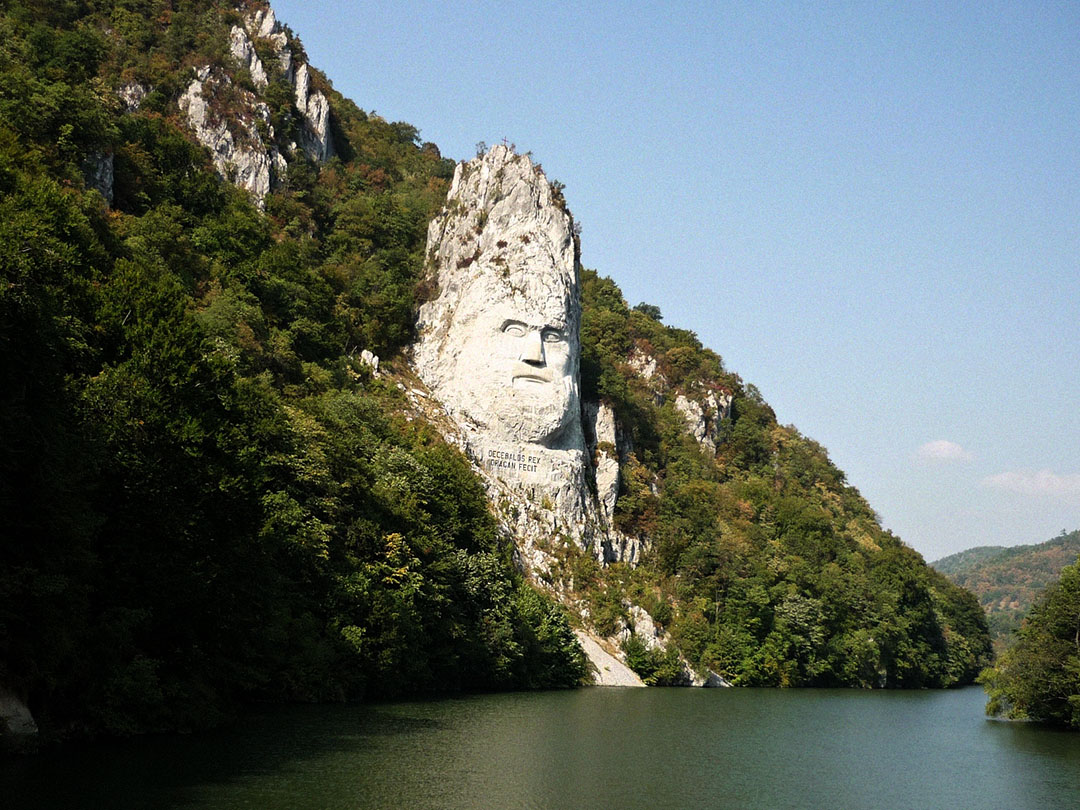
A colossal portrait of Dacian king Decebalus carved directly into a limestone cliff above the Danube at the Iron Gates. Created over eleven years with pneumatic hammers, scaffolding and explosives, the monument faces the Serbian bank where an ancient Roman inscription records the road built for Emperor Trajan's armies – the same armies that eventually destroyed Decebalus' kingdom and drove the king to suicide.
The Rock Sculpture of Decebalus is a colossal face carved into a limestone cliff above the Danube in southwestern Romania, close to the entrance of the Mraconia valley near Dubova. The monument depicts Decebalus, the last king of Dacia, staring across the river towards Serbia from one of the narrowest and most dramatic sections of the Iron Gates gorge. According to the monument's current official measurements, the carving is approximately 42.9 metres high and 31.6 metres wide, with eyes measuring more than four metres across and a nose approximately seven metres long.
The setting was deliberately chosen for its historical significance. Almost directly across the Danube stands the Tabula Traiana, a Roman inscription created around AD 100 to commemorate the construction of Emperor Trajan's military road through the Iron Gates. Roman engineers had cut sections of the route directly into the cliffs and supported others above the river on timber structures. The road became part of the infrastructure that allowed Roman forces to move through the region during the wars that ultimately destroyed the Dacian kingdom.
Decebalus had ruled Dacia since approximately AD 87 and spent much of his reign confronting Rome. He fought first against Emperor Domitian and later against Trajan, whose campaigns of AD 101–102 and 105–106 eventually overwhelmed the Dacian state. Following the second war, Roman forces captured the principal Dacian strongholds and incorporated much of the kingdom into a new Roman province.
Decebalus did not survive the conquest. After escaping from the defeated Dacian forces, he was pursued by Roman cavalry and chose suicide rather than capture. Trajan's Column in Rome depicts the final episode, showing the king kneeling and cutting his own throat as Roman soldiers close in around him. His body was then decapitated and his head sent to Rome, where ancient accounts indicate that it was publicly displayed as proof that the long campaign was finally over.
Nearly nineteen centuries later, Romanian businessman Iosif Constantin Drăgan decided to place Decebalus back above the Danube on an almost unimaginable scale. Drăgan selected the cliff during the 1980s and later acquired the rock face on which the monument would be created. Italian sculptor Mario Galeotti examined the limestone, took samples and produced early sketches before the enormous practical task of carving the mountain began in 1993.
The work was carried out by a team of sculptors and experienced climbers under extremely difficult conditions. Heavy machinery could not reach the site. Equipment arrived by boat and then had to be carried up the rock face, sometimes in loads weighing 40 to 50 kilograms. Scaffolding, ladders, ropes, pulleys, compressed-air lines and electricity cables were installed against the cliff before serious carving could begin.
For more than a decade the crew worked mainly between March and October, often in two six-hour shifts. Every working day began with a climb of roughly half an hour from the base of the cliff to the scaffolding. Large sections of limestone were blasted away with dynamite, while pneumatic hammers, picks and hand tools were used for progressively finer shaping. Project records state that around 20,000 holes were drilled and approximately 6,000 cubic metres of rock removed during the construction.
The first six years were largely spent establishing the enormous basic form of the head. The finishing work proved no less difficult. One of the most serious problems involved Decebalus' nose, where cracks and unstable stone forced the team to remove damaged material and reconstruct part of the feature with reinforced concrete. Stainless-steel bars were inserted into holes approaching two metres deep, while a pulley system was needed simply to transport concrete to the required position on the cliff.
Beneath the face, Drăgan had the Latin words DECEBALUS REX – DRAGAN FECIT carved into the rock. The phrase translates approximately as “King Decebalus – Drăgan made it,” deliberately echoing the monumental Latin inscriptions of antiquity while ensuring that the patron's own name became part of the landscape. The inscription was completed around 2000, while detailed finishing continued until the entire project was declared complete in 2004.
The monument was not intended merely as an oversized historical portrait. Drăgan had developed a strong interest in Dacian and Thracian history and promoted the idea that ancient peoples associated with the territory of modern Romania had played a much greater role in the origins of European civilisation than conventional scholarship recognised. His own foundation still describes the sculpture in those terms, presenting Decebalus as a symbol of Romanian antiquity and of Drăgan's belief that the region represented one of the earliest centres of European civilisation.
This places the sculpture within the broader Romanian phenomenon generally called Dacianism or protochronism, in which Dacian history became closely connected with ideas of national antiquity and cultural precedence. Decebalus was particularly suitable for such treatment: unlike a victorious ruler, he became famous through resistance, defeat and a suicide that could be interpreted as refusing humiliation at the hands of Rome. The enormous face above the Danube turns that final defeat into a permanent image of defiance.
The relationship with the Roman monument across the river makes the location particularly striking. The Tabula Traiana was created by the victorious empire that conquered Decebalus; the giant head was created almost two thousand years later to honour the defeated king. Drăgan reportedly even proposed that a corresponding colossal portrait of a Roman ruler should be carved on the Serbian side, creating two monumental faces looking towards one another across the Danube, but the idea was never realised.
The Tabula itself no longer occupies its original position. Construction of the Iron Gate I hydroelectric dam during the 1960s threatened to submerge the Roman road and inscription as the level of the Danube rose. In 1969, the plaque and part of the surrounding rock were cut away and moved substantially higher up the cliff. It now survives just above the waterline on the Serbian bank, accessible visually from the river but not by land.
The modern Decebalus sculpture therefore stands within a landscape that has itself been repeatedly reshaped by human ambition. Romans cut a military road into the gorge to invade Dacia; modern engineers raised the level of the Danube and moved an ancient monument to save it from drowning; and at the end of the 20th century another section of mountain was blasted and carved into the face of the king whose defeat had helped make the Roman road necessary in the first place.
Location: On the Danube at the Iron Gates gorge, near Dubova, Mehedinți County.
Address: DN57, Dubova 227170, Romania
Category: monument, sculpture, mythology
Tags: Decebalus, Decebal, Iron Gates, Danube, Dubova, Mehedinți, rock carving, Dacia, Trajan
Darkness Level: ☠ ☠ ☠ ☠ ☠
Map: Open in Google Maps
Gallery