Poenari Castle – The Real Dracula’s Fortress
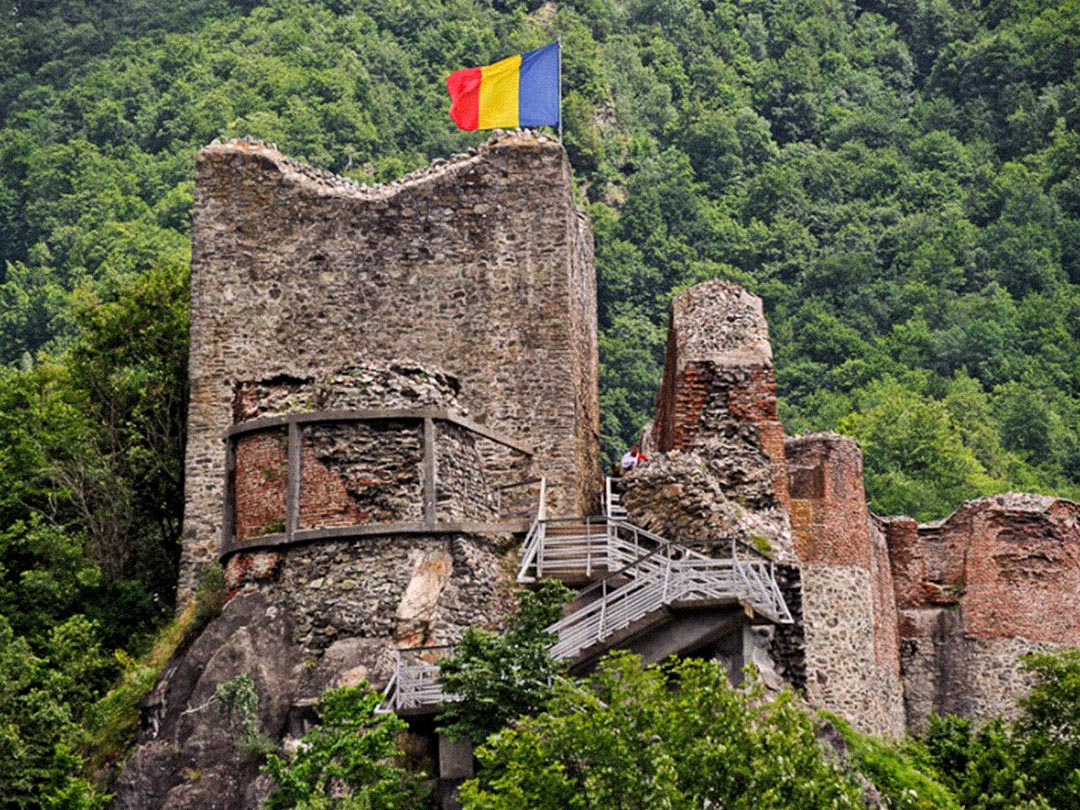
A ruined mountaintop fortress in Romania, once the stronghold of Vlad the Impaler, known for its brutal history and eerie isolation.
High above the Argeș River, balanced on a narrow ridge in the southern Carpathians, stand the ruins of Poenari Castle. If Bran Castle is the place most tourists know as “Dracula's Castle”, Poenari has the considerably better claim when it comes to the real Vlad III of Wallachia – Vlad Țepeș, better known as Vlad the Impaler. This was an actual fortress used and strengthened by him, a defensive refuge perched high enough above the valley to make reaching it difficult even before somebody decided to add more than 1,400 steps.
The fortress is older than Vlad himself. Archaeological evidence points to an earlier medieval stronghold on the ridge, including a square stone tower belonging to an older phase of construction. By the middle of the 15th century, however, Poenari was considerably expanded. Thick walls followed the shape of the narrow rock, with five defensive towers and walls measuring roughly two to three metres thick in places. The result was a small but formidable fortress capable of housing a garrison of only a few dozen men. It did not need to accommodate an army. Its position did much of the defensive work.
Vlad Țepeș recognised that advantage. During his second reign over Wallachia, from 1456 to 1462, he strengthened Poenari and used it as a secondary residence and military refuge. From the fortress, the Argeș valley could be watched from above while the steep slopes made a direct assault extremely difficult. Unlike Bran Castle, where Vlad's personal connection is tenuous at best, Poenari belongs firmly to his actual story.
And naturally, where Vlad the Impaler is involved, there is also a much bloodier version of events.
A Wallachian chronicle tells how Vlad took revenge on the boyars and townspeople he blamed for betrayal and for the death of members of his family. During an Easter celebration, he supposedly seized them without warning. The older prisoners were impaled, while the younger men and their families were marched to Poenari and forced to work on the fortress until their fine Easter clothes had been reduced to rags. Later versions of the story describe exhausted workers passing stone up the mountain and dying during the construction.
There is probably genuine history buried inside the story, but centuries of retelling have made the exact details difficult to separate from Vlad's already considerable legend. The surviving chronicle does specifically connect prisoners with construction work at Poenari, while archaeological evidence confirms that the fortress underwent major expansion during the 15th century. Whether everything happened exactly as later storytellers describe it is another matter. Vlad acquired a terrifying reputation during his own lifetime, and writers hostile to him were never particularly shy about improving a gruesome story.
Poenari played an important role during Vlad's war against the Ottoman Empire in 1462. After his famous night attack against Sultan Mehmed II failed to destroy the Ottoman army, Vlad continued fighting while his political position deteriorated. His younger brother Radu, backed by the Ottomans, gained increasing support among the Wallachian nobility. With his forces dwindling, Vlad eventually withdrew to Poenari, one of the strongest places still available to him.
The fortress could resist soldiers coming up the mountain, but it was not completely beyond the reach of artillery. Accounts of the campaign describe Ottoman forces managing to place guns on a neighbouring height from which they could bombard Poenari. Vlad eventually abandoned the fortress and headed towards Transylvania as his second reign collapsed. The image of the Impaler retreating from his mountain stronghold is considerably less romantic than the invincible Dracula of later fiction, but considerably more interesting historically.
That retreat produced another of Poenari's famous legends. According to local tradition, Vlad's wife realised that the fortress was about to fall and chose death rather than Ottoman captivity. She supposedly climbed onto the battlements and threw herself into the river far below, declaring that she would rather have her body consumed by the fish of the Argeș than become a prisoner of the Turks. The water below Poenari consequently became associated in folklore with her death. There is no firm historical evidence that the event happened, but the story has become inseparable from the mythology of the fortress.
Another legend tells how villagers from nearby Arefu helped Vlad escape through the mountains, guiding him along secret paths towards Transylvania. These stories are part of the reason Poenari occupies such an unusual position between documented history and Dracula folklore. Unlike many places retrospectively attached to Vlad simply because a connection sounds good, he genuinely was here. It is the details surrounding what happened here that become increasingly difficult to untangle.
Poenari continued to be used after Vlad's death in 1476 but gradually lost its military importance. By the 17th century it was largely a ruin. Nature then accomplished what invading armies had struggled to do. Earthquakes and landslides damaged the fortress over the following centuries, and in the early 20th century part of the structure collapsed from the ridge towards the Argeș far below. Later earthquakes caused further damage before restoration work stabilised what remained.
Reaching the fortress eventually became part of the Poenari experience in its own right. A modern staircase of around 1,480 steps climbs from the Transfăgărășan road through the forest to the ruins at roughly 850 metres above sea level. By the time the walls finally appear through the trees, the strategic wisdom of putting a fortress up there is fairly obvious. An attacking medieval soldier would have had to make essentially the same climb, except while carrying weapons and with people at the top actively trying to kill him.
Poenari underwent another major restoration between 2022 and 2025. The work was complicated enough that some construction materials had to be transported to the mountaintop by helicopter. Walls were consolidated, access was improved and new areas were created within the restored ruins. The fortress reopened in April 2025 after being inaccessible for roughly three years.
It then promptly encountered a problem Vlad Țepeș never had to solve with a European heritage grant: bears.
Only weeks after the reopening, access had to be suspended after a female brown bear and her two cubs repeatedly appeared around the route to the fortress. The animals were eventually captured and relocated, additional paths were blocked and the electric fencing protecting the site was strengthened before Poenari reopened again in May 2025. For all the stories about impalements, Ottoman armies and Dracula, the modern danger on the mountain turned out to have four legs and absolutely no interest in medieval history.
Poenari is frequently advertised as the “real Dracula Castle”, although even that description needs some care. Bram Stoker never placed Count Dracula here, and his fictional castle was located hundreds of kilometres farther north in Transylvania. Vlad Țepeș and Count Dracula have become so thoroughly merged in popular culture that separating them is now almost impossible. Poenari's importance does not really depend on the vampire anyway. This was Vlad's fortress, connected with his wars, his political collapse and the brutal stories that surrounded him centuries before Dracula acquired fangs.
Bran Castle may look more like the castle people expect Dracula to have lived in. Poenari asks a little more from the imagination: broken walls, ruined towers and a very long climb above the Argeș valley. But if the question is where Vlad the Impaler actually sought refuge while his enemies closed in, this lonely ridge is much closer to the real story.
Location: Located on a cliff above the Argeș River in Romania.
Address: Poenari Castle, Arefu, Argeș County, Romania
Category: castle, historical site, Vlad Tepes, Dracula
Tags: Poenari Castle, Vlad the Impaler, Dracula, Romania
Darkness Level: ☠ ☠ ☠ ☠ ☠ ☠ ☠ ☠ ☠
Homepage: cetateapoienari.ro
Map: Open in Google Maps
Gallery