Old Melbourne Gaol
A 19th-century prison in central Melbourne where more than 50,000 people were incarcerated and 133 executions were carried out, including the hanging of bushranger Ned Kelly in 1880.
Old Melbourne Gaol is a former prison on Russell Street in central Melbourne. Construction of a permanent gaol began in 1841, replacing a series of earlier and less secure lock-ups used during the first years of the Port Phillip settlement. The first purpose-built cell block opened in 1845 with 59 male and nine female prisoners. Melbourne’s rapid growth during the gold rush soon overwhelmed the prison, and a much larger second cell block was completed in 1859. A separate female block followed in 1864, and by 1870 the complex occupied approximately two city blocks with exercise yards, hospitals, workshops, a chapel, bath house and staff accommodation.
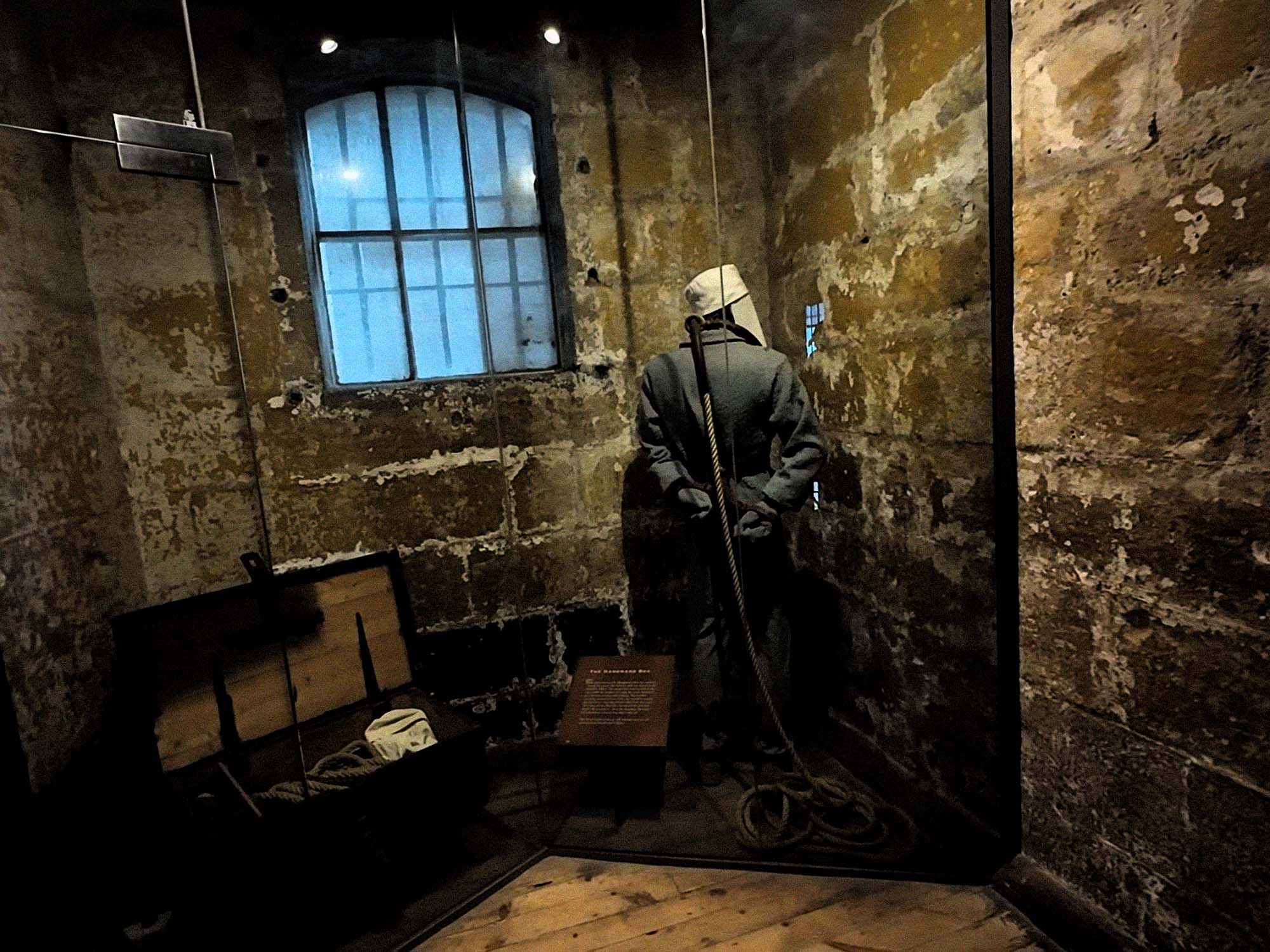
The prison was influenced by the 19th-century Model Prison system, which regarded isolation, silence and strict routine as methods of reform. New prisoners could spend up to 23 hours a day in solitary confinement in cells measuring approximately 2.7 by 1.5 metres. When removed from their cells, prisoners could be required to wear canvas silence masks intended to prevent recognition and communication. Rules prohibited talking, singing, laughing, gambling and tattooing, while punishments included reduced rations, chains, punishment cells and hard labour.
Hard labour included physically exhausting tasks intended partly as punishment rather than productive work. Prisoners could be placed on a treadmill for extended periods. Serious disciplinary offences committed by male prisoners over sixteen could result in flogging with the cat-o’-nine-tails, with the prisoner stripped to the waist and secured to a lashing triangle. The system of separation was eventually recognised as psychologically damaging, and prolonged isolation contributed to mental breakdown among some prisoners.
More than 50,000 prisoners passed through Melbourne Gaol during its operation. They were not limited to people convicted of serious violent crimes. Petty offenders, people imprisoned for vagrancy and homelessness, mentally ill people and children were confined within the same institution. Before the dedicated female wing was completed, women were held within the main prison alongside male inmates, although attempts were made to keep the sexes apart. Children could also be imprisoned in the adult gaol for offences such as theft or simply because there was nowhere else to accommodate them. One documented example is Michael Crimmin, who was sentenced to gaol for being “idle” in 1854 at only three years of age.
The Melbourne Gaol complex became one of Victoria’s principal sites of capital punishment. Between 1842 and 1924, 133 people were executed in connection with the gaol. The first were the Aboriginal men Tunnerminnerwait and Maulboyheenner, who were publicly hanged outside the earlier Melbourne Gaol on 20 January 1842. Their execution was badly conducted, and both men died slowly by strangulation. Later executions took place within the prison itself, and the surviving cell block still contains the gallows used during the later period.
The gaol’s most famous prisoner was Edward “Ned” Kelly. Following the gunfight at Glenrowan in June 1880, Kelly was captured, tried for the murder of police officer Thomas Lonigan and sentenced to death. He spent the final months of his life at Melbourne Gaol and was hanged on 11 November 1880, becoming the 101st person executed there. His cell and the gallows remain among the principal parts of the museum, together with a plaster death mask produced after his execution.
Death masks were commonly made from executed prisoners immediately after death. The head was shaved or prepared, covered with oil and coated in plaster to create a mould. During the 19th century such casts were used partly for phrenology, the now-discredited belief that criminal personality could be read from the shape of the skull. The museum’s collection includes masks connected with several notorious prisoners, among them Ned Kelly, serial murderer Frederick Deeming, poisoner Martha Needle and child murderer Frances Knorr.
Not every execution represented reliable justice. Colin Campbell Ross was hanged at Melbourne Gaol on 24 April 1922 for the murder of twelve-year-old Alma Tirtschke in the case known as the Gun Alley Murder. Ross maintained his innocence. Modern forensic examination later showed that hair used as important evidence against him did not belong to Tirtschke, and he received a posthumous pardon in 2008. His remains were subsequently identified and returned to his family.
Executed prisoners were normally buried within the prison grounds. Following the closure of the gaol, many of these graves were exhumed. In 1929, approximately thirty bodies were removed and reburied in mass graves at Pentridge Prison, with further remains transferred in 1937. Members of the public entered the disturbed burial area during the 1929 work and reportedly removed bones as souvenirs, including remains believed to belong to Ned Kelly. A skull later displayed at Old Melbourne Gaol as Kelly’s was stolen in 1978 and recovered decades later. DNA testing established that it was not Ned Kelly’s skull, and the location of Kelly’s actual skull remains unknown.
The final ordinary prisoner left Melbourne Gaol in 1924, and the complex was formally decommissioned in 1929. Much of the original prison was demolished as the surrounding justice precinct was redeveloped. The surviving 1850s cell block was later used during World War II as a military detention barracks for Australian servicemen and some prisoners of war. These included German naval captain Theodor Detmers, commander of the cruiser Kormoran, which sank HMAS Sydney in 1941.
The National Trust of Australia opened the surviving prison as a museum in 1972. Visitors can now enter the original cells, view the gallows and death masks and examine exhibitions covering executions, punishment and the experiences of women and children. The adjacent former City Watch House, constructed on part of the original gaol site in 1909 and used as Melbourne’s central police lock-up until 1994, also forms part of the wider visitor precinct.
Location: On Russell Street in Melbourne’s central business district.
Address: 377 Russell Street, Melbourne VIC 3000, Australia
Category: prison, museum
Tags: prison, executions, gallows, capital punishment, solitary confinement, corporal punishment, death masks, Ned Kelly, true crime, child prisoners, hard labour
Darkness Level: ☠ ☠ ☠ ☠ ☠ ☠ ☠ ☠ ☠
Homepage: oldmelbournegaol.com.au
Map: Open in Google Maps
Gallery