NS Documentation Centre of the City of Cologne
A museum and memorial inside Cologne's former Gestapo headquarters, where political opponents, foreign forced labourers and others persecuted by the Nazi regime were imprisoned, interrogated and tortured. Ten original basement cells survive with more than 1,800 inscriptions scratched and written by prisoners, while at least 400 people were executed in the courtyard area during the final months of the war.
NS Documentation Centre of the City of Cologne, commonly known as NS-DOK, occupies the EL-DE Haus in the centre of Cologne. Between December 1935 and March 1945, this apparently ordinary office building served as the regional headquarters of the Geheime Staatspolizei – the Gestapo. Its upper floors contained offices from which surveillance, arrests and political persecution were organised, while ten small cells in the basement formed an internal prison where detainees were held between interrogations. In the final months of the Second World War, the rear courtyard area became an execution site where at least 400 people were killed.
The building was never intended to become a secret-police headquarters. Cologne businessman Leopold Dahmen commissioned it in 1934 as a residential and commercial property, and its familiar name derives simply from the pronunciation of his initials, L and D – EL-DE. While construction was still under way, the Gestapo rented the unfinished building and ordered alterations to suit its needs. The basement prison was among the most important additions. The Gestapo moved in during December 1935 and remained until American forces approached Cologne almost ten years later.
The Cologne Gestapo was responsible not only for the city but for a much wider region. Its authority extended across the Cologne administrative district and, during the war, into the Aachen district and the occupied Belgian territories of Eupen and Malmedy. From the EL-DE Haus, officers monitored political opponents, religious groups, forced labourers, foreign workers, resistance networks and anyone considered socially or racially undesirable under National Socialist ideology.
The persecution of Cologne's Jewish population was also organised from offices inside the building. Gestapo officials participated in the gradual removal of civil rights, confiscation of property, arrests and ultimately the deportation of Jewish residents to ghettos and concentration and extermination camps in occupied eastern Europe. The building therefore functioned not merely as a local police station but as one component of the administrative machinery through which Nazi racial policy was transformed into imprisonment, deportation and murder.
The basement prison contained only ten cells, measuring between approximately 4.3 and 9.3 square metres. They appear originally to have been intended for one or two prisoners each. During the final years of the war, however, overcrowding became extreme as the Gestapo increasingly targeted the enormous population of foreign forced labourers brought to Cologne. Official Gestapo documents themselves referred to cells holding eight or ten times their intended capacity, while one surviving prisoner inscription records 33 people inside a single cell.
People could remain in these rooms for weeks or sometimes months. Interrogations took place both in the offices above and in the prison areas below, and torture was used to force confessions, obtain names and break resistance. The number of people who passed through the EL-DE Haus during its ten years as Gestapo headquarters is unknown. What survives most directly from them is not an administrative record but what they left on the walls.
Approximately 1,800 inscriptions and drawings from prisoners remain in the basement cells. Most date from 1943 to 1945 because the walls were repainted following bomb damage in 1943, covering earlier writing. Prisoners subsequently filled the new surfaces with names, dates, prayers, political statements, messages to relatives, drawings and simple records of how long they had been confined. Some were written in pencil, chalk, charcoal or lipstick; others were scratched into the walls with nails, screws and even fingernails.
The languages reveal who increasingly filled the prison during the final phase of the war. More than a third of the surviving inscriptions are written in Cyrillic script, while hundreds of others are in French, Polish, Dutch and other languages. They reflect the huge foreign forced-labour population in wartime Cologne. At the peak in 1944, around 30,000 civilian forced labourers and an estimated 15,000 to 20,000 prisoners of war were working in the city at the same time; over the course of the war, more than 100,000 foreign workers probably passed through Cologne.
The inscriptions are often more powerful than any reconstruction could be. Prisoners wrote imaginary letters to families who had no idea where they were, counted the days of imprisonment or recorded fear that they would never return home. Others left defiant political messages or simply carved their names as evidence that they had existed inside a system designed to reduce them to case files and prisoner categories.
During the final phase of the war, the EL-DE Haus changed from a place of detention and torture into a major killing site. Beginning in the autumn of 1944, the Gestapo started executing prisoners in the rear courtyard area, particularly foreign forced labourers accused of resistance, escape, theft, sabotage or other offences against the increasingly desperate Nazi regime. Most were hanged, although some were shot.
The executions reached extraordinary proportions as the regime collapsed. On 1 March 1945, only days before American troops entered the left bank of Cologne, approximately one hundred prisoners were reportedly transferred from the nearby Klingelpütz prison and hanged at the EL-DE Haus. The exact total number killed on the premises cannot be reconstructed, but current research places it at at least 400 people during 1944 and early 1945.
The bodies were removed with chilling bureaucratic practicality. Municipal refuse vehicles transported corpses from the Gestapo headquarters to a mass burial area at Cologne's Westfriedhof, where the secret police maintained what became known as the Gestapofeld. By the final days of the war even this process was breaking down. Some bodies remained behind and were discovered later in 1945 together with the gallows used for the executions.
All of this happened in the middle of Cologne rather than behind the fences of a distant concentration camp. Prisoners were brought through a city already devastated by bombing, executions were carried out within an ordinary urban block and bodies were transported through municipal systems. The EL-DE Haus demonstrates how closely Nazi terror could exist beside everyday civic life.
The building itself survived almost by chance. Allied bombing destroyed enormous areas of central Cologne, yet the EL-DE Haus suffered comparatively little damage. The Gestapo continued operating there until shortly before American troops entered the city in March 1945. When the war ended, the cells, inscriptions and former Gestapo offices were therefore still physically present inside a city where much of the surrounding architecture had been reduced to ruins.
Its immediate post-war history was remarkably mundane. The City of Cologne moved various municipal departments into the building, including the pension office, legal departments and, temporarily, the civil registry. Between 1947 and 1949 the structure was renovated and enlarged, even receiving an additional floor. The former Gestapo cells below were not immediately preserved as a memorial. For years they were used largely as storage rooms for documents and rubbish while their wall inscriptions deteriorated.
The fact that the prison survived did not automatically mean that Cologne was ready to confront it. Public pressure and civic activism during the following decades were crucial in preventing the basement from disappearing beneath routine municipal use. In 1979, Cologne City Council finally decided to establish a documentation centre devoted to the city's history under National Socialism and to preserve the former Gestapo prison as a memorial.
The Gestapo Prison Memorial opened on 4 December 1981. The NS Documentation Centre moved into the EL-DE Haus in 1988, and the permanent exhibition Cologne under National Socialism opened in 1997. The museum has since expanded through more of the building, while the preserved prison remains the historical core of the site. The courtyard execution area has also been incorporated into the memorial route.
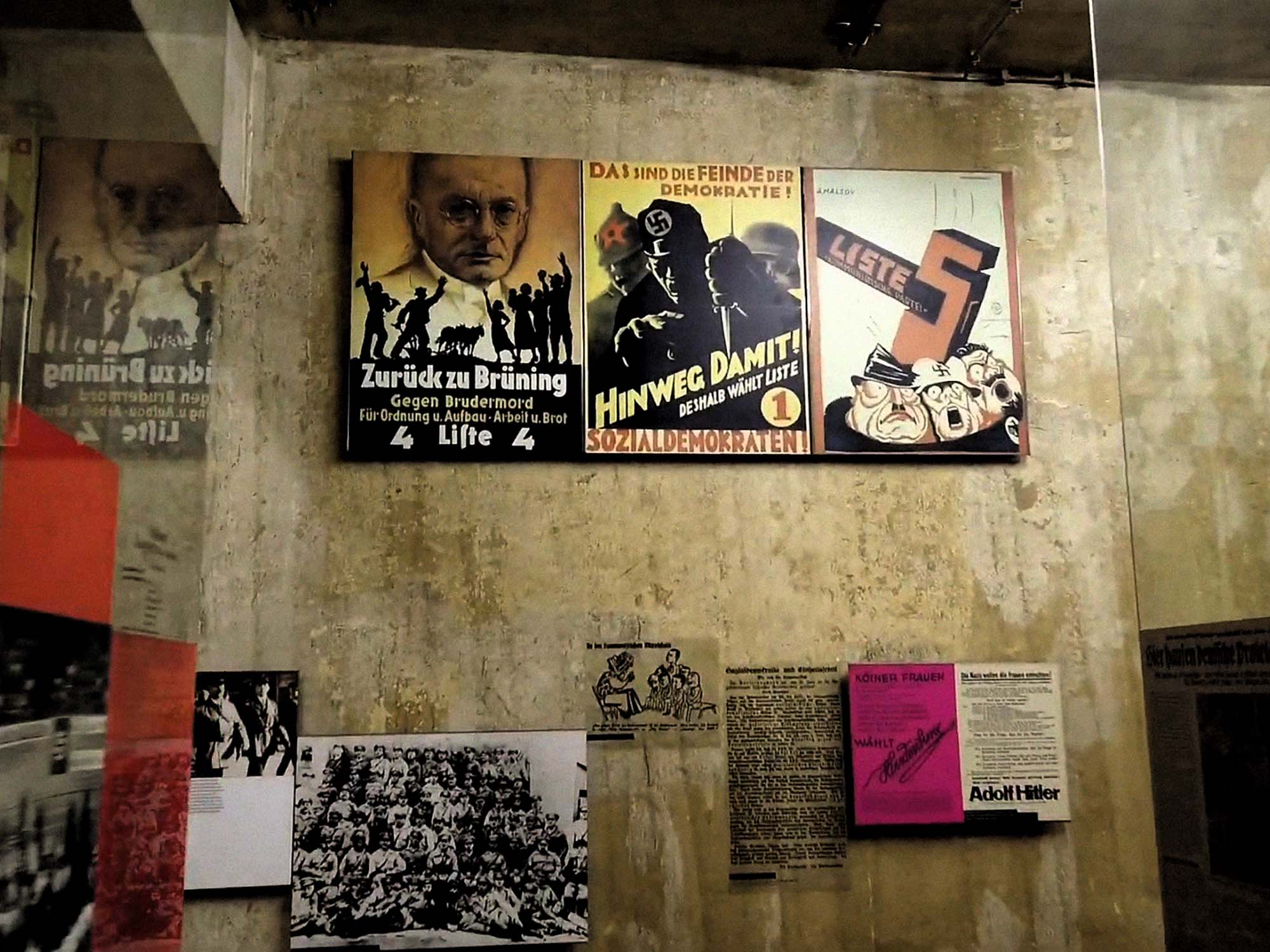
The museum examines far more than the Gestapo alone. Its permanent exhibition follows the transformation of Cologne after 1933: the destruction of democratic institutions, everyday life under dictatorship, propaganda, youth organisations, racial persecution, forced labour, opposition and resistance, the Holocaust and the physical destruction of the city during the war. Individual victims are repeatedly placed back into the history rather than presented only through abstract statistics.
Yet the basement gives the NS-DOK a character few historical museums can reproduce. These are not reconstructed cells transported from elsewhere. The doors, walls and confined rooms belong to the building where the Gestapo actually held its prisoners, and much of the writing was made by people who had no reason to believe anyone outside would ever read it. The marks left behind range from carefully written messages to scratches made with whatever object a prisoner could find.
Location: Inside the former EL-DE Haus on Appellhofplatz in central Cologne, the headquarters of the Cologne Gestapo from 1935 to 1945.
Address: Appellhofplatz 23–25, 50667 Cologne, Germany
Category: Gestapo, prison, museum
Tags: EL-DE Haus, Gestapo, Nazi Germany, National Socialism, political prisoners, torture, executions, hanging, mass execution, forced labour, forced labourers, prison cells, prisoner graffiti, wall inscriptions, Cologne Gestapo, Holocaust, Jewish deportations, racial persecution, political persecution, mass grave, Westfriedhof, Second World War, resistance, secret police
Darkness Level: ☠ ☠ ☠ ☠ ☠ ☠ ☠ ☠ ☠ ☠
Homepage: nsdok.de
Map: Open in Google Maps
Gallery