Mummy Crypt in Wiuwert
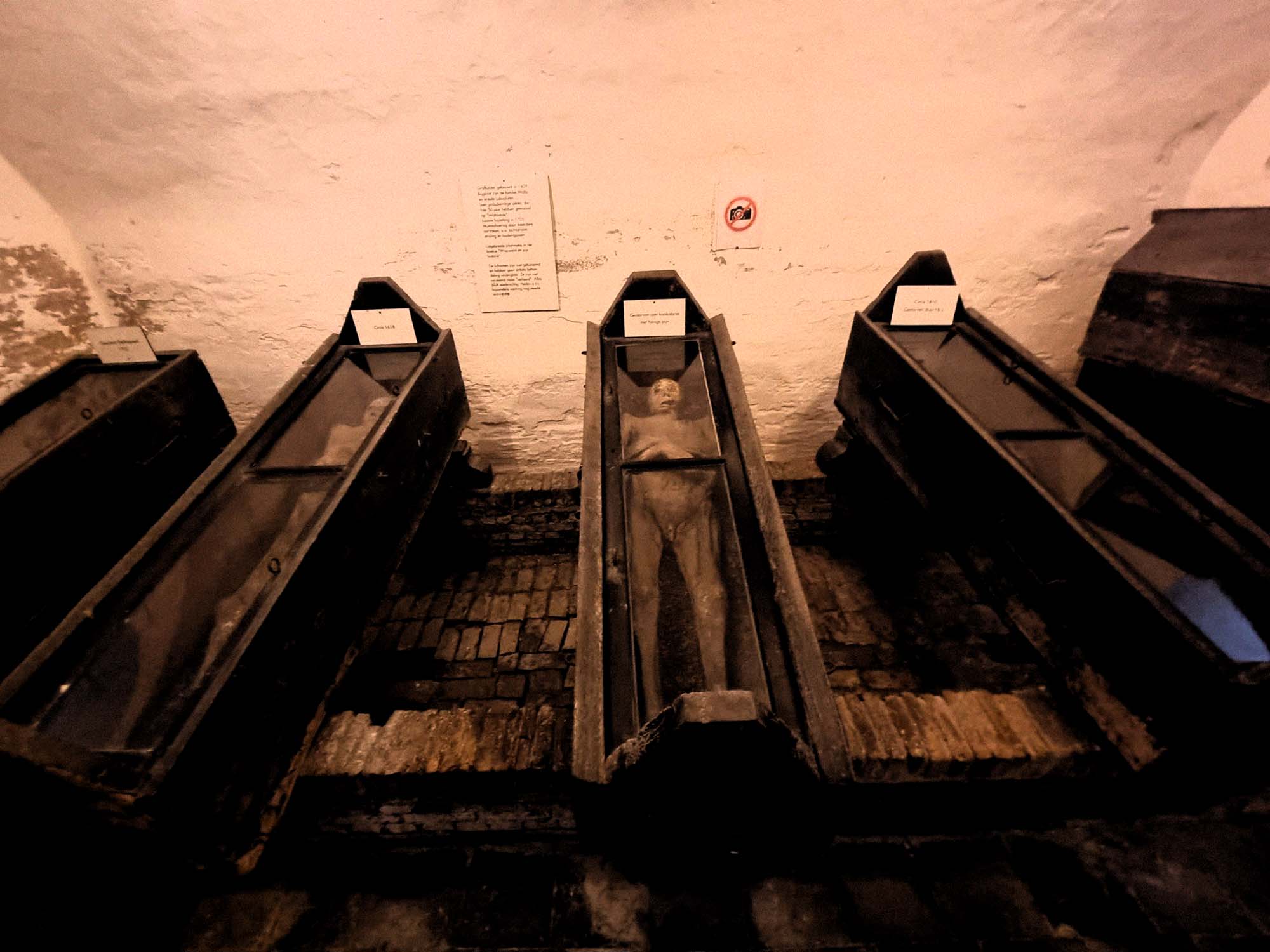
A burial crypt beneath the medieval St Nicholas Church in Wiuwert, containing four naturally mummified human bodies discovered in 1765 and preserved without embalming or artificial treatment.
Mummy Crypt in Wiuwert, known in Dutch as Mummiekelder Wiuwert, is situated beneath the choir of St Nicholas Church in the Frisian village of Wiuwert. The church is largely medieval in origin, with its oldest surviving sections dating from the 13th century. The burial vault was constructed in 1609 for the wealthy Walta family, who owned the nearby Walta State estate and held considerable influence in the surrounding area.
In 1765, carpenters carrying out work inside the church opened the previously concealed crypt and discovered a collection of coffins containing remarkably well-preserved bodies. Historical accounts differ over the precise number: some refer to seven preserved bodies, while others describe eleven coffins containing mummified remains. The bodies had not been embalmed or deliberately prepared. Instead, they had undergone natural mummification, with the soft tissue drying before normal decomposition could take place.
The preservation has generally been attributed to the particular conditions inside the crypt, including its dry air, continuous ventilation and stable microclimate. Tests involving dead animals placed inside the chamber also resulted in mummification, demonstrating that the effect was produced by the environment rather than by treatment of the bodies. The exact combination of factors responsible has never been established conclusively, and attempts to reproduce the same result in other cellars have not always succeeded.
Only four human mummies remain in the crypt today, displayed in coffins beneath protective glass. They are traditionally described as a fourteen-year-old girl who died from tuberculosis around 1610, an elderly woman who died around 1618, a man whose death has been linked to a severe jaw abscess and a goldsmith named Stellingwerf, who was reportedly the final person buried in the vault in 1705. These identifications are based partly on later examinations and local tradition, and the complete identities of those buried in the crypt have not been established with certainty.
The disappearance of the other bodies is only partly documented. Several were removed for examination at the former University of Franeker, where exposure to different environmental conditions caused some of the remains to deteriorate. Bones and skulls were reportedly returned to Wiuwert in two sealed chests, one of which later disappeared. Additional stories claim that French soldiers, visiting researchers or souvenir hunters removed bodies or parts of them, although several of these accounts remain unverified.
The crypt is also connected with the Labadists, a strict Protestant religious community founded by the French theologian Jean de Labadie. Members of the movement settled at Walta State in 1675 and lived communally near the church. Because ownership of the burial vault passed with the estate, it is possible that some Labadists were buried there. The scholar, artist and theologian Anna Maria van Schurman, one of the community’s most prominent members, died at Wiuwert in 1678. She has sometimes been linked to the mummies, but historical evidence indicates that she requested a simple burial in the churchyard, and none of the four surviving bodies has been conclusively identified as her.
The church contains an exhibition about the Walta family, the Labadist community and the discovery of the bodies. Visitors enter the crypt by a staircase inside the church and can view the four mummies in the place where they were preserved. The church and burial vault are protected as part of a Dutch national monument.
Location: Beneath the choir of St Nicholas Church in the centre of Wiuwert.
Address: Terp 1, 8637 VH Wiuwert, Netherlands
Category: crypt, church
Tags: mummies, human remains, natural mummification, burial crypt, Labadists, Walta family, religious history
Darkness Level: ☠ ☠ ☠ ☠ ☠ ☠ ☠ ☠ ☠
Homepage: mummiekelder.nl
Map: Open in Google Maps
Gallery