Memorial to the Murdered Jews of Europe
A vast and unsettling monument in Berlin dedicated to the six million Jewish victims of the Holocaust.
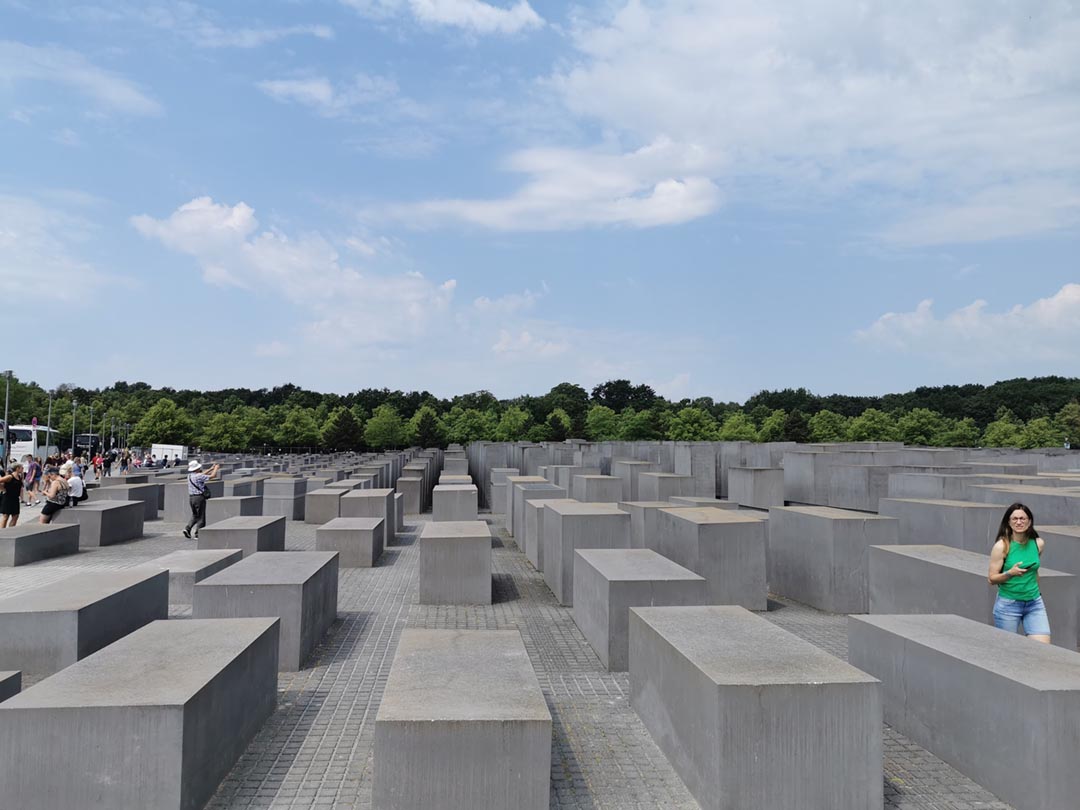
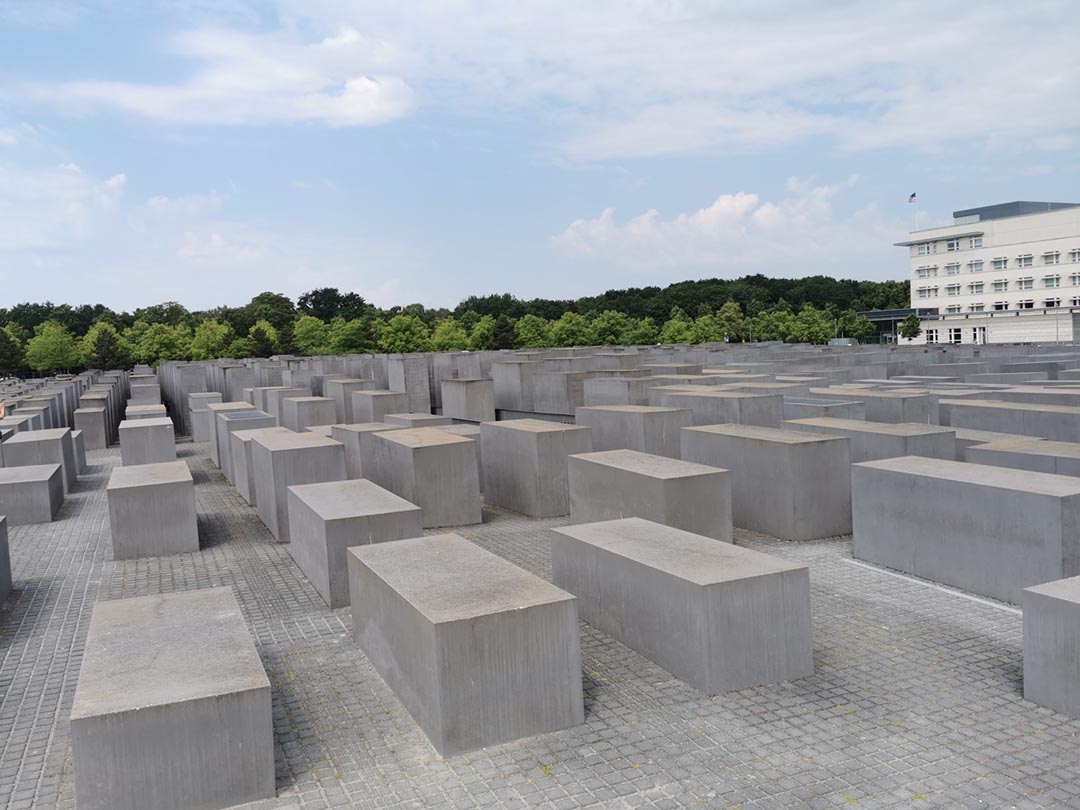
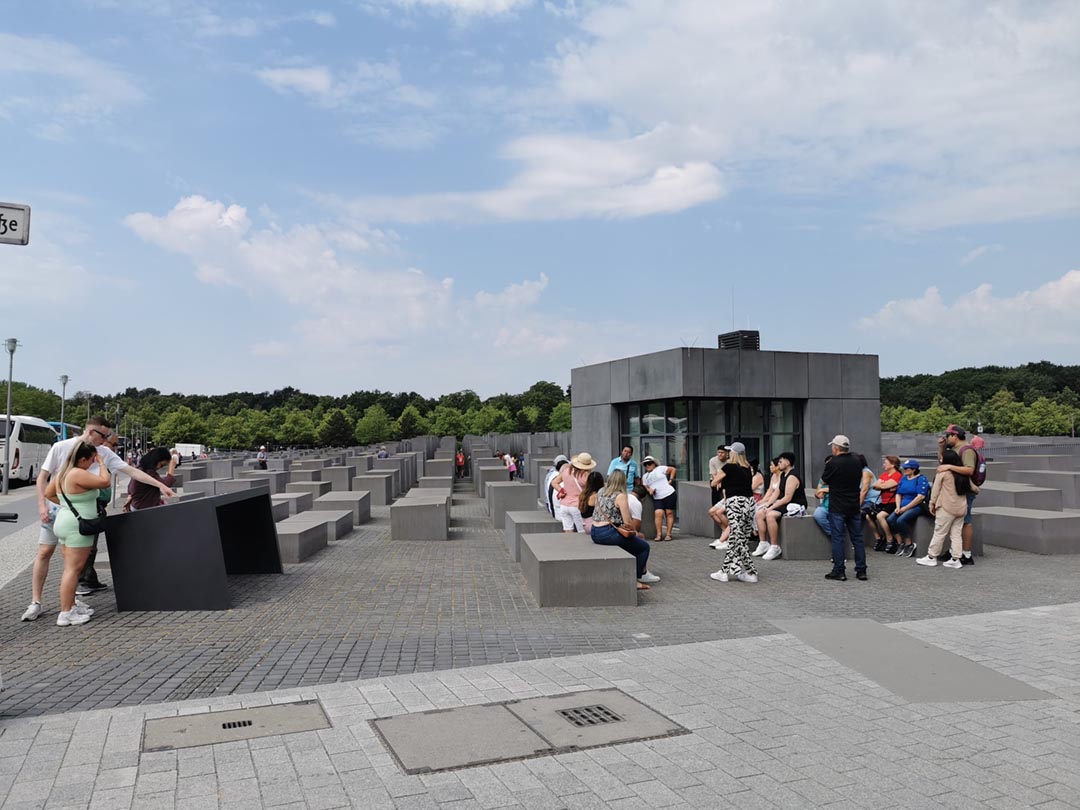
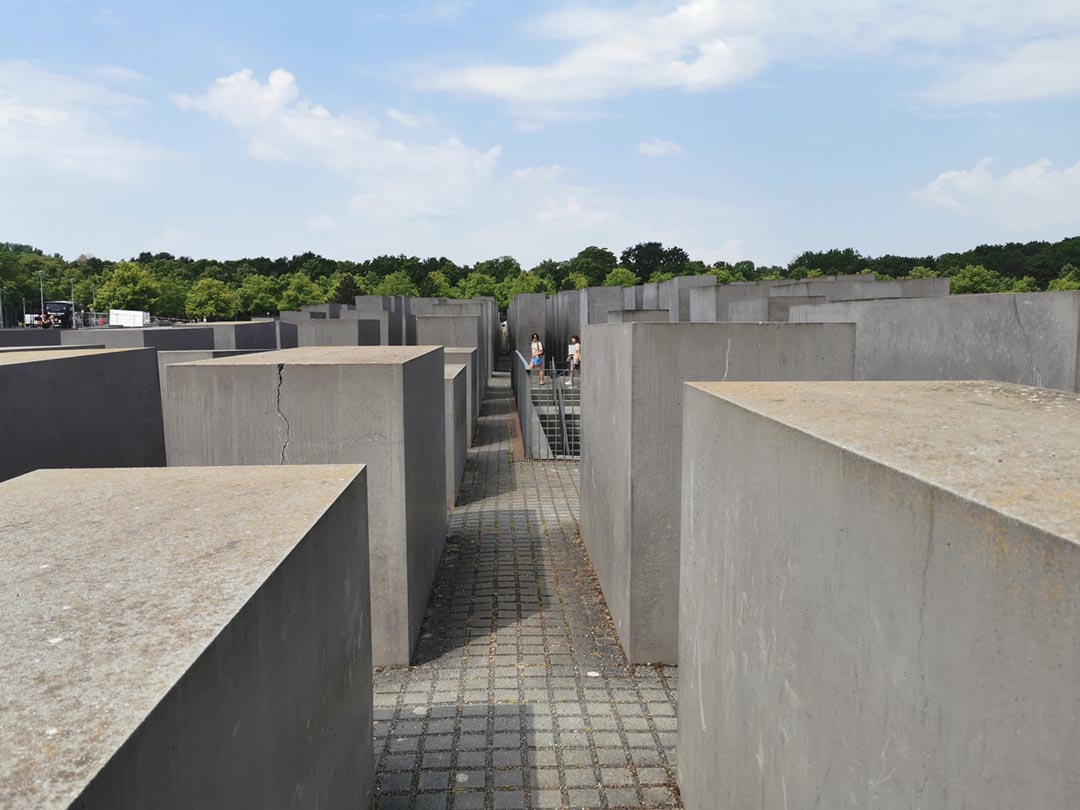
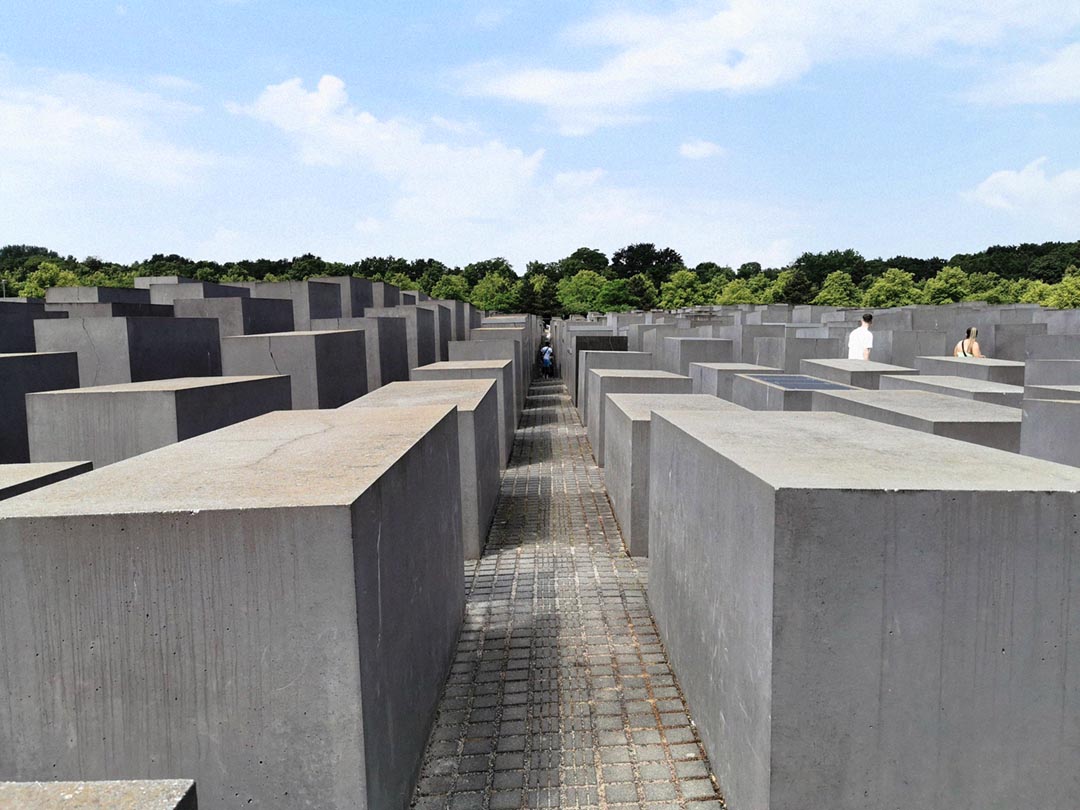
Just south of the Brandenburg Gate, in the political and historical centre of Berlin, more than 2,700 grey concrete blocks spread across an entire city block. There are no names carved into them, no statues and no single entrance telling you where to begin. From the outside, the Memorial to the Murdered Jews of Europe can initially appear surprisingly simple. Then you walk into it.
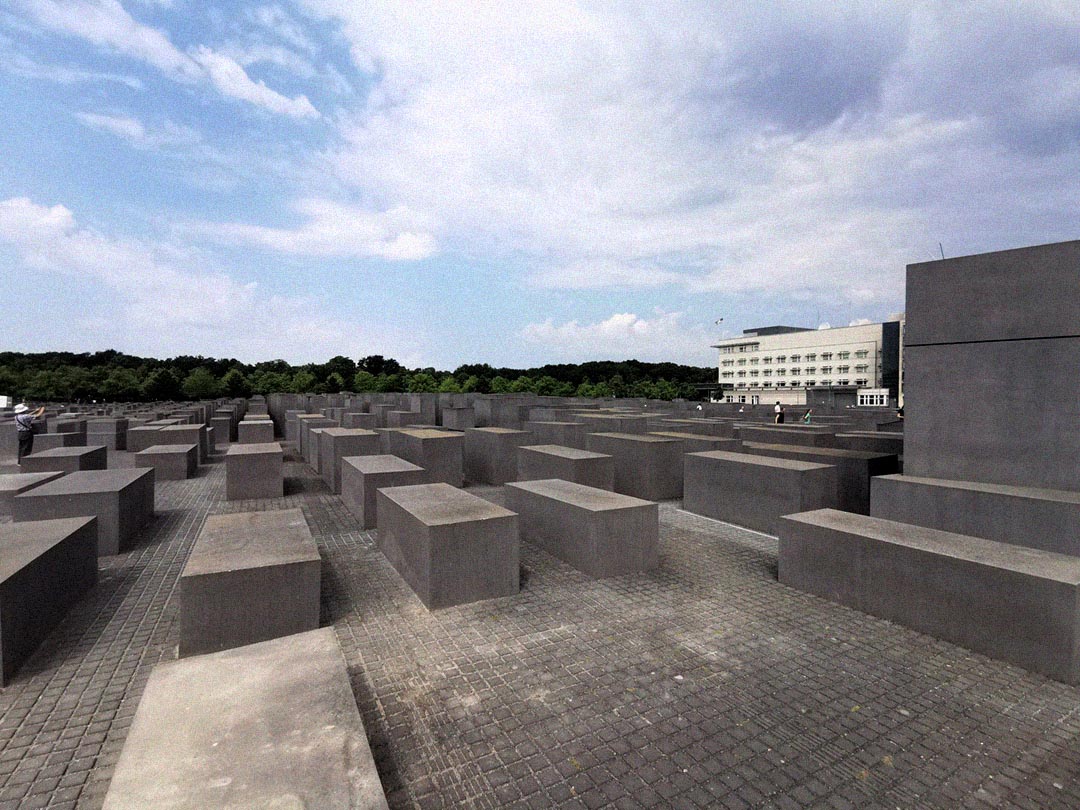
The memorial covers just over 19,000 square metres and was designed by American architect Peter Eisenman. The concrete blocks, or stelae, are arranged in a strict grid, but almost nothing else remains level. The ground rises and falls beneath your feet while the stelae gradually increase in height. Near the edges they can be little more than low slabs. Deeper inside, some tower more than four metres above the pathways.
The change happens remarkably quickly. The surrounding city disappears behind walls of concrete, people who were walking beside you vanish into neighbouring passages and the Brandenburg Gate suddenly feels much farther away than it actually is. There is no prescribed route through the field and no destination waiting in the middle. You simply move between the blocks until you eventually emerge somewhere else.
It is tempting to say that the stelae represent graves, coffins or the millions of people murdered during the Holocaust, but Eisenman deliberately avoided giving the monument such a straightforward interpretation. He was interested in what happens when an apparently rational and orderly system begins to lose its stability. The grid remains perfectly organised while the ground and heights change around it, creating spaces that become increasingly narrow, deep and difficult to read. Visitors are left to experience that for themselves rather than being told exactly what they are supposed to feel.
The idea of creating a central German memorial to the murdered Jews of Europe emerged in the late 1980s, driven particularly by journalist Lea Rosh and historian Eberhard Jäckel. What followed was more than a decade of public argument over how Germany should commemorate the Holocaust, who the memorial should represent and what such a monument could possibly look like. On 25 June 1999, the German Bundestag finally voted to construct Eisenman's Field of Stelae and to include an underground information centre devoted to the victims and the places where the crimes were committed.
Construction began in 2003, but even that produced an uncomfortable reminder of how deeply Nazi history remained embedded in German industry. Work was temporarily halted after it became public that an anti-graffiti coating intended for the concrete was supplied by Degussa. During the Nazi period, Degussa had held a substantial interest in Degesch, the company involved in supplying Zyklon B, the poison used to murder people in gas chambers including those at Auschwitz-Birkenau. After considerable debate, the foundation decided to continue using the product. The controversy became another example of how difficult it was to construct a Holocaust memorial in Germany without encountering the history it was intended to address.
The memorial was formally inaugurated on 10 May 2005 and opened to the public two days later. Its location was deliberately prominent. This was not a monument placed quietly on the outskirts of Berlin but in the centre of the reunited German capital, close to the Reichstag and Brandenburg Gate and only a short distance from the former centres of Nazi power. Germany had placed the memory of the people murdered by its own regime directly within its modern government district.
The concrete field is only half of the memorial. Beneath it lies the Ort der Information, or Information Centre, where the scale of the Holocaust is gradually brought back down to individual people. The exhibition begins with the Nazi persecution and murder of European Jews between 1933 and 1945, but instead of allowing the victims to remain an almost unimaginable number, much of the exhibition concentrates on names, faces, families, letters and final messages.
In the Room of Dimensions, diary entries, letters and farewell notes written by people facing persecution and death are displayed beneath the field above. These are often painfully ordinary documents. People write about their families, their fears and what they hope might happen next, sometimes without knowing that very little time remains. Statistics can explain the scale of the Holocaust. A final letter to somebody's husband, child or mother does something very different.
The following Room of Families traces the lives of fifteen Jewish families from different parts of Europe. Photographs show birthdays, weddings, holidays and everyday family life before persecution began. The same histories then fragment into deportation, separation and murder. The presentation is deliberately important because the people remembered here were not born as Holocaust victims. They had jobs, relationships, arguments, ambitions and family photographs long before Nazi Germany reduced their lives to entries on deportation lists.
Perhaps the most powerful space is the Room of Names. The room itself is almost empty. A name, year of birth and year of death are projected onto the walls while a voice reads a short biography of a murdered or missing Jewish person. Then another begins. And another. According to the memorial foundation, reading the available life stories of all the victims in this manner would take approximately six years, seven months and 27 days.
That figure makes the problem faced by any Holocaust memorial painfully clear. Six million is a number so large that it can become abstract almost immediately. Six years of continuously listening to individual names and lives is harder to reduce to a statistic. Even then, the record can never be complete. Documents were destroyed, entire families disappeared and for many of the murdered there is no surviving photograph, testimony or even a fully reconstructed name.
The final major section broadens the story across Europe. The Room of Sites documents 220 places connected with persecution and mass murder: ghettos, concentration and extermination camps, mass-shooting sites, deportation routes, death marches and locations involved in the Nazi “euthanasia” killings. It is an important reminder that the Holocaust did not happen in one camp or even in one country. The machinery of persecution stretched across an entire continent.
Location: The Memorial to the Murdered Jews of Europe is located in central Berlin, near Brandenburg Gate.
Address: Cora-Berliner-Straße 1, 10117 Berlin, Germany
Category: memorial, historical site, monument
Tags: jews, holocaust, memorial
Darkness Level: ☠ ☠ ☠ ☠ ☠ ☠ ☠ ☠ ☠
Homepage: stiftung-denkmal.de
Map: Open in Google Maps
Gallery