Master Thief Ole Høiland's Cave
After robbing The Bank of Norway in 1836, Norway's master thief Ole Høiland escaped to live in a cave in Lillomarka with the stolen money.
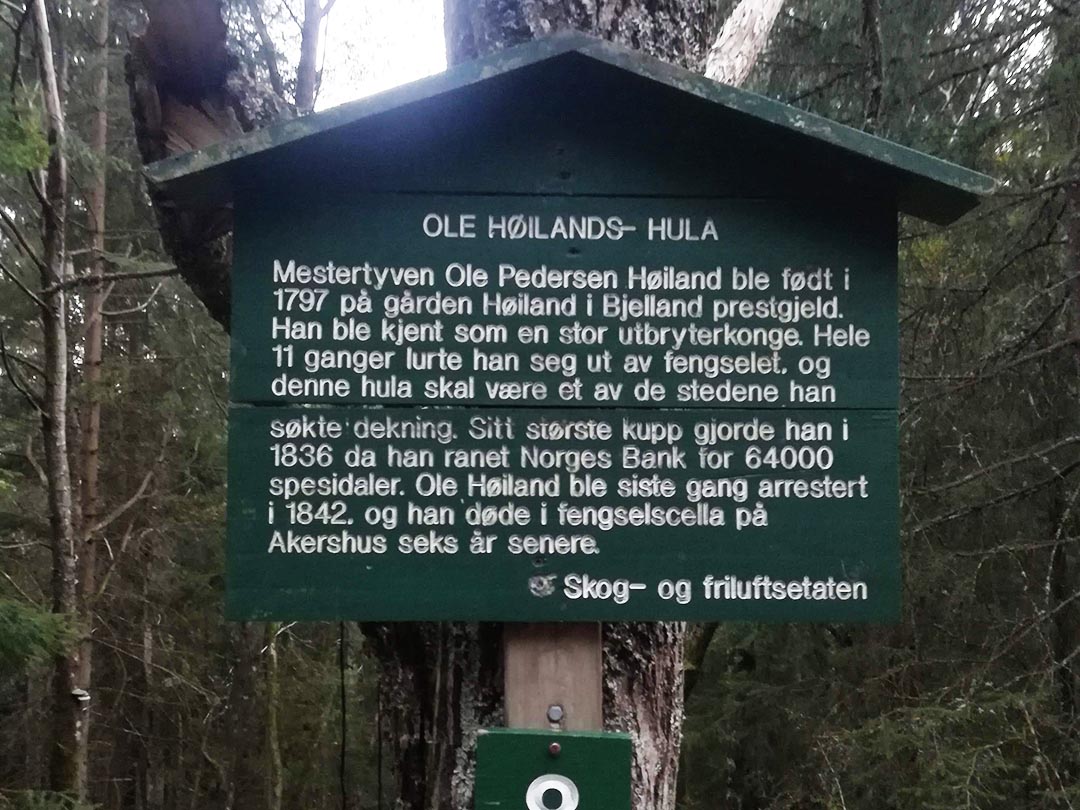
Hidden among the rocks and trees of Lillomarka in Oslo is a small cave associated with one of the most colourful criminals in Norwegian history. Ole Pedersen Høiland was a thief, prison escape artist and eventually something of a folk hero, famous above all for breaking into Norges Bank and stealing an enormous fortune. After one of his many escapes from Akershus Fortress, tradition holds that he used this secluded rock shelter in Lillomarka as one of his hiding places. Nearly two centuries later, Ole Høiland's Cave can still be found in the forest.
Høiland was born in 1797 in what is now Lyngdal municipality in southern Norway and spent much of his adult life moving between crime, imprisonment and escape. He became notorious for a long series of burglaries and thefts and managed to escape from custody eleven times. His ability to repeatedly outwit guards and authorities gradually turned him into a legendary figure. In popular stories he was sometimes portrayed almost as a Norwegian Robin Hood, a clever outlaw challenging the establishment, although the romantic image that developed around him was considerably kinder than the historical record.
His greatest crime came on the night between 31 December 1834 and 1 January 1835. After months of preparation, Høiland broke into the Christiania branch of Norges Bank at Bankplassen. He had studied the bank's security and managed to produce copies and lock-picking tools that allowed him to pass through a succession of locked doors. It did not work immediately. According to accounts of the burglary, he had to withdraw and make adjustments before finally reaching the vault. When he succeeded, he walked away with 64,100 speciedaler in banknotes – an extraordinary fortune at the time and one of the most famous thefts in Norwegian history.
The authorities reacted accordingly. A reward was offered for his capture, and Høiland was arrested in Lier only a few weeks later. Much of the stolen money was eventually recovered, but not all of it. Norges Bank recorded that around 14,000 speciedaler were still missing as late as 1842. Exactly what happened to the remainder has never been established, which inevitably helped create stories of money buried somewhere in the forests around Christiania.
After his conviction, Høiland was returned to Akershus Fortress and subjected to unusually strict security. He was confined alone inside a wooden enclosure in Kronprinsens kruttårn, the Crown Prince's Gunpowder Tower. Even that was not enough. During 1839 he secretly worked beneath the wooden floor, digging through the damp earth and eventually creating a tunnel beneath the foundations. Contemporary accounts describe how he removed his clothes while digging so that guards would not notice dirt on them afterwards. On the night of 16–17 September 1839, he finally made his move.
After crawling through the tunnel, Høiland reached the fortress walls and attempted to lower himself down using a hidden rope. The rope broke, sending him crashing to the ground below while still burdened with iron restraints. Remarkably, he survived the fall and disappeared into the countryside. An official wanted notice dated 20 September offered 300 speciedaler for his capture. By then, Høiland was already famous enough for his latest escape to inspire songs and newspaper stories. Even the poet Henrik Wergeland wrote about it.
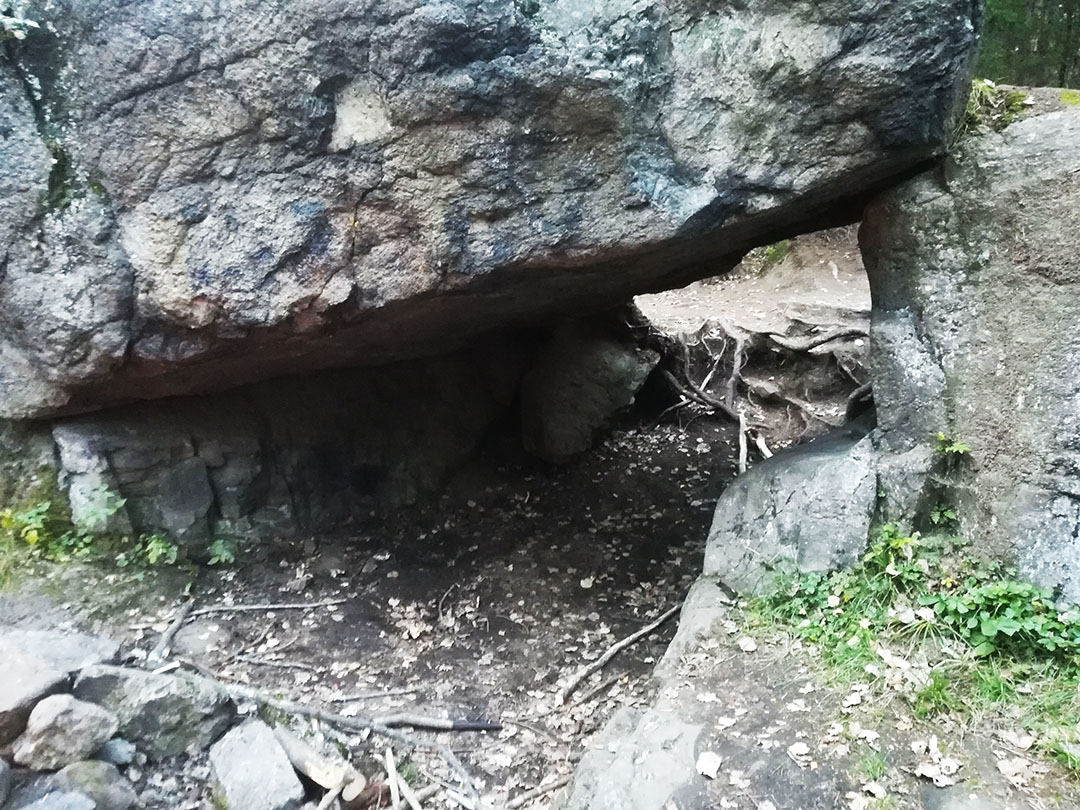
For the next three years Høiland remained at large, moving between hiding places and relying on people willing to shelter him. He spent periods in the forests surrounding Christiania, including Nordmarka and Lillomarka, where life on the run meant cold, hunger and constant fear of discovery. One of the places traditionally associated with him is the small rock shelter on Storhaug near Linderudkollen that is now known as Ole Høilands hule. Whether every story attached to the cave can be documented is another matter, but local histories have long identified it as one of his hiding places.
The cave itself is surprisingly modest. It is more a natural opening beneath and between large rocks than the comfortable underground chamber the word “cave” might suggest. There are openings at both ends, and it is difficult to imagine it offering much protection against a cold Norwegian night. What it does offer is concealment. Even today, with marked trails and signs in the surrounding forest, it is easy to understand why someone trying not to be found might have chosen the place. In the 1830s, surrounded by considerably more wilderness than today, it must have felt very remote indeed.
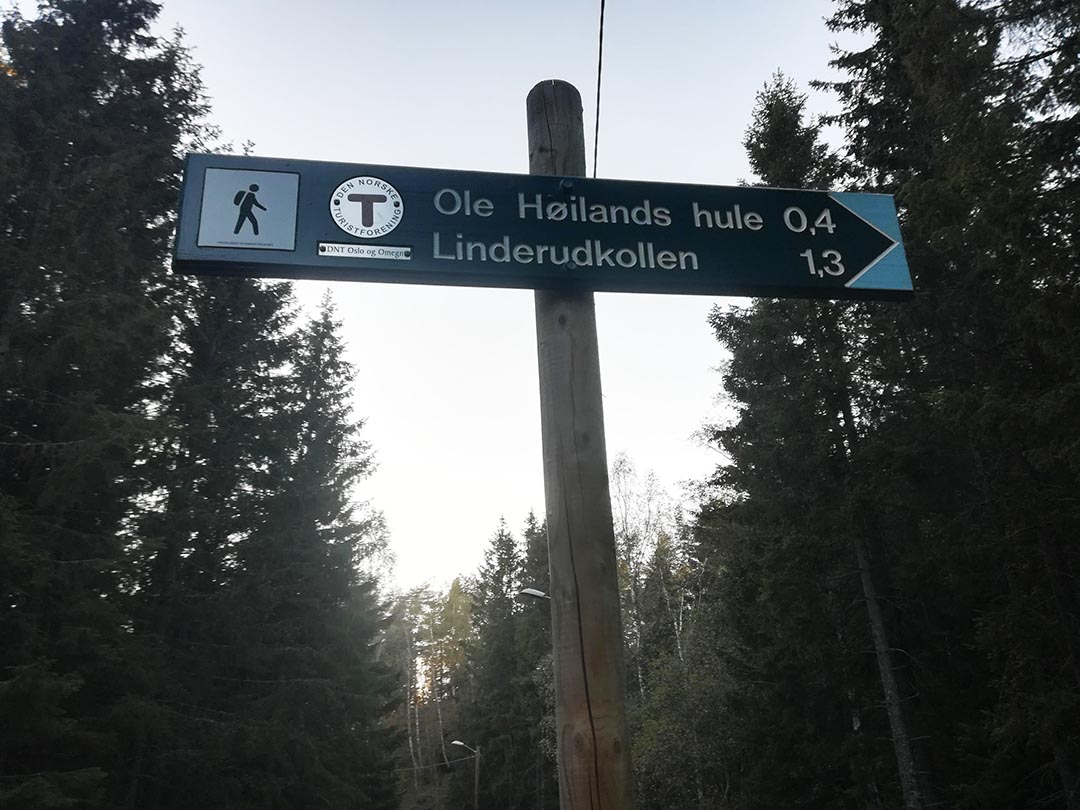
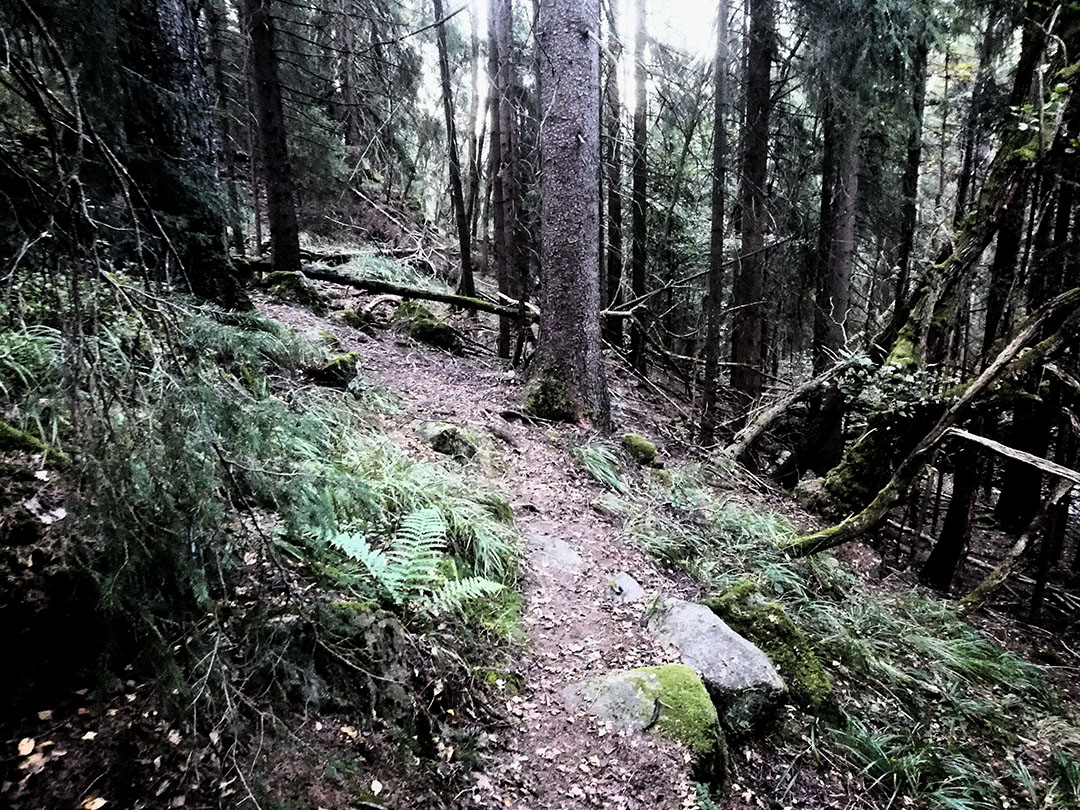
One of the easiest approaches begins at Isdammen at Årvoll. The small artificial lake has an interesting history of its own: it was created in the 1920s for harvesting natural ice and remained in use until the winter of 1967–68, making it the last place in Oslo where ice was commercially cut from a pond. From here the route continues into Lillomarka and meets part of the old road towards Hadeland. Along the way stands an old kastestein, or throwing stone, where travellers traditionally added a stone to the pile for good luck. Eventually a sign points away from the main trail towards Ole Høiland's Cave. From there the route becomes narrower and considerably more overgrown, climbing through the forest before reaching the rock shelter.
Standing there, one question is difficult to avoid: how did Høiland ever find the place? There were no hiking signs pointing towards “Ole Høiland's Cave” in 1839. It is tucked away in uneven woodland, far enough from the main routes to disappear almost completely among the rocks and trees. It would not have been a pleasant home, but for a man whose face was known across the country and who had a substantial reward hanging over him, comfort probably came a distant second to not being seen.
Høiland's final period of freedom ended in 1842 at Konnerud near Drammen. The family sheltering him betrayed his whereabouts, apparently tempted by the reward offered for his capture. The arrest caused considerable excitement in Drammen, where Høiland had by then acquired the reputation of a folk hero. Accounts even describe hostility towards the family who had given him up. He was returned to Akershus Fortress, once again placed under exceptionally close guard, and this time there would be no spectacular escape.
Høiland repeatedly petitioned for a pardon during his final years in prison but was refused. On 20 December 1848, aged 51, he died by suicide in his cell at Akershus Fortress. His death did little to end the stories. Books, ballads and eventually the 1970 film Balladen om mestertyven Ole Høiland kept his name alive, while caves and hiding places bearing his name can still be found in several parts of Norway.
The little shelter in Lillomarka is perhaps one of the most tangible pieces of that legend. There is no treasure chest waiting inside, and almost two centuries of storytelling make it difficult to separate every detail of Høiland's life from folklore. We do know, however, that some of the money stolen from Norges Bank was never recovered and that Høiland spent years hiding in the forests around Christiania. That is probably enough to make anyone walking through Lillomarka look at the rocks a little more carefully than usual.
Location: The cave is hidden in the forest of Lillomarka. Look for signs to follow for the right direction.
Address: Lillomarka, 0496 Oslo
Category: cave, forest, history
Tags: thief, history, Ole Høiland, cave
Darkness Level: ☠ ☠ ☠ ☠ ☠ ☠ ☠ ☠
Map: Open in Google Maps
Gallery