Kenilworth Castle
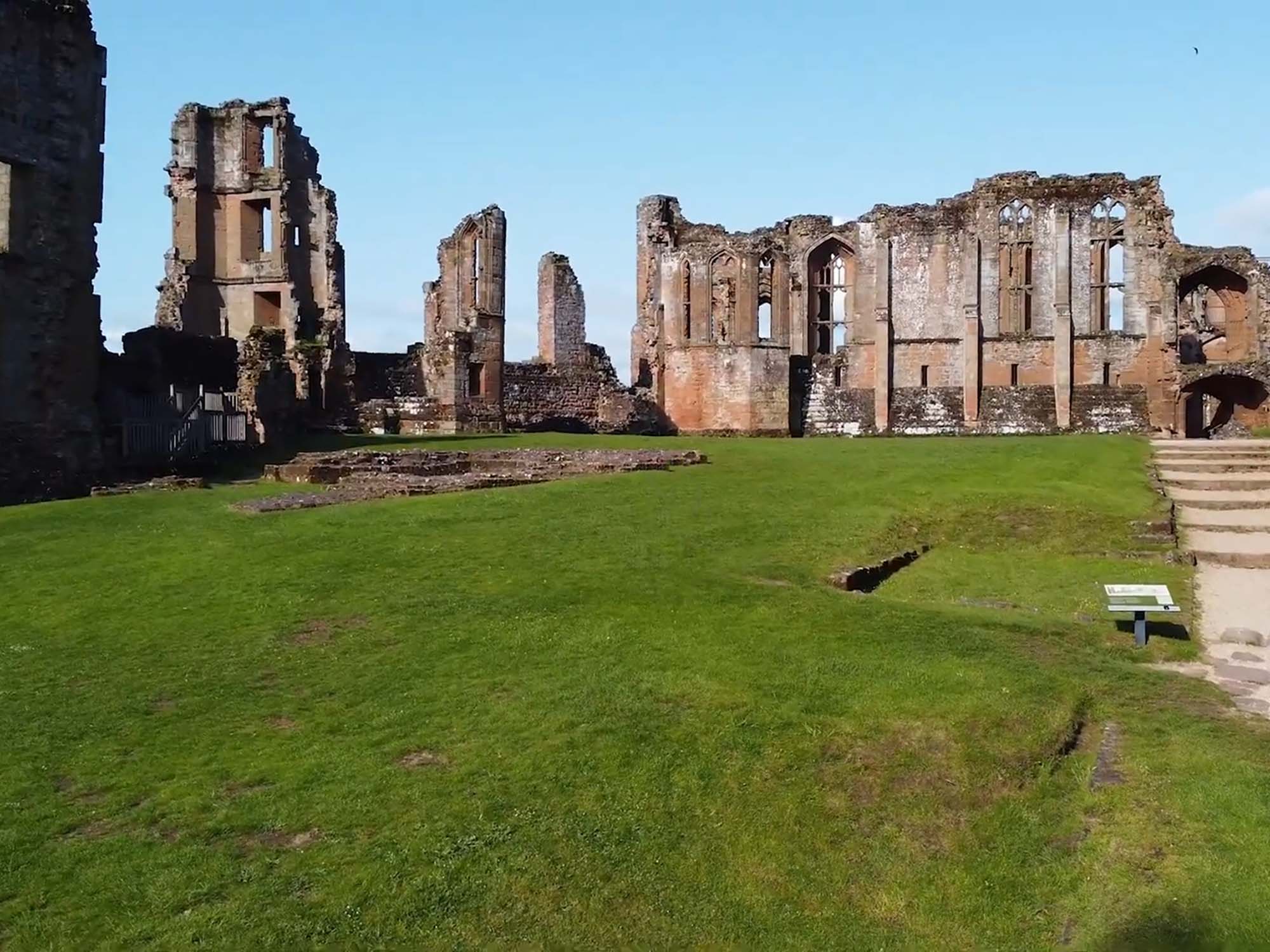
The extensive ruins of a medieval royal fortress and Tudor palace, known for the 172-day Siege of Kenilworth in 1266, its association with Elizabeth I and Robert Dudley, and its deliberate destruction after the English Civil War.
Kenilworth Castle is a large ruined castle in Warwickshire with a history spanning more than nine centuries. The first castle was established during the 1120s by Geoffrey de Clinton, chamberlain and treasurer to Henry I. Its earliest surviving structure is the massive Norman keep, which originally served as both a fortified residence and the defensive centre of the complex.
Kenilworth became a royal castle during the reign of Henry II. In the early 13th century, King John greatly strengthened its defences by constructing an outer circuit of stone walls and towers. A dam was built across the valley south of the castle, creating a large artificial lake known as the Great Mere. The water protected the walls from direct attack and undermining, while the narrow causeway across the dam controlled access to the main gate.
The castle was the scene of the Siege of Kenilworth during the Second Barons’ War. Henry III had granted Kenilworth to his brother-in-law, Simon de Montfort, Earl of Leicester, who led a rebellion against the king. After de Montfort was defeated, killed and mutilated at the Battle of Evesham in 1265, his remaining supporters continued to resist from Kenilworth. Henry initially attempted to negotiate, but a royal messenger sent to the garrison returned with one of his hands cut off.
The siege began on 25 June 1266. More than 1,200 men, women, children and servants were reportedly inside the castle, with substantial food supplies and powerful siege engines. Henry’s army surrounded Kenilworth with stone-throwing machines, crossbowmen and a large siege tower. Barges were transported overland from Chester for an attempted attack across the mere, but the waterborne assault was repelled. Projectiles from the opposing siege engines were described as colliding in the air above the walls.
The castle was never successfully stormed. After 172 days, disease and food shortages forced the defenders to surrender in December 1266. Dysentery had severely weakened the garrison, and only two days of food were said to remain. The siege became one of the longest in medieval English history and was so expensive that Henry III was forced to pawn jewels belonging to the shrine of Edward the Confessor at Westminster Abbey.
Kenilworth later passed to the House of Lancaster. During the late 14th century, John of Gaunt, son of Edward III, transformed much of the fortress into a palace. His extensive building programme included a great hall, state apartments, kitchens and service buildings. The great hall, constructed from local red sandstone, was one of the largest and most elaborate aristocratic halls of its period, with six fireplaces and large traceried windows.
In 1563, Elizabeth I granted Kenilworth to her favourite, Robert Dudley, Earl of Leicester. Dudley spent heavily converting the medieval castle into a Renaissance palace suitable for receiving the queen. He constructed Leicester’s Building, a four-storey accommodation block designed specifically for Elizabeth, together with a new gatehouse, bridge, hunting park and private garden.
Elizabeth visited Kenilworth four times. Her final visit in 1575 lasted nineteen days, the longest she stayed at the home of any courtier during her reign. Dudley arranged elaborate entertainments that included theatrical performances, hunting, music, banquets and fireworks reportedly heard many miles away. The celebrations have often been interpreted as part of Dudley’s continuing attempt to persuade Elizabeth to marry him, although no marriage took place.
Kenilworth was occupied by Parliamentarian forces in August 1642 during the English Civil War, but it did not become the scene of another major battle. In 1649, Parliament ordered that the castle be made militarily unusable. The north wall of the Norman keep was demolished, sections of the outer curtain wall were breached and the Great Mere was drained. Interiors were stripped, building materials were removed or sold, and most of the complex was abandoned. Leicester’s Gatehouse was converted into a residence and remained the only substantial inhabited section.
The ruins became a popular destination during the 18th and 19th centuries. Their fame increased after the publication of Sir Walter Scott’s novel Kenilworth in 1821, which fictionalised the relationships between Elizabeth I, Robert Dudley and Dudley’s wife Amy Robsart. The castle entered state care during the 20th century and is now managed by English Heritage. Visitors can explore the medieval keep, John of Gaunt’s great hall, Leicester’s Building, the gatehouse and a recreated version of the Elizabethan garden prepared for the queen’s visit in 1575.
Location: On Castle Green, west of Kenilworth town centre.
Address: Castle Green, Off Castle Road, Kenilworth, Warwickshire CV8 1NG, England
Category: castle, ruins
Tags: castle ruins, medieval fortress, siege, Second Barons’ War, Simon de Montfort, Henry III, John of Gaunt, Elizabeth I, Robert Dudley, English Civil War, slighting, royal history
Darkness Level: ☠ ☠ ☠ ☠ ☠ ☠ ☠
Homepage: english-heritage.org.uk
Map: Open in Google Maps
Gallery