Kakola Prison Hotel
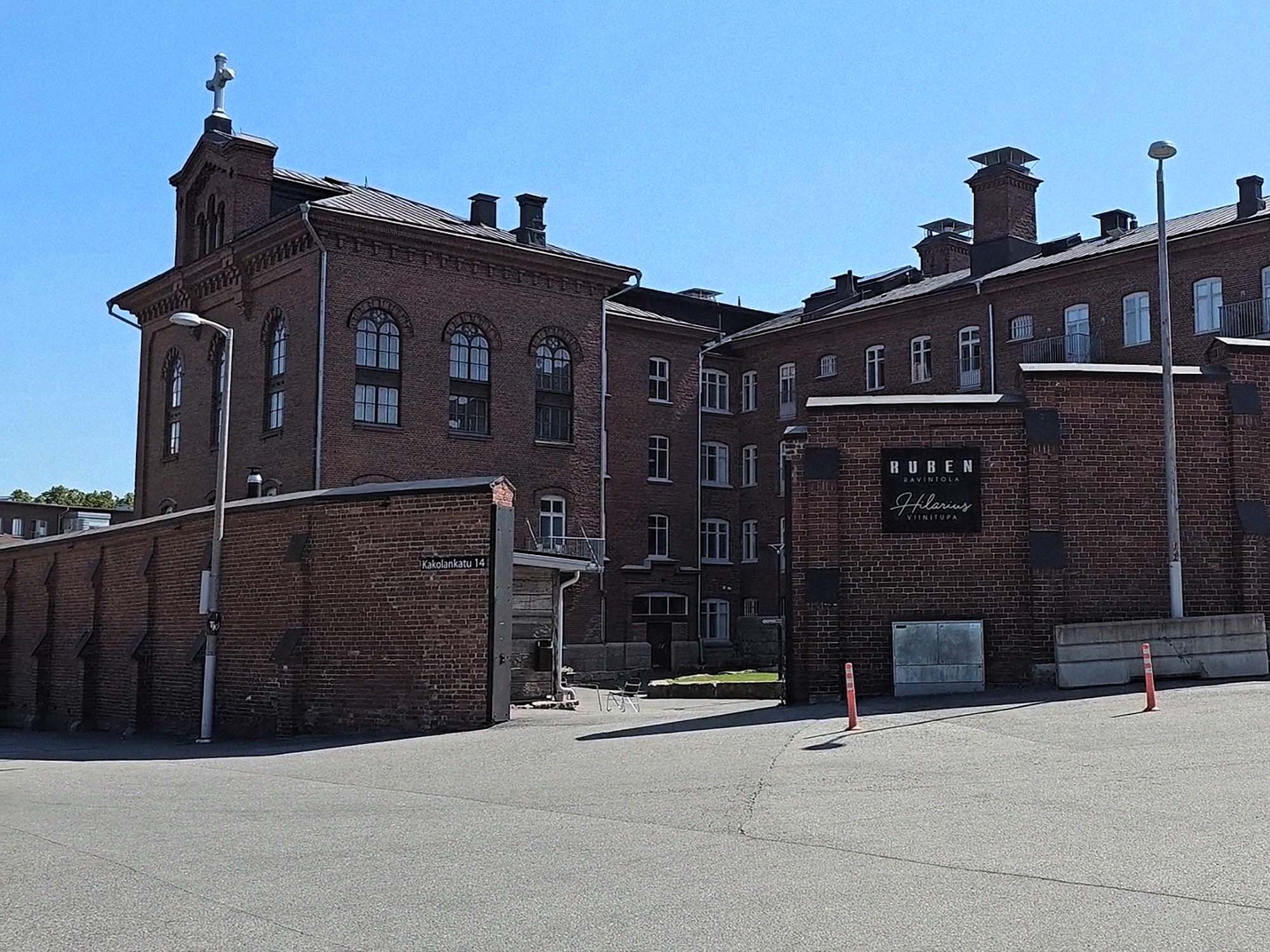
A hotel inside the former Turku County Prison, part of the vast Kakolanmäki prison complex that housed some of Finland's most notorious criminals for more than a century. The preserved red-brick corridors, barred windows and former cells recall a darker history of isolation, overcrowding, suicides and spectacular escapes, while guests can now spend the night in rooms built directly into genuine prison cells.
Hotel Kakola occupies the former Turku County Prison on Kakolanmäki hill in Turku, Finland. The red-brick building served the Finnish prison system from 1890 until 2007 and now forms part of a much larger former prison district containing granite cell blocks, workshops and a former prison psychiatric hospital. After an extensive conversion, the building reopened in September 2020 as Hotel Kakola, retaining much of the architecture that once separated prisoners from the outside world.
The distinction between the hotel and “Kakola Prison” is worth making. Hotel Kakola stands in the former Turku County Prison, while the name Kakola originally referred particularly to the enormous central prison higher on the hill. Together with the prison psychiatric hospital, the buildings developed into one of the largest prison complexes in Finland. At its most crowded during the first half of the 20th century, more than 1,300 prisoners were held on Kakolanmäki at the same time.
The unusual name predates the prison. During the 18th century, a poorhouse stood on the eastern slope of the hill and housed, among others, people then regarded as mentally incapable of supporting themselves. Local dialect referred to such people as kakot, and the institution became known as Kakola. The rocky ground behind it consequently acquired the name Kakolanmäki – Kakola Hill – long before its association with serious criminals.
The first major prison-related building was constructed higher on the hill between 1845 and 1853. Designed by Ernst Lohrmann, it began as a workhouse and correctional institution intended to discipline men considered unwilling or unable to fit into ordinary society through compulsory labour. Prisoners from Turku Castle helped construct the building and quarried the hard local granite, which they nicknamed kakoliitti. After temporarily housing Russian soldiers during the Crimean War, the building was converted into a penal prison during the early 1860s.
Labour became a defining part of life at Kakola. Prisoners quarried stone from the hill and worked in a succession of workshops producing furniture, shoes, military clothing, toys, metal goods and books. The institution eventually developed its own extensive working environment behind the walls. For much of Kakola's history, work was compulsory rather than optional, reflecting the older belief that hard physical labour formed part of punishment and moral reform.
The county prison that now contains Hotel Kakola was completed in 1890 and was the last of Finland's traditional county prisons to be constructed. Like its counterparts elsewhere in the country, it was built in red brick on a cross-shaped plan. It functioned partly as a remand prison, giving rise to the grimly humorous description of it as a “house full of innocent people”: suspects could remain there while the courts decided whether they were guilty at all.
Those who stayed after conviction included prisoners serving comparatively short sentences, people unable to pay fines, drink drivers and some first-time murderers. The building also contained a separate women's section at different periods. During the 1990s, around twenty cells in the south wing were again allocated to women as the number of female prisoners convicted of drug and violent offences increased. The administrative wing, where the hotel lobby now stands, formerly contained offices, the prison chapel and medical facilities; its lower level included prisoner reception rooms and a solitary-confinement section.
Conditions elsewhere on Kakolanmäki could be considerably harsher. New cell wings were added as prison philosophy shifted increasingly towards isolation. The North Cell, opened during the early 1880s, followed the Philadelphia system in which prisoners could spend almost all of their time alone. Contemporary descriptions spoke of a depressing line of tiny rooms, each holding one man with little more than a table, chair and folding bed.
An even more severe arrangement appeared in the East Cell block in 1893–1894. Its sleeping compartments were made from iron plate and measured only approximately two metres by 1.2 metres. Prisoners called them katiskat, or fish traps. The cells remained in use until the 1930s, when the system was finally abandoned specifically because it was considered inhumane. In 1935 the East Cell was connected to the main prison by an enclosed passage appropriately nicknamed the Bridge of Sighs.
A separate prison psychiatric hospital was completed behind its own high wall in 1908. Before then, mentally ill prisoners had been held alongside the general prison population. The hospital became the third major penal institution on Kakolanmäki alongside the county prison and central prison, making the hill an unusually concentrated landscape of incarceration, psychiatric care and compulsory labour.
The most feared part of the complex eventually became the massive Western Cell block, completed in 1911. For decades it served as a compulsory institution for persistent offenders, including prisoners with more than six convictions. Overcrowding became severe after the Second World War. Cells originally designed for one person could contain as many as five men, with four using bunk beds and a fifth sleeping beneath the window on a woodworking bench while the same cramped room was also used for work during the day.
Kakola's reputation was reinforced by some of the men sent there. One of the most notorious was murderer Matti Haapoja, a violent repeat offender who spent periods in Finnish and Siberian prisons during the late 19th century. After murdering Maria Jemina Salonen in 1890, Haapoja received a death sentence that was eventually commuted to lifelong forced labour at Kakola. During an escape attempt he stabbed three guards and then stabbed himself repeatedly in the chest. One guard subsequently died from infection caused by his wounds.
Haapoja survived and was prosecuted again. In 1895, shortly before a new verdict was to be delivered, he tore woollen thread from his socks and hanged himself in his Kakola cell. Although popular accounts have attributed a much larger number of killings to him, Finland's National Museum notes that only three murders can be established with certainty. His combination of violence, repeated escapes and suicide helped make him one of the most mythologised criminals in Finnish history.
Another famous inmate was the confidence trickster Ruben Oskar Auervaara, whose surname became so closely associated with romantic fraud in Finland that it entered everyday language. He targeted women through newspaper advertisements, presenting himself in staged photographs as everything from an aviator to a wealthy estate owner before attempting to obtain their money. After numerous convictions he spent years in prisons including Kakola, where he reportedly behaved quietly, assisted the prison chaplain and played the organ during Sunday services.
Kakola also earned a reputation for escape attempts. In the summer of 1952, several prisoners escaped during a period of considerable unrest. The following year came one of the prison's most celebrated breakouts. In December 1953, safecracker Heino Hilarius Sorjonen and Uuno “Dynamite” Laine overpowered guards, seized pistols and escaped from the central prison. Sorjonen later attempted to rob a bank in Vihti but left without harming the female bank manager when she refused to surrender the vault key, an episode that contributed to his nickname “Soft-hearted Hilarius.”
Escapes became common enough for Kakola to acquire the joking nickname Pakola, playing on the Finnish verb for escaping. Another famous inmate, bank robber Matti “Volvo” Markkanen, had escaped from other prisons before being placed in Kakola's high-security cells. He later claimed that his claustrophobia was so severe that he secretly kept dynamite in his cell because he feared being trapped if an emergency occurred and nobody came to unlock the door.
The prison's history was not composed solely of colourful criminals and escapes. Overcrowding and isolation took a psychological toll. Kakola's own historical account notes that suicides increased during the overcrowded post-war years, contributing to pressure for prison reform during the 1950s. Conditions were gradually relaxed: prisoners received better pay for work, prison shops were established, exercise became easier and inmates were eventually allowed small comforts such as curtains, rugs and personally chosen colours on cell walls.
By the late 20th century, another grim feature of prison life had become more visible. The Western Cell contained a protected section for prisoners who feared being killed or assaulted by other inmates. Known in Finnish prison slang as “lizards”, they included prisoners targeted because of debts, sexual offences, crimes against children or conflicts linked to the drug trade. They lived in individual cells and were kept almost completely separated from the rest of the prison population. Additional security cells were fitted with double doors so meals could be passed inside without opening the cell completely.
By the 1980s, the aging complex was increasingly regarded as unsuitable for a modern prison. Its location, once deliberately isolated, had also become problematic as Turku expanded around Kakolanmäki. The Finnish Ministry of Justice decided in 1999 to replace it with a new facility. In September 2007, the central prison, county prison and prison psychiatric hospital were closed and their remaining population of fewer than 300 inmates was transferred approximately 8.5 kilometres away to the new Saramäki Prison.
For the first time in roughly a century and a half, Kakolanmäki was no longer a closed prison district. Public tours began almost immediately and attracted around 50,000 visitors between 2008 and 2011. Redevelopment accelerated after the prison properties were sold during the middle of the following decade. Apartments, restaurants, a bakery, brewery and other businesses gradually appeared inside buildings that had previously been hidden behind prison walls.
The former county prison was purchased in 2016, and conversion work began in autumn 2018. Rather than erase the building's previous function completely, the developers incorporated parts of its fabric into the new hotel. Old floorboards and other materials were reused as furniture and interior elements, while cell corridors, brick walls, barred details and heavy doors were retained or referenced throughout the building. Hotel Kakola finally opened in September 2020.
Most guest rooms are now conventional modern hotel rooms created within the former prison structure, but the hotel also retains dedicated cell rooms. These are built in genuine former cells and preserve details intended to recall incarceration, including barred features, bunk-style accommodation and the confined proportions of the original rooms. The irony is difficult to miss: people now voluntarily pay to sleep in spaces where earlier occupants were locked in by the state.
Other reminders are less literal. Prison terminology and imagery appear throughout the hotel, while the surrounding Kakolanmäki district still preserves enough of the original walls, granite architecture and cell blocks to make its former purpose immediately recognisable. The prison psychiatric hospital survives separately, as do the enormous central prison buildings where many of Finland's most notorious inmates were actually held. Hotel Kakola therefore represents only one portion of a much larger historical prison landscape.
The transformation could hardly be more complete. Kakolanmäki once represented confinement, compulsory labour and social exclusion; today the former prison district contains homes, restaurants, a brewery and even a spa. Yet Hotel Kakola works precisely because the old prison has not disappeared entirely beneath the renovation. Behind the comfortable rooms remain the cross-shaped plan of the county jail, the former solitary-confinement spaces and corridors through which suspects, murderers, debtors, drink drivers and other prisoners were moved for more than a century.
Location: On Kakolanmäki hill overlooking central Turku, inside the former Turku County Prison and the wider historic Kakola prison complex.
Address: Kakolankatu 14, 20100 Turku, Finland
Category: prison hotel, prison, hotel
Tags: former prison, prison hotel, prison cells, solitary confinement, prison psychiatric hospital, executions and punishment, suicide, escape attempts, Matti Haapoja, Ruben Auervaara, Heino Hilarius Sorjonen, Volvo Markkanen, forced labour, prison history, cell room, dark tourism
Darkness Level: ☠ ☠ ☠ ☠ ☠ ☠ ☠ ☠
Homepage: hotelkakola.fi
Map: Open in Google Maps
Gallery