Jesse James Home and Museum
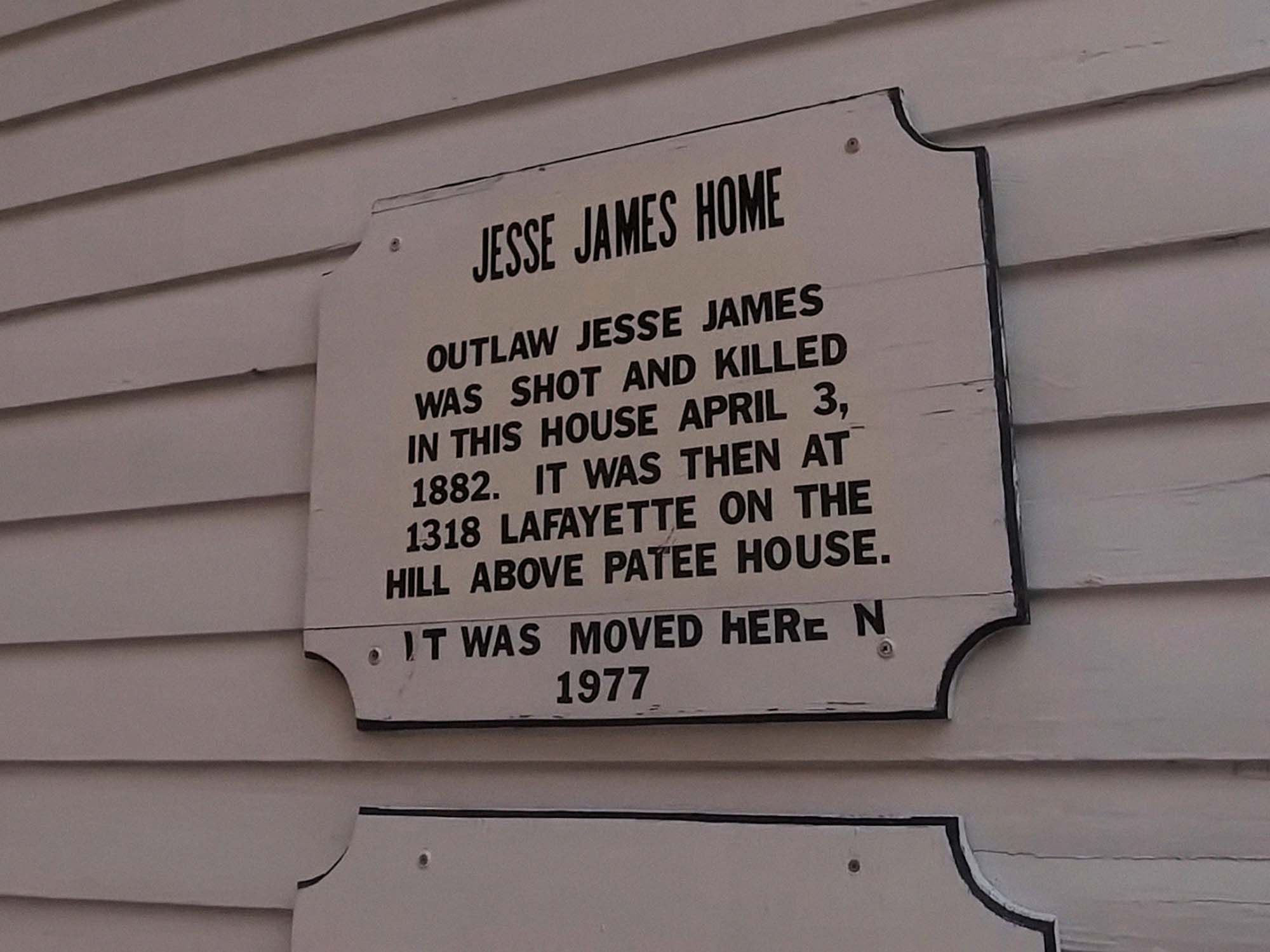
The small Missouri house where outlaw Jesse James spent the final months of his life under an assumed name before being shot in the back of the head by fellow gang member Robert Ford on 3 April 1882. The preserved home contains objects connected with his death and later exhumation, while even its floorboards and famous wall damage became targets for souvenir hunters almost immediately after the killing.
Jesse James Home and Museum preserves the small house in St. Joseph, Missouri, where the notorious outlaw Jesse Woodson James was shot and killed on 3 April 1882. James had been living here with his wife Zerelda “Zee” Mimms James and their two surviving children under the assumed name Thomas Howard, attempting to remain hidden while continuing to plan robberies. His death inside the house ended a criminal career that had begun in the aftermath of the American Civil War and helped transform him from a wanted murderer and robber into one of the most persistent figures in American outlaw folklore.
The modest one-storey house was built around 1880 and originally stood at 1318 Lafayette Street, approximately two blocks north of its present location. Jesse and Zee rented it from a local owner for $14 a month and moved in on Christmas Eve 1881. The family had already been living under false names for years. Jesse presented himself as a cattle buyer, while the children grew up knowing that their father's real identity could not be freely discussed.
The secrecy was necessary because Jesse James had spent most of his adult life moving between guerrilla warfare and organised crime. Born in Missouri in 1847 into a slave-owning family sympathetic to the Confederacy, he joined Confederate guerrillas while still a teenager. In 1864 he rode with William “Bloody Bill” Anderson during the raid on Centralia, Missouri, where twenty-two unarmed Union soldiers were murdered before more than a hundred soldiers were killed and mutilated in the battle that followed. James later claimed responsibility for killing Union commander Major Andrew Johnston.
After the Civil War, Jesse and his older brother Frank became associated with a succession of bank, stagecoach and train robberies. Their gang eventually joined forces with the Younger brothers and operated across several states. Jesse also cultivated his own reputation, sending letters to sympathetic newspaper editor John Newman Edwards, who portrayed him as a Confederate avenger and increasingly as a kind of Robin Hood figure. The historical record provides little support for the popular idea that James routinely stole from the rich to give to the poor; his robberies instead involved killings, intimidation and substantial personal profit.
One of the gang's most serious disasters occurred at Northfield, Minnesota, in 1876, when an attempted bank robbery collapsed under armed resistance from local citizens. Several gang members were killed, the Younger brothers were captured and Jesse and Frank escaped. The brothers subsequently lived under assumed identities in Tennessee before Jesse eventually returned to Missouri and began recruiting a new generation of accomplices.
By 1881, Missouri governor Thomas T. Crittenden was determined to end the James brothers' career. Money supplied by railroad and express companies financed a large reward for their capture. Jesse's old circle had been decimated by death and imprisonment, and among the men now close to him were brothers Charley and Robert “Bob” Ford. Bob had already held secret discussions with Crittenden about obtaining the reward by capturing or killing Jesse.
The Ford brothers stayed with the James family in the St. Joseph house while the men discussed a planned robbery of a bank at Platte City. Jesse apparently trusted them enough to allow them inside his carefully protected domestic life, although later accounts suggest he had become increasingly suspicious of virtually everyone around him. A reward of $10,000 had been offered for the James brothers, an enormous sum at the time and one that provided Bob Ford with a clear financial motive.
On the morning of 3 April 1882, Jesse, Bob and Charley were together inside the house. The traditional account says that Jesse removed his gun belt and climbed onto a chair to straighten or dust a picture hanging on the wall. With his back turned, Bob Ford raised a revolver and fired a single shot into the back of Jesse's head. Jesse fell from the chair onto the floor and died almost immediately. He was only 34 years old.
The apparent simplicity of the killing helped make it legendary. Jesse James had survived gunfights, guerrilla warfare, Pinkerton agents and years as one of America's most hunted criminals, only to be killed unarmed inside his own home by a man he had allowed to stay there. The shooting quickly generated accusations of cowardice and betrayal, particularly because Bob Ford had negotiated secretly with state authorities before pulling the trigger.
The Ford brothers surrendered after the shooting. They were charged with murder, pleaded guilty and were sentenced to death by hanging, only to receive almost immediate pardons from Governor Crittenden. They were also paid part of the reward. The arrangement created a political controversy: supporters of Jesse James could now portray him as the victim of a government-backed assassination rather than as a fugitive outlaw. That interpretation became an important part of the mythology that grew around his death.
Neither Ford brother enjoyed a peaceful aftermath. Charley Ford committed suicide in 1884. Bob attempted to profit from his notoriety, appearing publicly as “the man who killed Jesse James” and participating in stage recreations of the shooting. In 1892, he was himself shot dead inside a saloon in Creede, Colorado. The murder ensured that Jesse's assassin acquired his own violent ending ten years after the killing in St. Joseph.
Jesse's body became a spectacle almost immediately. It was examined and photographed, and large numbers of people came to see the corpse before it was transported back to the family property near Kearney. His mother Zerelda Samuel initially had him buried close to the farmhouse, partly because she feared grave robbers. The remains were moved to Mount Olivet Cemetery in 1902.
The St. Joseph house developed its own souvenir problem. According to a later statement from the landlord's daughter, visitors began cutting pieces from the floor where Jesse's head was said to have rested after the shooting. The damaged boards were removed soon afterwards and preserved by the family. In 1955, Rose Gernaudt donated them to the St. Joseph Museum together with a written statement identifying them as the original boards beneath Jesse's body.
The wall also acquired a famous “bullet hole” traditionally associated with the fatal shot. Historic photographs show the damaged area, and souvenir hunters gradually enlarged it by removing fragments of plaster. Later forensic work complicated the traditional explanation of the hole. Examination of Jesse's exhumed skull found a clear entrance wound behind the right ear and traces of bullet material within cranial fragments, making the exact path of the fatal projectile less straightforward than older museum stories suggested.
The house itself has also travelled. In 1939, it was moved from Lafayette Street to the Belt Highway and operated as a roadside attraction. Robert and Lois Keatley purchased it in 1977 and donated it to the Pony Express Historical Association, which moved it back into its original neighbourhood beside the Patee House Museum. Returning it precisely to 1318 Lafayette Street was no longer practical because much of the original hill had been graded away and the site had changed substantially.
The house was entered on the National Register of Historic Places in 1980. Although it no longer stands on the exact patch of ground where Jesse died, the structure itself is the genuine building in which the shooting occurred. The rooms have been furnished to suggest their appearance during the James family's short residence rather than preserved as an untouched 1882 interior.
One of the strangest chapters in the museum's history came more than a century after the murder. Persistent stories claimed that Jesse James had somehow staged his death and lived for decades under another identity. In July 1995, forensic scientist James E. Starrs led an official exhumation of the remains at Mount Olivet Cemetery in an attempt to settle the question.
The examination produced several pieces of evidence consistent with Jesse James. The remains matched his age and physical characteristics, and investigators found an old bullet among the right ribs corresponding with a known Civil War wound. Most importantly, mitochondrial DNA obtained from teeth and hair matched living maternal relatives. The resulting forensic study concluded that the genetic evidence strongly supported the identification of the exhumed remains as Jesse James.
Objects connected with that exhumation are now displayed inside the museum. They include coffin handles, a small tie pin found with the remains, the old bullet recovered from the right rib area and a cast of the reconstructed skull, showing the entrance wound behind the right ear. The museum therefore contains artefacts connected not only with Jesse's life and murder but with the unusual forensic investigation carried out 113 years after his death.
The neighbouring Patee House is also directly connected with the aftermath. At the time it operated as the World's Hotel. Zee James, the two children and Jesse's mother stayed there for two nights following the shooting, while the hotel became a centre for the investigation. The two museums now stand together, linking the murder scene with the building where much of the immediate response to the killing unfolded.
Jesse James' death helped complete the transformation of a violent criminal into a folk legend. Songs, books and films increasingly emphasised betrayal, rebellion and the image of the outlaw pursued by powerful institutions. The idea that he had been a heroic robber who redistributed his loot became particularly persistent, despite the absence of meaningful evidence that the James gang operated as charitable bandits. The surviving house makes that contrast unusually tangible: the legend became enormous, but the place where it ended is a remarkably small and ordinary family home.
Location: Beside the Patee House Museum in St. Joseph, approximately two blocks from the house's original site at 1318 Lafayette Street.
Address: 1202 Penn Street, St. Joseph, MO 64503, United States
Category: western, museum
Tags: Jesse James, Robert Ford, Bob Ford, Charley Ford, James-Younger Gang, outlaw, murder, assassination, gunshot death, crime scene, bullet hole, souvenir hunters, Civil War guerrilla, Bloody Bill Anderson, Centralia Massacre, bank robbery, train robbery, Thomas Crittenden, bounty, DNA testing, western, human remains, American West
Darkness Level: ☠ ☠ ☠ ☠ ☠ ☠ ☠ ☠
Homepage: ponyexpressjessejames.com
Map: Open in Google Maps
Gallery