Jesse James Bank Museum
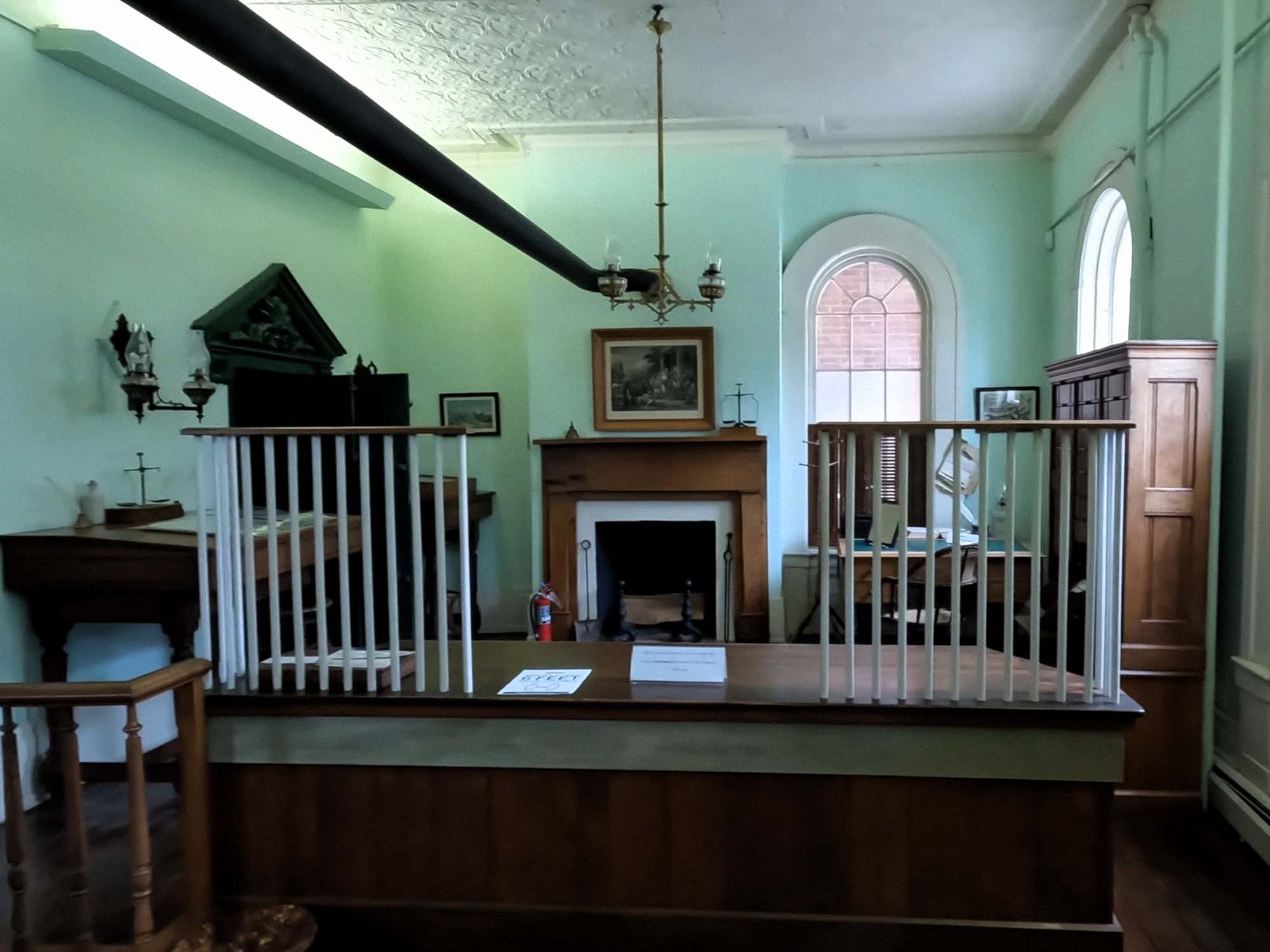
The preserved Missouri bank where a gang of former Confederate guerrillas carried out one of America's earliest and most notorious daylight bank robberies in 1866, escaping with around $60,000 and killing teenage college student George “Jolly” Wymore outside. The crime later became identified with Jesse James and his emerging outlaw legend, although no robber was ever convicted and Jesse's presence has never been proven.
Jesse James Bank Museum occupies the former Clay County Savings Association on the historic square in Liberty, Missouri. Behind its modest red-brick exterior survives the original bank vault associated with the armed robbery of 13 February 1866, an attack widely described as the first successful daylight bank robbery committed in the United States during peacetime. The crime became one of the foundational stories of the James–Younger Gang, although the men who actually entered the bank were never conclusively identified.
The building predates the robbery by several years. Construction began in 1858, and the bank opened in the new premises in January 1859 as a Liberty branch of the Farmers Bank of Missouri at Lexington. Banking was still relatively new to the town: before the branch was established, residents of Liberty and surrounding communities often travelled considerable distances to conduct financial business. The building is now regarded as Liberty's only surviving antebellum commercial structure of its type.
After the disruption of the Civil War, the building became home to the Clay County Savings Association. Its cashier was Greenup Bird, a long-established Liberty resident who had previously served as county clerk and held other public positions. His son William Bird worked beside him as a clerk. On the afternoon of 13 February 1866, father and son were the only employees inside when a group of armed horsemen arrived in Liberty.
The Civil War had formally ended the previous year, but western Missouri was far from peaceful. Clay and neighbouring counties had spent years at the centre of guerrilla warfare involving Confederate bushwhackers, Union troops, pro-slavery militants and Kansas Jayhawkers. Men who had learned to raid, ambush and kill during the war did not simply disappear when the Confederacy collapsed. Former guerrilla networks remained active, and political violence continued across the Missouri–Kansas border.
On that February afternoon, approximately ten to twelve horsemen gathered around Liberty Square while two entered the bank. Accounts based on Greenup Bird's recollections describe one of the strangers initially asking for change for a ten-dollar bill. The situation then changed immediately: revolvers were produced and Greenup and William were ordered to surrender the contents of the bank.
The robbers took approximately $60,000 in government bonds, currency, gold, silver and tax stamps, an enormous sum in 1866. William Bird was forced to place the valuables into a sack while the gunmen kept both men under threat. Once the money had been collected, Greenup and William were forced into the bank vault and the door was closed behind them.
The robbers failed to secure the vault completely, allowing the Birds to get out shortly afterwards. As the gang prepared to leave Liberty, gunfire broke out around the square. Accounts differ over precisely why the shooting began and whether the shots were intended to frighten witnesses or resulted from confusion as the riders mounted their horses.
Whatever prompted the gunfire, one bullet struck George “Jolly” Wymore, a teenage student at nearby William Jewell College. Wymore had no involvement with the bank and was simply outside as the robbery unfolded. He was fatally shot as the gang fled, turning an audacious robbery into a killing. Modern sources differ slightly over whether Wymore was seventeen or nineteen years old, but agree that he was a young college student and the only person killed during the raid.
Liberty residents quickly organised a posse, but the pursuit was hampered by poor weapons, winter conditions and a developing snowstorm that obscured the riders' trail. Witnesses reported the fugitives heading towards the Missouri River, but the gang disappeared with the money. No participant was arrested or convicted for the Liberty robbery.
The identity of those men remains the most important unresolved question surrounding the museum. The robbery has long been attributed to Jesse James, Frank James and the men who later became known collectively as the James–Younger Gang. Former Confederate guerrilla leader Archie Clement and members of his circle are generally considered strong suspects. Jesse and Frank had both moved in the same guerrilla world during the war, and later robberies were unquestionably associated with them.
There is, however, no reliable evidence proving that Jesse James participated in the Liberty robbery. Even the State Historical Society of Missouri describes its surviving 1866 account as a robbery “supposedly committed” by Jesse James. Modern historians generally regard former Confederate bushwhackers as the likely perpetrators, but Jesse's name appears to have become attached more firmly to the crime only after he achieved national notoriety through later robberies.
This uncertainty is particularly significant because Jesse was not yet the famous outlaw he would become. His name did not receive major national attention until the 1869 robbery at Gallatin, Missouri, when cashier John Sheets was shot dead. As Jesse and Frank became increasingly notorious during the 1870s, earlier crimes committed by former Confederate guerrillas were often retrospectively folded into the James Gang story. The Liberty robbery became especially attractive as an origin point because it occurred close to the James family home and resembled the methods used in later attacks.
The political background also complicates the familiar image of James as a romantic western outlaw. Jesse and many of his associates had fought as Confederate guerrillas during a bitter civil conflict in which civilians were regularly targeted. In the years after the war, sympathetic former Confederate journalist John Newman Edwards helped create an image of Jesse as a heroic rebel resisting victorious Unionist political power. The later idea that the James gang behaved like Robin Hood, stealing from wealthy institutions and helping ordinary people, has little historical support.
The Clay County Savings Association itself did not recover from the loss. The robbery contributed to the bank's collapse, and surviving accounts state that its owners liquidated assets, called in loans and used personal funds in an attempt to repay depositors. Even then, depositors reportedly recovered only around 60 cents for every dollar lost in the robbery. The famous theft therefore affected considerably more people than the two employees held at gunpoint and the young man killed outside.
The building nevertheless remained in commercial use after the Clay County Savings Association disappeared, and other banking businesses occupied the premises at different periods. Much of Liberty Square changed dramatically during the following century, leaving the former bank as a rare survivor from the town as it appeared before the Civil War.
Its transformation into a museum began in the 1960s. In 1965, the building was purchased and restored by Jack Wymore, a relative of George “Jolly” Wymore, the student killed during the robbery. The following year – the centenary of the crime – it opened as the Jesse James Bank Museum. There is an obvious historical irony in the name: a member of the victim's family helped preserve the crime scene, while the museum was named after the outlaw whose presence at the robbery remains unproven.
The surviving bank room has been arranged to resemble its appearance in 1866. Most importantly, visitors can still see the original vault into which Greenup and William Bird were forced. Period banking furniture and documents help reconstruct the setting, while a Seth Thomas clock is permanently set to the date and approximate time of the robbery. A separate display contains photographs and material relating to the James family and the crime.
The museum also preserves material connected with George Wymore. His family donated memorabilia associated with the young man whose death was often reduced to a footnote once Jesse James became the dominant figure in the story. That material restores an important balance to the museum: regardless of who committed the robbery, Wymore was a real person killed during it, while the celebrity subsequently attached to Jesse James was largely created after the event.
The building was placed on the National Register of Historic Places in 1992. Its significance rests both on the robbery and on the survival of an unusually intact pre-Civil War commercial building in Liberty. The museum is now operated as one of the historic sites maintained by Clay County.
Location: On the northeast corner of historic Liberty Square, north-east of Kansas City in Clay County, Missouri.
Address: 103 N Water Street, Liberty, MO 64068, United States
Category: western, museum, bank
Tags: Jesse James, Frank James, James–Younger Gang, bank robbery, Clay County Savings Association, George Wymore, Jolly Wymore, western, shooting, Greenup Bird, William Bird, Archie Clement, bushwhackers, American Civil War, outlaw history, original vault, unsolved crime, Wild West mythology
Darkness Level: ☠ ☠ ☠ ☠ ☠ ☠ ☠ ☠
Homepage: visitclaymo.com
Map: Open in Google Maps
Gallery