Frankenstein Castle
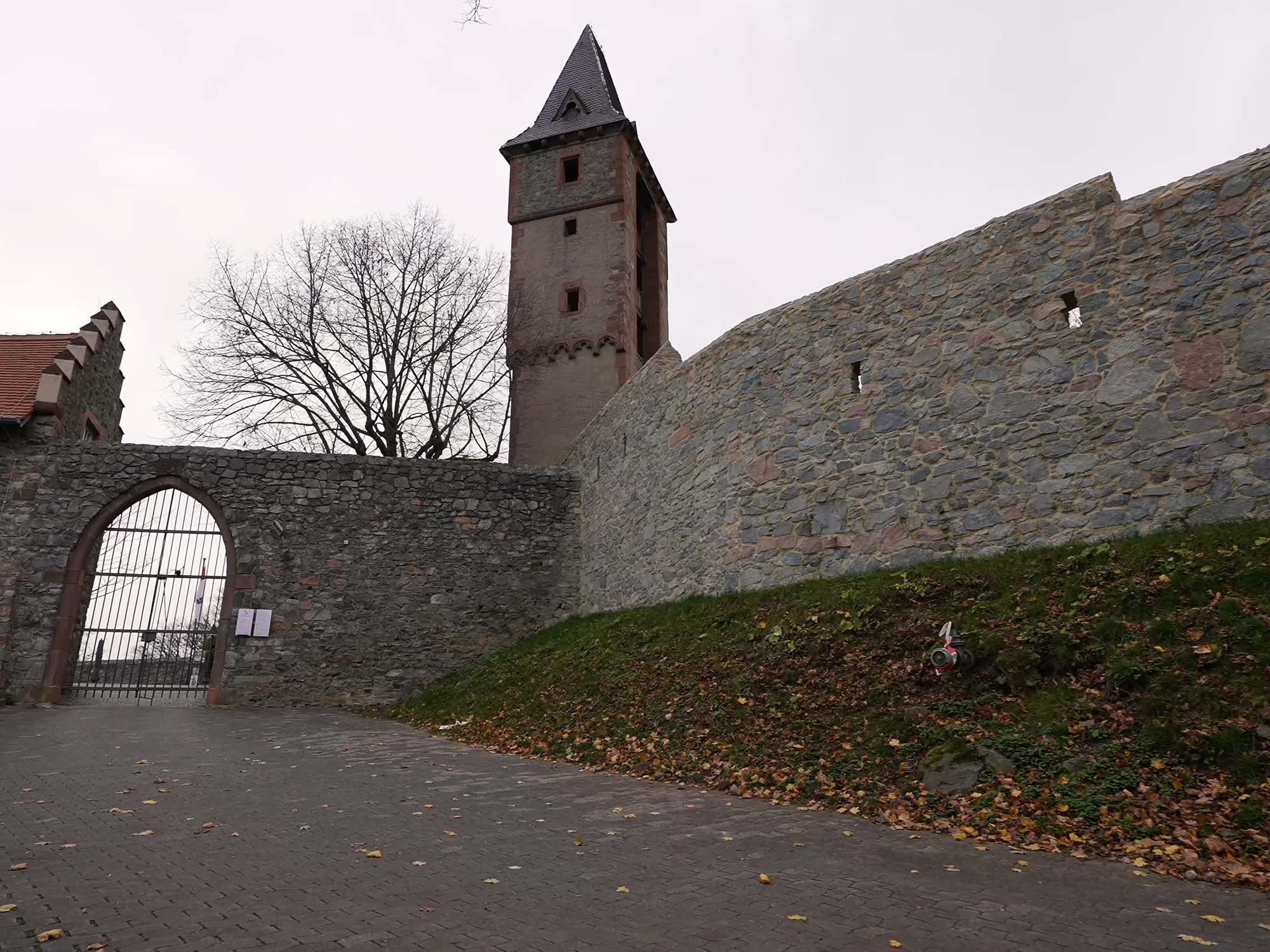
A ruined medieval castle near Darmstadt, associated with the alchemist Johann Conrad Dippel, local legends and a disputed claim that it inspired Mary Shelley’s Frankenstein.
Frankenstein Castle, known in German as Burg Frankenstein, is a medieval hilltop castle on the northern edge of the Odenwald. It was probably constructed during the second quarter of the 13th century by Conrad II Reiz of Breuberg. The castle was first recorded in a document dated 2 June 1252, in which Conrad referred to himself as being at the castle of Frankenstein. He and his descendants subsequently adopted the name von Frankenstein.
The castle was expanded repeatedly during the following centuries. After the Frankenstein family divided into two branches in 1363, both lines occupied and administered the property. The complex developed into an inner castle containing residential buildings and a fortified outer bailey with defensive walls, agricultural buildings and a chapel. The surviving gate tower dates largely from the late 14th century, while the castle chapel and several other structures were added or altered during the 16th century.
Following prolonged disputes with the Landgraves of Hesse-Darmstadt over religion and local authority, the Frankenstein family sold the castle and its surrounding territory to Landgrave Louis VI in 1662. The property was subsequently used to house military invalids and occasionally served as a prison. Lack of maintenance caused the buildings to deteriorate during the 18th century, and much of the residential complex became ruinous. The two prominent towers were restored and partly reconstructed during the 19th century under Grand Duke Louis III of Hesse, meaning that parts of the present silhouette do not reproduce the medieval buildings exactly.
The castle is closely associated with Johann Conrad Dippel, a theologian, physician and alchemist born there in August 1673. His family had taken refuge at the castle during military unrest involving French forces. Dippel later became known for controversial religious writings, chemical experiments and an animal oil that he promoted as a medicine. Later stories claim that he experimented on corpses at Frankenstein Castle or attempted to transfer souls between bodies. No historical evidence shows that he conducted experiments at the castle, or even that he returned there to work after his childhood.
Dippel’s activities have frequently been presented as a possible inspiration for Mary Shelley and her novel Frankenstein; or, The Modern Prometheus, published in 1818. Shelley travelled along the Rhine in 1814 and passed through the wider region, but her surviving journal does not mention Frankenstein Castle, Dippel or a visit to the ruins. The theory that she heard the story of Dippel and used him as the basis for Victor Frankenstein remains popular, but it is unsupported by contemporary documentation and is generally rejected by historians connected with the castle.
An older local legend concerns the knight Georg von Frankenstein, who is said to have fought and killed a dragon that threatened the surrounding villages. According to the story, Georg was fatally poisoned by the creature during the fight. The tale developed from regional folklore and is not a documented historical event, although a memorial image of a knight named Georg von Frankenstein contributed to its later popularity.
The connection between the castle and modern horror culture became firmly established during the 1970s. After an American Forces Network broadcast promoted the ruins as the supposed home of Frankenstein’s monster, American military personnel stationed around Darmstadt helped organise a Halloween event at the castle in 1976. The event developed into a large annual horror festival featuring costumed performers, staged scares and theatrical displays. It remained at Frankenstein Castle until 2023, when extensive restoration work required the event to move elsewhere.
Frankenstein Castle is administered by the State Palaces and Gardens of Hesse. A major programme of structural repairs and conservation began in 2023 and is planned to continue through the end of 2028. Access to parts of the castle may be restricted during the work.
Location: On a wooded hill in the Odenwald, south of Darmstadt and above the village of Nieder-Beerbach.
Address: Burg Frankenstein, 64367 Mühltal, Germany
Category: castle, ruins
Tags: castle ruins, medieval, fortress, Johann Conrad Dippel, alchemy, Mary Shelley, Frankenstein, Gothic literature, dragon legend
Darkness Level: ☠ ☠ ☠ ☠ ☠ ☠ ☠
Homepage: schloesser-hessen.de
Map: Open in Google Maps
Gallery