Domen
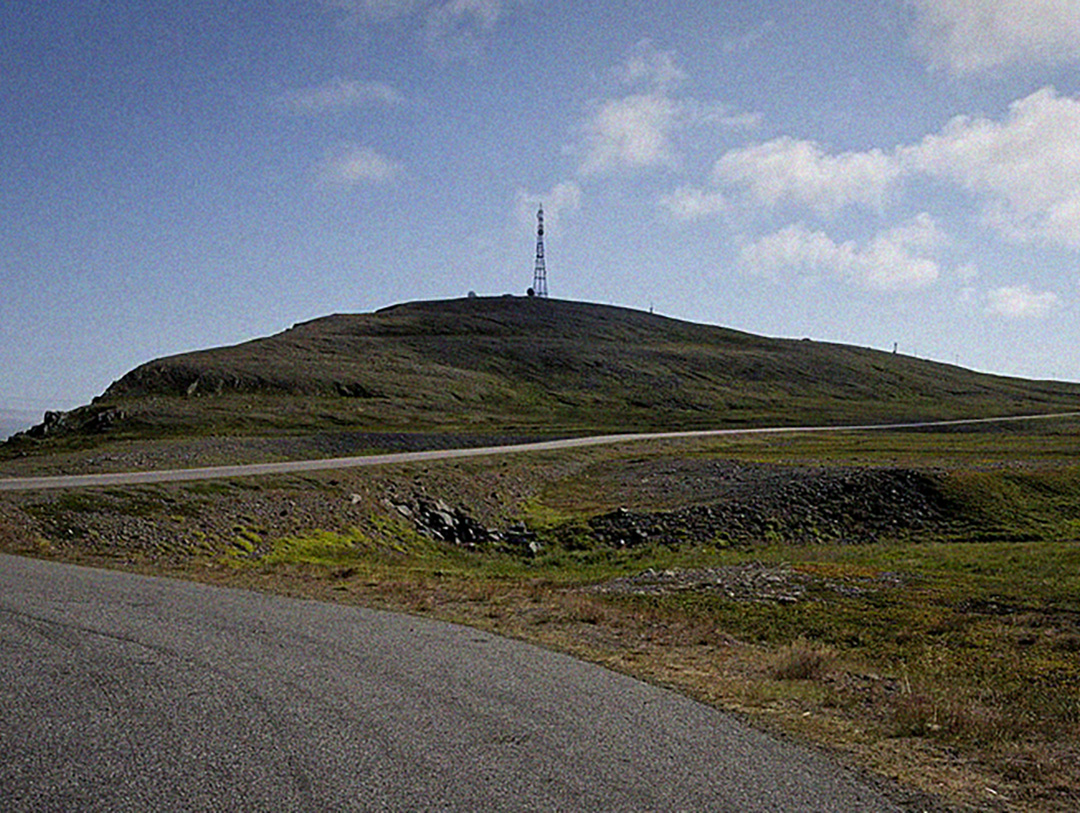
A barren Arctic mountain outside Vardø that became the symbolic centre of the Finnmark witch trials. In 17th-century court records, accused women described flying to Domen, dancing with Satan, raising storms and travelling from the mountain into Hell itself. These confessions, often produced after torture and extreme pressure, helped turn an ordinary 164-metre mountain into Norway's most infamous “witch mountain” while dozens of real people were imprisoned and burned nearby.
Domen is a low, treeless mountain on the Varanger Peninsula immediately southwest of Vardø in northeastern Norway. Rising only about 164 metres above the Barents Sea, it is not imposing by conventional standards, yet few landscapes in Norway became so deeply entangled with ideas of witchcraft, Satan and Hell. During the 17th-century witch trials in Finnmark, the mountain repeatedly appeared in confessions extracted from accused women and gradually became the imagined meeting place of an organised community of witches.
The persecutions did not begin with a supposed gathering on Domen. The first great chain of witchcraft trials in eastern Finnmark developed after a genuine disaster at sea. On Christmas Eve 1617, a violent storm struck the coast around Vardø and Kiberg. Ten fishing boats were lost and around 40 fishermen drowned, an enormous loss for the small coastal communities. When witchcraft prosecutions intensified several years later, women were accused of having deliberately created the storm through magic.
In January 1621, Else Knutsdatter of Kiberg told the court that women had tied three knots in a fishing line, spoken curses over them, spat on them and then released the knots to summon the storm. According to the surviving court record, the sea then “rose like ashes” and the fishermen died. Else and nine other women were condemned to death at Vardø on 27 January. The case became the first major mass witchcraft prosecution in Finnmark and established patterns that would return repeatedly during the following four decades: weather magic, accusations passed from one suspect to another, meetings with Satan and increasingly elaborate stories of organised witch gatherings.
The authorities were operating within a much wider European fear of demonic witchcraft. Earlier Norwegian cases had often concerned harmful magic, healing or curses between neighbours. By the early 17th century, however, educated demonological ideas about a secret conspiracy of witches serving Satan were spreading northwards. The accused were increasingly expected not simply to admit performing magic but to describe how they had renounced God, entered agreements with the Devil, travelled through the air and met other witches at hidden gatherings.
Mountains became natural locations for these imagined assemblies. Early Finnmark testimony referred to places including Lyderhorn outside Bergen, already notorious in southern Norwegian witchcraft tradition, but local landscapes soon acquired the same role. Domen, together with nearby places such as Baldvolden, became one of the most frequently named meeting places in the surviving Finnmark trials. By the middle of the century it had developed into something more than a mountain: in the language of the trials, it was a geographical border between the ordinary world and Satan's realm.
The most detailed and disturbing stories emerged during the great prosecution of 1662–1663, the worst witch hunt in Norwegian history. At least nineteen women were condemned to death in eastern Finnmark within only a few months. Several described gatherings on Domen around St John's Eve – Sankthansaften, a night already surrounded by beliefs that the boundary between the human world and supernatural forces was unusually thin.
In these confessions, Domen became the scene of elaborate celebrations. Women claimed that they had flown to the mountain, transformed themselves into birds or other animals and danced with other witches. Satan himself supposedly attended. Some described him playing a fiddle – on occasion specifically a red fiddle – while beer and wine were served in pewter vessels. One woman claimed that she lost a shoe while dancing with “Gammel-Erik,” an old Norwegian name for the Devil, and that he provided her with another.
Solvi Nilsdatter, one of the women caught in the 1662–63 prosecutions, confessed that she had transformed herself into both a crow and an auk and joined other women dancing on Domen. She also described travelling into Hell itself to see what it was like. In another account Satan played music for the gathered women on a horn and langeleik. These extraordinary descriptions should not be read as eyewitness accounts of secret rituals. They survive because women facing prosecution were questioned within a system that already possessed a detailed idea of what witches were expected to do.
Domen was also connected directly with supposed attacks on ships. During the 1662–63 prosecutions, accused women described travelling in a barrel from Vadsø towards the mountain, flying onto Domen and untying magical knots before transforming into animals and setting out to destroy a vessel. Weather magic was particularly believable in the fishing communities of Finnmark, where sudden Arctic storms could kill large numbers of men within hours. Natural disasters therefore provided fertile ground for accusations that someone had deliberately summoned the wind.
The mountain's reputation became darker still through stories that it contained an entrance to Hell. A deep, narrow cave exists near Domen, and trial material eventually connected the mountain with a passage into the infernal world. In testimony associated with Maren Olsdatter, Domen was described as one of the gateways by which witches could enter Hell. Later retellings sometimes present this as an ancient local tradition, but its clearest historical context is the demonological worldview recorded in the witchcraft proceedings themselves.
The confessions behind these stories were produced under conditions that make their fantastic detail understandable. Accused women could be imprisoned for long periods at the old Vardøhus, threatened with death, subjected to the water ordeal and, in some cases, tortured after conviction so that they would name additional witches. During the water ordeal a suspect was tied and thrown into the freezing sea; floating could be interpreted as confirmation of guilt. Once one prisoner named another, the process could spread through families and neighbouring communities in a chain of accusations.
Children were drawn into the final great prosecution as well. Girls younger than twelve began repeating stories about witches, Satan and journeys through the air. The escalation was eventually checked in the summer of 1663 when lagmann Mandrup Pedersen Schønnebøl arrived in Vardø and treated the children's accusations with considerably greater legal scepticism. His intervention resulted in acquittals and helped bring the most destructive phase of the Finnmark persecutions to an end.
The victims associated with Domen were not executed on the mountain itself. Those condemned in Vardø were generally imprisoned in the old Vardøhus and taken to the execution ground at Steilneset, where many were burned. Domen occupied a different place in the process: it was the supernatural landscape described in the accusations, while Vardøhus and Steilneset were the very real places where those stories became imprisonment and death.
Across Finnmark as a whole, 91 people were sentenced to death for witchcraft between 1600 and 1692. Seventy-seven were women and fourteen were men. The persecution was extraordinarily intense in relation to the small population, particularly in the fishing settlements of eastern Finnmark. Between 1621 and 1663 alone, sixty-three women and two men were executed during the trials associated with the Vardø region in which Domen repeatedly appeared.
The surviving records also demonstrate how easily folklore and judicial procedure reinforced one another. Investigators arrived with ideas about Satan, witches' meetings and demonic conspiracies; frightened prisoners eventually supplied stories containing precisely those elements; later prisoners then heard or were confronted with earlier confessions. Through repetition, Domen became increasingly established as the place where the supposed conspiracy assembled, making the mountain itself part of the logic sustaining the prosecutions.
By the late 17th century the association was strong enough to be recorded visually. Finnmark official and historian Hans H. Lilienskiold, who documented the northern witch trials around the 1690s, included an image of Domen in his work. The mountain had by then acquired a reputation extending beyond the individual court cases: it had become Norway's principal witch mountain, associated with Satanic dances, weather magic and the entrance to Hell.
The landscape today is very different from the isolated 17th-century setting. The E75 crosses Domen between Vardø and Kiberg, and the surrounding area contains remains of German military positions from the Second World War. Yet the mountain itself remains largely open, exposed and treeless, looking across the Barents Sea towards Vardøya. From the Steilneset Memorial in Vardø – created centuries later for the 91 people executed in the Finnmark witch trials – Domen remains visible across the surrounding landscape.
Location: Located just outside Vardø, Finnmark, northern Norway.
Address: Domen Mountain, 9950 Vardø, Norway
Category: execution site, folklore, witch trials, hell, witch
Tags: Domen, witch trials, Vardø, witchcraft, Blåkulla, Devil, execution, witches, hell
Darkness Level: ☠ ☠ ☠ ☠ ☠ ☠ ☠ ☠ ☠
Map: Open in Google Maps
Gallery