Craco
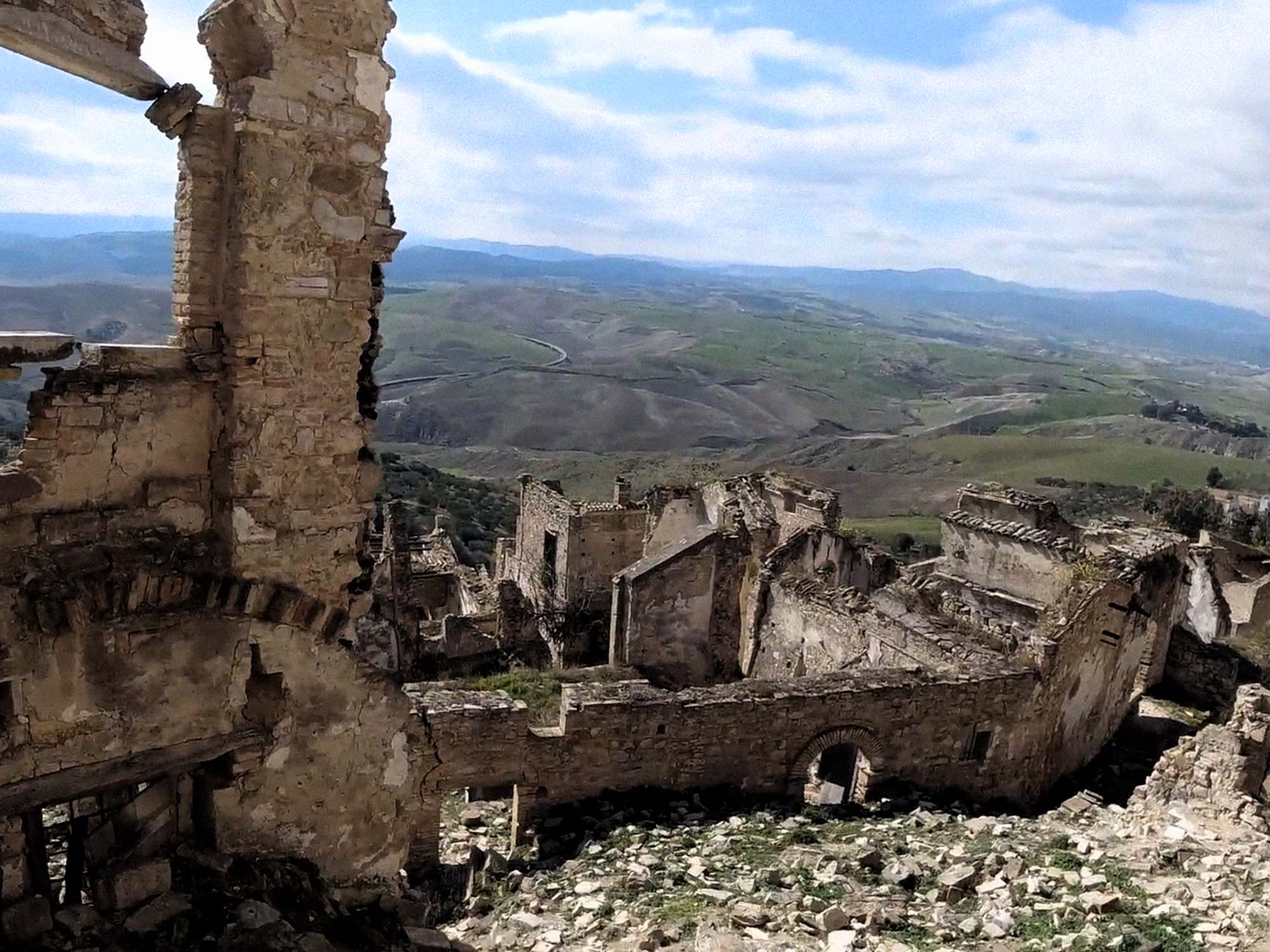
An abandoned medieval hill town in southern Italy, progressively evacuated after a series of devastating landslides tore through its streets and buildings. Long before it became one of Europe’s best-known ghost towns, Craco had endured plague, political bloodshed, brigand attacks and executions. Its empty houses and ruined churches have since attracted stories of unexplained voices and apparitions.
Craco is an abandoned hill town in the Basilicata region of southern Italy, standing above the surrounding clay badlands of the province of Matera. The old settlement, usually called Craco Vecchia, rises around a medieval tower on a steep ridge overlooking an eroded landscape of ravines and exposed earth. Rows of stone houses remain stacked against the hillside, but many are roofless, fractured or partially buried by debris from the landslides that eventually forced the population away.
Human occupation around Craco is considerably older than the surviving town. Tombs discovered in the area have been dated to approximately the 8th century BC, while the settlement enters written history more clearly in 1060, when it belonged to the bishop of Tricarico and was recorded under the name Grachium. During the Middle Ages it developed into a fortified community, with its dominant stone tower becoming the most recognisable feature of the skyline. The settlement expanded around the tower and the Church of San Nicola, eventually acquiring substantial noble residences including Palazzo Maronna, Palazzo Grossi and Palazzo Carbone.
Craco’s history was not particularly peaceful even before the ground beneath it began to fail. In 1656, the great plague epidemic that devastated the Kingdom of Naples reached the town. Local historical accounts state that hundreds of inhabitants died, drastically reducing the number of families living there. The epidemic formed part of one of the deadliest disease outbreaks in the history of southern Italy, which spread extensively through the Kingdom of Naples during 1656–1658.
The late 18th and 19th centuries brought another period of violence. In 1799, supporters of the newly proclaimed Parthenopean Republic attempted to overthrow the old feudal order in Craco. On 4 March, a political demonstration descended into what local records describe as a bloodbath. Several men were killed, including doctors Nicola Antonio Rigirone and Vincenzo Nardandrea, Don Alessandro Orsone, Nicola Maria Carbone and Antonio Quaranta. The republican experiment was short-lived, and the town subsequently passed through the turmoil surrounding French and Bourbon rule.
During the Napoleonic period, the countryside around Craco became associated with brigandage. On 10 May 1807, a group of around fifteen brigands led by Nicola Chiarito attacked the town. Francesco Antonio Colabella, who organised the defence, was killed, several residents were wounded and buildings were burned. A second raid followed on 18 July, when another band killed 28-year-old Nicola Rigirone before looting the town. Chiarito’s brother Antonio was captured the following year and, after a brief trial, was shot in Craco.
Violence returned after the unification of Italy. On 14 November 1861, approximately 1,000 brigands and their local supporters entered Craco, firing weapons around Palazzo Carbone and Palazzo Magistro, burning stables and robbing wealthy households. Ten days later, sixteen people were executed in front of the Franciscan convent in connection with the uprising. Those identified in surviving accounts included farmers, coachmen, a barber, a café owner, a priest and Giovanni Baldassarre, who was only sixteen years old. The conflict continued in the surrounding countryside: on 25 June 1862 two customs guards were killed near Craco, while a National Guard soldier from the town was reportedly decapitated with a knife by brigands.
The disaster that ultimately destroyed Craco was far slower than these episodes of violence. The town had been built above unstable geological formations where harder conglomerate and sandy layers sit over weaker clay. Concerns about ground movement were recognised long before the final evacuation, and the town council was already petitioning the government for intervention in 1886. Modern geological studies have identified several types of instability around Craco, including rotational and translational landslides, earth flows, rockfalls and lateral spreading.
Major movement began again in 1959. The crisis intensified dramatically in December 1963, when a landslide spread beneath a substantial part of the settlement after prolonged rain. Contemporary reports described around one hundred houses inside the affected zone, with evacuation orders issued as cracks appeared in buildings and streets. Geological work conducted during the following years recorded both vertical and horizontal movement, while leaking water and sewer systems, wells and construction work appear to have aggravated an already naturally unstable slope.
Craco is therefore often described rather too simply as having been abandoned in 1963. In reality, the evacuation was gradual. Around 1,800 residents began being transferred to the new settlement of Craco Peschiera, lower in the valley, while attempts were made to stabilise the old town. A retaining wall constructed during the 1960s failed to solve the problem, and renewed movement in 1965 and 1969 was followed by catastrophic damage around the centre of the village in 1971. Flooding in 1972 made the possibility of returning increasingly unrealistic. The 1980 Irpinia earthquake inflicted further damage and effectively ended any remaining prospect of restoring Craco Vecchia as an inhabited town.
The abandoned buildings did not simply disappear. Much of the town remained standing, albeit in increasingly precarious condition, leaving streets, houses, churches and palazzi frozen at different stages of collapse. The Norman tower still rises over the ridge, while the ruins of the Church of San Nicola remain among the most prominent structures below it. In 2010, the historic centre was included on the World Monuments Watch, drawing international attention to the need to protect what remained. Parts of Craco have since been stabilised and incorporated into the Parco Museale Scenografico di Craco, with controlled routes through sections of the ruins.
One of Craco’s more unusual surviving religious traditions concerns San Vincenzo Martire, the town’s patron saint. A small relic had arrived from Rome in 1769, followed in 1792 by a much larger reliquary associated with a Christian martyr named Vincenzo. Historical documentation described a sacred body accompanied by a flask of blood, while the present display consists of relics arranged within a reclining wax figure dressed as a Roman soldier. The reliquary is now kept in the Church of Santa Maria della Stella, near Craco Vecchia, inside a glass-sided case positioned in front of the altar.
A local legend claims that people from a neighbouring community once attempted to steal San Vincenzo’s remains. As the story goes, the reliquary became progressively heavier as the thieves carried it away until they could no longer move it and abandoned it beside the road. When people from Craco recovered the saint, they supposedly heard a voice asking to be taken home with music. The episode belongs to religious folklore rather than documented history, but the story became part of the continuing devotion surrounding San Vincenzo.
Craco’s transition from inhabited town to enormous ready-made film set began surprisingly early. Alberto Lattuada used the town for La lupa (1953), when Craco was still populated. After the evacuation began, its old streets became even more attractive to filmmakers requiring an isolated southern Italian or biblical setting. Francesco Rosi used Craco extensively in Christ Stopped at Eboli (1979), where the abandoned town stood in for the fictionalised version of Aliano known as Gagliano. Houses, steep lanes and views across the valley were used to create the impoverished 1930s settlement described by writer Carlo Levi.
Later productions included King David (1985), The Nativity Story (2006) and the James Bond film Quantum of Solace (2008). Craco’s most recognisable screen appearance, however, may be in Mel Gibson’s The Passion of the Christ (2004). While much of the film’s biblical Jerusalem was created in Matera and at Cinecittà, Craco was used for the scene in which Judas Iscariot hangs himself. The ruined buildings and barren clay landscape provided a suitably desolate background for the sequence.
An abandoned town this large inevitably developed a paranormal reputation. Stories circulating about Craco describe voices and screams heard among the empty buildings, shadowy figures in windows and unexplained lights. Some accounts also claim that church bells have been heard despite the absence of functioning bells. These stories are widely repeated by paranormal websites and enthusiasts, but there is no reliable evidence demonstrating supernatural activity at Craco, and much of the folklore appears to have developed after the town became internationally known as a “ghost town.” The creaking of unstable buildings, wind moving through empty rooms and the echoes created by narrow stone streets provide considerably more ordinary possibilities for many reported sounds.
What gives Craco its unsettling quality does not really require ghosts. Unlike an archaeological ruin abandoned centuries ago, its destruction took place within living memory. People who grew up there watched cracks spread through their houses and eventually left behind a community that had existed on the ridge for generations. Parts of the town were demolished, others slid downhill, while still more were simply closed and left empty. The result is a place caught somewhere between a medieval ruin and a recognisably modern town whose population has disappeared.
Access to Craco Vecchia is now controlled because the geological instability that emptied the town has never entirely ceased to be relevant. Visitors follow designated routes through the Parco Museale Scenografico, and protective helmets are required for entry to the ruins. The surviving town remains an unusually complete record of how a settlement can die slowly rather than in a single catastrophe: weakened by unstable ground, repeatedly damaged by landslides and earthquakes, emptied of its population and finally preserved as one of Italy’s most distinctive ghost towns.
Location: On a steep ridge above the Calanchi badlands in Basilicata, approximately 40 kilometres south of Matera.
Address: Strada Comunale Craco-Montalbano Jonico 6, 75010 Craco MT, Italy
Category: ghost town, abandoned settlement, ruins
Tags: abandoned town, ghost town, medieval village, landslide, natural disaster, earthquake, Irpinia earthquake, ruins, plague, brigands, executions, political violence, San Vincenzo Martire, religious relic, ghost lore, haunted, paranormal, filming location, The Passion of the Christ, Quantum of Solace, Christ Stopped at Eboli, King David, The Nativity Story, Basilicata, Calanchi
Darkness Level: ☠ ☠ ☠ ☠ ☠ ☠ ☠ ☠
Homepage: oltrelartecraco.it
Map: Open in Google Maps
Gallery