Château de Montségur
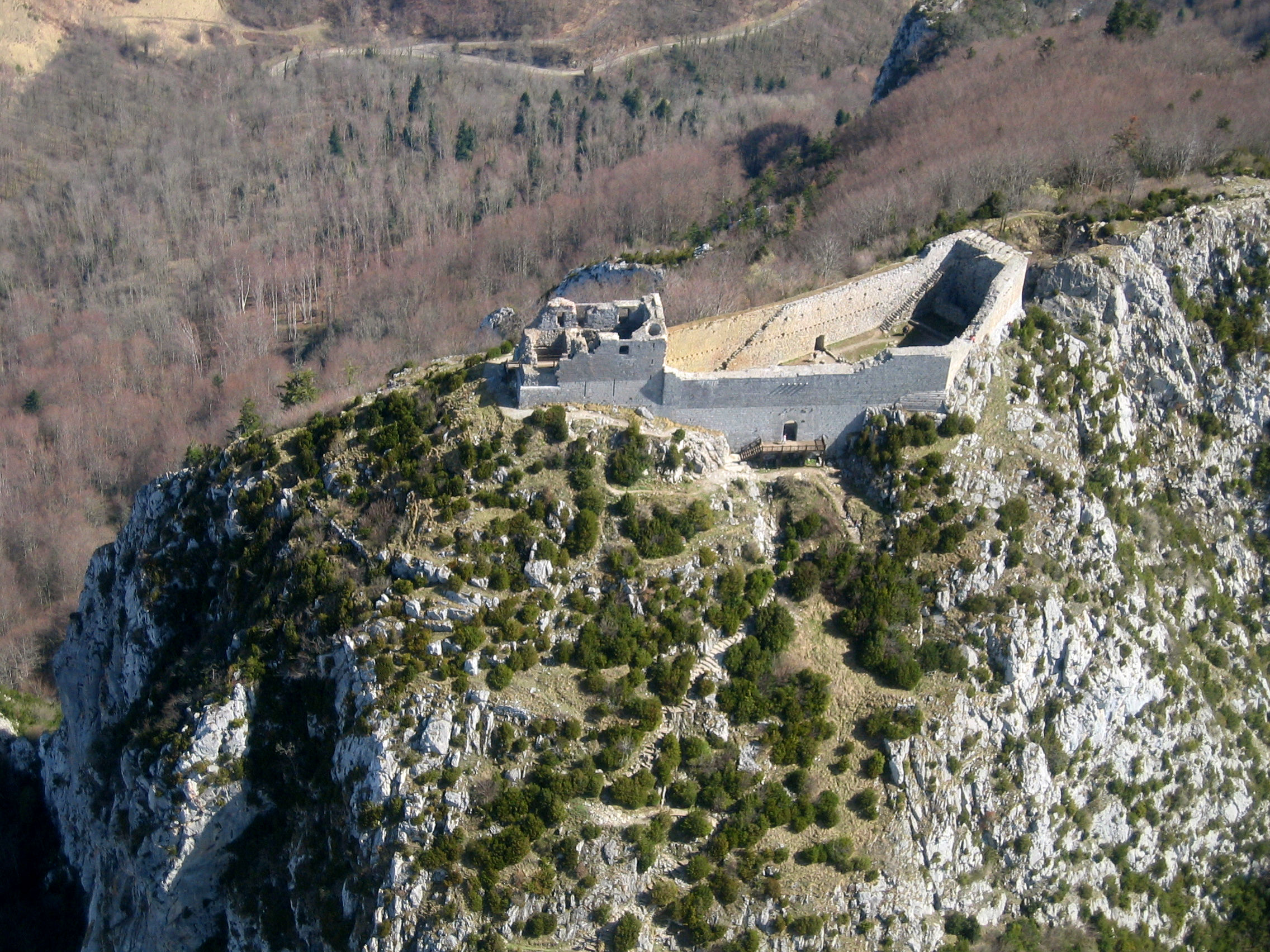
Perched high in the Pyrenees, Château de Montségur was the final refuge of the Cathars, a mysterious religious sect believed to hold esoteric knowledge and the key to the Holy Grail.
High above the village of Montségur in the French Pyrenees, a ruined fortress seems to grow directly out of a sheer limestone mountain. The peak is known locally as the pog, and reaching the castle requires a steep climb through forest and across exposed rock. More than 750 years ago, however, this was not simply an isolated fortress. Hundreds of people lived on the mountain, and Montségur had become one of the most important refuges of the Cathars – a Christian movement condemned as heretical by the medieval Catholic Church.
The Cathars believed in a profound division between the spiritual and material worlds. In broad terms, the spiritual realm belonged to God while the corrupt material world was associated with evil. They rejected several teachings and institutions of the Catholic Church, including its sacraments and elaborate clerical hierarchy. Their spiritual elite, later commonly called the Perfects, lived austere lives centred on prayer, work and the ritual known as the consolamentum. To the medieval Church, this was not simply an unusual alternative form of Christianity. It was heresy that had to be destroyed.
By the beginning of the 13th century, Catharism had become particularly strong across Languedoc. In 1209, Pope Innocent III launched what became known as the Albigensian Crusade against the movement and the southern nobles who protected it. The campaign became notorious for its brutality, and over the following decades the combination of warfare, political conquest and the newly developing Inquisition gradually dismantled Cathar communities across southern France.
Montségur offered something increasingly difficult to find: safety. In 1204, Cathar religious leaders asked local lord Raymond de Péreille to rebuild an older ruined fortification on the mountain. What developed was not merely a castle but an entire fortified settlement, or castrum, spread across terraces around the summit. Houses clung to the edge of the cliffs, connected by narrow passages and steps cut into the rock. At times somewhere between 500 and 600 people lived on the pog, including Cathar religious figures, ordinary believers, families and armed defenders.
In 1232, Montségur became the seat of the Cathar Church in the region. As other safe places disappeared, important Cathar clergy and refugees gathered on the mountain. It was protected by its almost absurd geography. The summit rises more than 1,200 metres above sea level, with steep cliffs and narrow approaches making a conventional assault extremely difficult. Looking up from the valley today, it is not hard to understand why the people living there believed they had found somewhere that could survive almost anything.
That confidence was tested after a particularly violent incident in 1242. A group of armed men connected with Montségur descended on the village of Avignonet and murdered two inquisitors, Guillaume Arnaud and Étienne de Saint-Thibéry, together with members of their entourage. The killings gave the authorities another reason to eliminate the Cathar stronghold once and for all.
In May 1243, a royal army under Hugues des Arcis, seneschal of Carcassonne, and Pierre Amiel, archbishop of Narbonne, surrounded Montségur. Medieval sources and later accounts place the besieging force at as many as 10,000 men, although only a fraction could operate effectively on the steep mountain itself. For months the defenders held them back. Supplies and messengers continued to move in and out through difficult routes, and the geography that had made Montségur attractive to the Cathars now made it equally frustrating to their enemies.
The breakthrough came around Christmas 1243. A small group of attackers managed to climb the cliffs at night and capture an advanced defensive position known as the Roc de la Tour. From there the besiegers could move siege machinery higher onto the mountain and bombard the fortifications at much closer range. Stone projectiles discovered by archaeologists still provide physical evidence of the fighting. By early 1244, the defenders knew that the mountain could no longer save them.
On 2 March, negotiations began and Montségur surrendered. The defenders were granted a fifteen-day truce before the terms took effect. The soldiers and most ordinary inhabitants would be allowed to leave, but Cathars who refused to renounce their faith faced death by fire. Remarkably, during those final days several people who had not previously belonged to the Cathar spiritual elite chose to receive the consolamentum, knowing exactly what that decision would mean.
On 16 March 1244, around 225 men and women refused to abandon their faith. They were taken down from the mountain to an area traditionally identified as the Prat dels Cramats – the Field of the Burned – and killed together in a huge fire. Modern descriptions often speak of individual stakes, but the historical picture appears to have been closer to a large enclosed pyre into which the condemned were driven or entered together. A memorial stone now stands near the place traditionally associated with their deaths.
The scale of the execution turned Montségur into the enduring symbol of Cathar persecution. It was not literally the final appearance of Catharism – communities and individuals survived elsewhere for decades – but the destruction of its leadership on the pog was a devastating blow. The fortified settlement on the summit was dismantled, its houses destroyed and the political world that had protected the Cathars effectively disappeared with it.
There is one particularly important surprise waiting for anyone who reaches the top today. The imposing stone fortress standing there is not the castle in which the Cathars made their final stand. Archaeological work has demonstrated that most of the visible keep and defensive walls belong to a new fortress constructed during the second half of the 13th century, after the Cathar settlement had been destroyed. The mountain passed to the Lévis family, allies of the French Crown, who rebuilt it as part of the new system of royal control over the conquered south.
Some remains of the earlier Cathar settlement can still be found outside and beneath the later walls: terraces where houses once stood, sections of dry-stone fortification, cisterns and narrow steps cut into the mountain. In a strange reversal, the great ruin that has become the visual symbol of Cathar resistance was largely built by the political order that replaced them. The Cathars left the legend; their conquerors left most of the castle.
Then there is the treasure.
Accounts based on later inquisitorial testimony indicate that members of the Cathar community succeeded in removing valuables from Montségur during the final stages of the siege. Another small group is said to have escaped around the time of the surrender carrying something that had been deliberately preserved. What exactly left the mountain is unclear. The most reasonable explanation is money, precious objects, documents or property belonging to the Cathar Church. Over the centuries, however, “church treasure” became considerably more exciting.
Eventually the story acquired the Holy Grail. Montségur was identified with the mysterious Grail castle of medieval romance, and the Cathars were reinvented as guardians of secret spiritual knowledge supposedly preserved from the ancient world. None of this appears in the medieval evidence for Montségur. There is no historical reason to believe that the Cathars possessed the cup of Christ, a supernatural relic or a hidden archive capable of changing world history. That did not prevent people from looking.
One of the most influential figures in creating the modern legend was German writer Otto Rahn. Fascinated by Catharism and Grail mythology, Rahn travelled through the Pyrenees and became convinced that Montségur was connected with the Grail castle described in medieval literature. In 1933 he published Crusade Against the Grail, blending Cathar history with mythology and his own interpretations. Rahn later joined the SS, which helped attach Montségur to an even larger collection of stories about Nazis searching for occult relics and ancient secrets. Much of what has subsequently been written about Nazi Grail expeditions to the mountain belongs to speculation rather than documented history, but by then Montségur had acquired an occult afterlife almost as elaborate as its medieval one.
The site has inspired less sinister popular culture as well. In 2003, Iron Maiden released the song Montségur on their album Dance of Death. Written by Janick Gers, Steve Harris and Bruce Dickinson, the song deals directly with the persecution of the Cathars and the burning of those who refused to renounce their beliefs. For a medieval siege in a remote corner of the Pyrenees, Montségur has travelled remarkably far.
In 2026, Montségur became part of the UNESCO World Heritage site Royal Capetian Fortresses of Languedoc, together with Carcassonne and six other mountain fortresses. There is another historical irony in that designation. UNESCO recognises the surviving castle primarily as part of the defensive system created by the French Crown after its conquest of Languedoc – exactly the political transformation that followed the destruction of the Cathar stronghold.
Location: The Château de Montségur is located in the French Pyrenees, in the Ariège region.
Address: 09300 Montségur, France
Category: occult, castle, Iron Maiden, fortress, religion
Tags: Catholic, holy grail, occult
Darkness Level: ☠ ☠ ☠ ☠ ☠ ☠ ☠
Homepage: montsegur.fr
Map: Open in Google Maps
Gallery