Chislehurst Caves
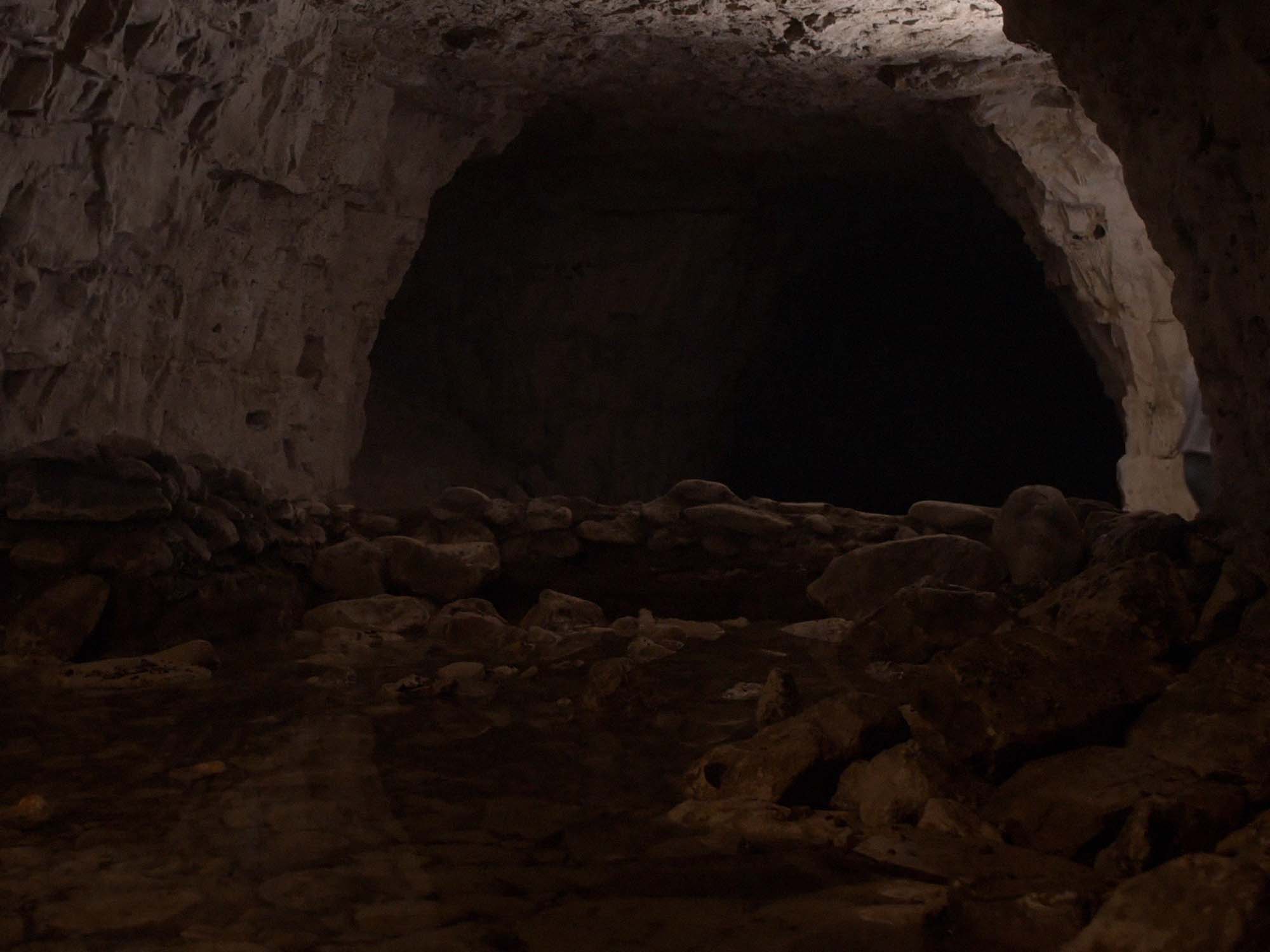
A vast network of man-made chalk tunnels beneath south-east London, later used as a First World War ammunition store, an underground refuge for thousands of civilians during the Blitz, a rock concert venue and a filming location for horror and science-fiction productions.
Chislehurst Caves is an extensive network of artificial tunnels beneath Chislehurst in south-east London. Despite the name, the passages are not natural caves but former chalk and flint mines, excavated to obtain chalk for lime burning and brickmaking and flint for tools and firearms. The underground workings cover more than six hectares and descend to approximately 30 metres below the surface in places.
Chalk extraction in the area is documented from the medieval period. A charter dating from approximately 1250–1275 indicates that chalk was being extracted around Chislehurst, although much of the surviving underground system appears to be considerably later. Archaeological investigation has shown that the section traditionally called the Inner Series was probably begun around 1706, while the London Borough of Bromley considers the surviving workings to be principally the product of 18th- and 19th-century mining. Chalk extraction continued into the early Victorian period.
The caves have long been surrounded by a much older origin story. When they began operating as a public attraction around 1900, sections were presented as having been excavated successively by Druids, Romans and Saxons. Archaeologist William Nichols promoted this interpretation in 1903 and the names remained attached to different parts of the tunnel system. Mining engineers challenged the theory almost immediately, and later archaeological work has found no convincing evidence that the surviving passages were created as Druid temples, Roman workings or Saxon tunnels. Stories of ancient rituals, smuggling and murder nevertheless became an enduring part of the caves’ folklore and guided tours.
During the First World War, the underground workings acquired a far more securely documented military role. They were used to store overflow ammunition and explosive material from the Royal Arsenal at Woolwich. Galleries were enlarged, storage areas were constructed and a narrow-gauge railway was installed so that ammunition could be transported through the tunnels. Workers handling the material faced risks not only from explosives but from chemicals used in ammunition manufacture, with surviving accounts describing burns and jaundice among personnel.
After the war, parts of the caves were used for mushroom cultivation during the 1920s and 1930s. Their most important period, however, began after the German bombing campaign against London intensified in September 1940. The caves were converted into one of Britain’s largest civilian deep air-raid shelters. Around 5,000 people were already sleeping underground each night during the early months, while contemporary reports during the heaviest periods of the Blitz estimated peak populations approaching 15,000 people.
The shelter developed into a substantial underground community. Families were allocated numbered sleeping pitches and paid one penny per adult per night. Shelter captains were elected to supervise groups of residents and enforce rules. Facilities eventually included toilets and washrooms, canteens, a chapel, a barber, a gymnasium and a dance floor. A medical facility contained seven wards, including two isolation wards, while new exits, ventilation shafts and large fans were installed to improve conditions. Special trains carried people from central London to Chislehurst, and during particularly heavy raids the railway station sometimes displayed signs stating that the caves were full.
The underground shelter was safer than remaining in the bombed districts above, but conditions were not without health risks. A medical officer reporting in 1944 recorded the deaths of three babies from gastro-enteritis and raised concerns about sanitation and overcrowding. Other fatalities connected with the shelter community included a boy who developed tetanus after being scratched while climbing a tree outside and a girl who was killed in 1944 when sand collapsed on her while she was digging near the shelter. These deaths were not caused by German bombs, and the caves themselves proved highly resistant to aerial attack.
After the war the tunnels returned to use as a visitor attraction, while parts of the complex developed an unexpected second life as an underground music venue. During the 1950s, 1960s and early 1970s, dances and concerts were staged inside the caves. Performers included The Rolling Stones, David Bowie, Jimi Hendrix and Pink Floyd, alongside numerous jazz, skiffle and early rock acts. The enclosed chalk chambers provided an unusually atmospheric but acoustically unpredictable setting for live music.
The caves also became a filming location. They appear in Beat Girl (1960), where Adam Faith performs during a sequence set among the underground youth scene. They were used extensively as the alien underground complex in Norman J. Warren’s science-fiction horror film Inseminoid (1981), with the production spending several weeks filming inside the tunnels. Television productions have included Doctor Who: The Mutants (1972), in which the passages represented caves on the planet Solos, as well as later productions including Merlin (2008).
The underground setting was also used for Iron Maiden’s “Can I Play with Madness” (1988) music video. The video begins at Tintern Abbey before Monty Python member Graham Chapman, playing an art teacher, falls underground and enters the Chislehurst tunnels, where the increasingly surreal sequence culminates in an encounter with the band’s mascot Eddie.
Chislehurst Caves have additionally acquired a long reputation for ghost stories. One section became known as the Haunted Chamber or Haunted Pool and was associated with a story that a woman had been murdered and thrown into a water-filled pit. No reliable historical documentation has established that such a murder occurred. For a period, the operators offered a challenge and cash reward to anyone willing to spend an entire night alone in the supposedly haunted area, but the practice was eventually abandoned for safety reasons.
The caves’ paranormal reputation was investigated more systematically on 14 March 1987, when fourteen members of the Association for the Scientific Study of Anomalous Phenomena spent the night underground using infrared cameras, audio equipment, radiation detectors and other instruments. Participants reported several unexplained sounds, including footsteps and what appeared to be a crying child, but most received ordinary explanations and the investigation recorded no clear evidence of paranormal activity.
Today, only a portion of the enormous network is accessible to the public and entry is by guided, lamp-lit tour. Surviving features include wartime shelter areas, ammunition-storage remains, graffiti and installations connected with the Second World War. The tunnels therefore preserve several very different phases of London’s underground history: industrial extraction, military storage, mass civilian shelter, entertainment, film production and more than a century of folklore about what might still inhabit the darkness beyond the public route.
Location: Beneath Chislehurst in the London Borough of Bromley, close to Chislehurst railway station.
Address: Caveside Close, Old Hill, Chislehurst, BR7 5NL, England
Category: caves, underground site, attraction
Tags: chalk mine, flint mining, underground tunnels, air-raid shelter, Blitz, World War II, World War I, ammunition storage, underground city, ghost lore, haunted, music history, filming location
Darkness Level: ☠ ☠ ☠ ☠ ☠ ☠ ☠ ☠
Homepage: chislehurst-caves.co.uk
Map: Open in Google Maps
Gallery