Chapel of Bones of Faro
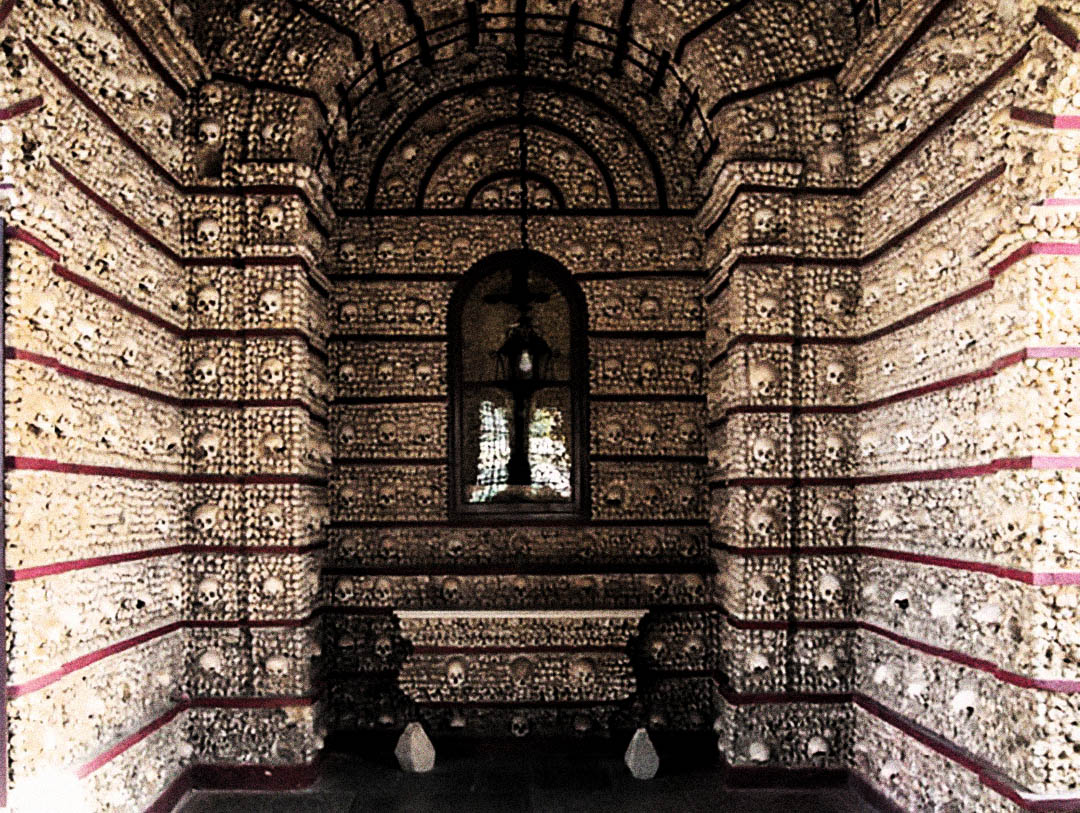
An 18th-century Baroque church in Faro, best known for its Chapel of Bones, whose walls and ceiling are covered with the skulls and skeletal remains of people exhumed from the adjoining cemetery.
Carmo Church, known in Portuguese as Igreja do Carmo, stands on Largo do Carmo in central Faro. Its full name is the Church of the Third Order of Our Lady of Mount Carmel. The Third Order was established in Faro in 1712, and construction of its own church began the following year on land acquired by Bishop António Pereira da Silva. The original design is attributed to the Carmelite priest and architect Frei Manuel da Conceição, and the church opened for worship in 1719.
The original façade and central section were demolished when a much larger rebuilding programme began in 1747 under the Algarve master builder Diogo Tavares. Work continued in several phases for more than a century. The eastern bell tower was completed during the early 19th century, while the western tower was finished in 1878. The resulting symmetrical façade, twin bell towers and elaborate stonework make the church one of Faro’s most prominent examples of Baroque religious architecture.
The interior consists of a single nave, a main chapel and four side chapels. Much of the decoration is executed in gilded woodcarving, with work by regional craftsmen including Gaspar Martins, Manuel Martins and Miguel Nobre. The church also contains decorative tiles, religious sculptures, a Baroque organ and an ornamented sacristy. The extensive use of gilded carving reflects the wealth available to Portuguese religious institutions during the 18th century, when large quantities of gold were being brought from colonial Brazil.
The feature most closely associated with the church is the Chapel of Bones, or Capela dos Ossos, situated behind the main building. It was constructed in 1816 using human remains removed from the cemetery beside the church. The walls and vaulted ceiling are covered with carefully arranged skulls, femurs and other bones, traditionally described as belonging to more than one thousand members of the Carmelite order and the surrounding religious community.
The chapel served both a practical and religious purpose. Removing remains from older graves allowed cemetery space to be reused, while displaying the bones created a Christian memento mori: a reminder that death and bodily decay await every person. Above the entrance is the Portuguese inscription “Pára aqui a considerar que a este estado hás-de chegar”, which translates as “Stop here and consider that you too will come to this state.”
Bone chapels and ossuaries were established in several parts of Portugal and elsewhere in Catholic Europe, particularly where limited burial space required older graves to be cleared. Faro’s chapel is smaller than the better-known Capela dos Ossos in Évora, but its dense arrangement of human remains makes it one of the most distinctive funerary monuments in the Algarve.
Carmo Church remains an active religious building and is also open to visitors. Access to the Chapel of Bones is through the church. The building and its contents are protected as a Portuguese Property of Public Interest.
Location: On Largo do Carmo in central Faro.
Address: Largo do Carmo, 8000-148 Faro, Portugal
Category: church, ossuary
Tags: Chapel of Bones, Capela dos Ossos, Faro, ossuary, skull art, mortality reminder, Carmo Church, Algarve
Darkness Level: ☠ ☠ ☠ ☠ ☠ ☠ ☠ ☠ ☠
Map: Open in Google Maps
Gallery