Cellular Jail
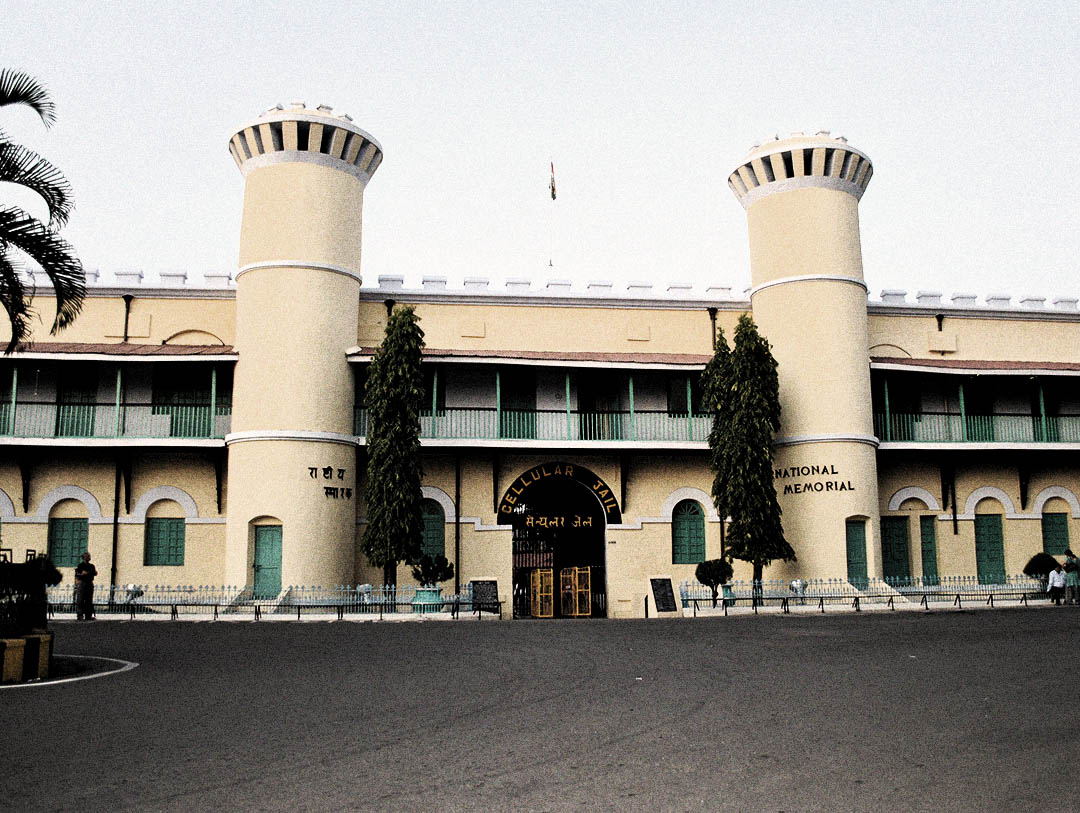
A haunting colonial prison in Port Blair, Andaman & Nicobar Islands, used by the British to isolate Indian freedom fighters in solitary confinement—now preserved as a solemn national memorial.
Cellular Jail is a former British colonial prison in Sri Vijaya Puram, formerly Port Blair, on South Andaman Island. Better known through the name Kālā Pānī – “Black Water”, it became one of the most feared places of imprisonment during the Indian independence struggle. Hundreds of political prisoners were transported more than a thousand kilometres from the mainland and confined in individual cells deliberately designed to prevent them from seeing or communicating with one another.
The history of British imprisonment on the Andaman Islands began long before the Cellular Jail itself. Following the Indian Rebellion of 1857, the colonial government re-established a penal settlement at Port Blair in 1858. The first group of around 200 prisoners arrived in March that year, and conditions were immediately brutal. Convicts were used to clear jungle, drain swamps, construct roads and build the settlement itself. Contemporary records from the first months describe deaths from disease, escape attempts ending in starvation or violence, and dozens of prisoners being hanged.
Transportation to the islands was intended to do more than physically imprison someone. The enormous distance from mainland India severed prisoners from families, political networks and familiar communities. The expression Kālā Pānī referred to the dark waters separating the Andamans from the mainland and also carried a deeper social meaning for some Hindu prisoners, for whom crossing the sea could traditionally be associated with loss of caste. Exile itself therefore became part of the punishment.
By the late 19th century, British authorities wanted a prison better suited to holding political prisoners and enforcing almost complete isolation. Following official investigations into the penal settlement, construction of the Cellular Jail began during the 1890s and was completed in 1906. Hundreds of convicts were themselves employed in building the prison that would later confine generations of prisoners.
The finished structure consisted of seven three-storey wings radiating from a central watchtower, resembling the spokes of a wheel. Around 700 individual cells were created. The arrangement is often compared with Jeremy Bentham's panopticon principle, although its most important function was isolation rather than simply constant observation. Each wing was positioned so that prisoners looking through the front of their cells faced the blank rear wall of another wing rather than another row of inmates.
The cells measured approximately 13½ feet by seven feet. A ventilator only three feet by one foot was positioned roughly nine feet above the floor, providing limited light and air but no meaningful view outside. There were no toilets inside the cells. Heavy iron doors and external locking mechanisms prevented prisoners from reaching the locks, while iron gates isolated each corridor from the central tower. Even within a prison holding hundreds of people, an inmate could therefore spend long periods almost completely alone.
The architecture gave the prison its name. It was a “Cellular” Jail because imprisonment was organised around the individual cell rather than communal barracks. Solitary confinement was not simply an additional punishment imposed on selected prisoners; it was embedded into the design of the building itself.
Forced labour formed another major part of prison life. Political prisoners could be ordered to dehusk coconuts, beat coir into fibre, twist rope or operate heavy oil mills by hand. Daily quotas could be deliberately difficult to reach. Failure or refusal brought additional punishment including handcuffs, bar fetters, crossbar fetters, leg irons, reduced food and prolonged solitary confinement. Flogging was carried out with prisoners secured to a triangular frame.
The prison also contained its own execution facility. Near the outer wall stood a gallows capable of hanging three prisoners simultaneously. A separate exit allowed bodies to be removed without carrying them back through the principal prison areas. Together with the isolation cells and punishment equipment, the gallows made virtually every stage of imprisonment, discipline and execution possible within the compound.
Some prisoners did not survive the psychological and physical pressure. Revolutionary Indu Bhushan Roy, sentenced in connection with the Alipore Bomb Case, died by suicide in the Cellular Jail in 1912 after years of imprisonment and hard labour. Other inmates suffered serious illness or psychological collapse. The remoteness of the Andamans meant that abuses which might have caused immediate public controversy on the mainland could occur far from journalists, relatives and political supporters.
Many prominent figures in the revolutionary independence movement were imprisoned here. They included Vinayak Damodar Savarkar and his brother Ganesh Damodar Savarkar, Barindra Kumar Ghosh, Ullaskar Dutt, Sachindra Nath Sanyal, Bhai Parmanand, Batukeshwar Dutt, Trailokyanath Chakravarty and Yogendra Shukla. They represented different organisations and political traditions, and had been convicted in cases ranging from bombings and assassinations to revolutionary conspiracies against British rule.
Vinayak Damodar Savarkar arrived in 1911 under two life sentences amounting to fifty years. His brother Ganesh was already incarcerated in the same prison. Their presence illustrates the effectiveness of the building's isolation system: even close relatives confined within the same enormous structure could be kept apart and denied ordinary communication.
Political prisoners repeatedly resisted prison conditions through protest, refusal to work and hunger strikes. The most notorious confrontation began in May 1933, when prisoners demanded improved food, sanitation, reading material, communication rights and recognition of their status as political detainees rather than ordinary criminals.
The authorities responded by attempting to force-feed the hunger strikers. Prisoners were restrained while tubes were pushed through their noses and liquid food forced into their bodies. The procedure killed three men: Mahavir Singh, Mohan Kishore Namadas and Mohit Moitra. In the case of Mahavir Singh, contemporary accounts state that milk entered his lungs during the procedure. The deaths provoked outrage on the mainland and increased public attention to conditions inside the prison.
The 1933 strike continued for approximately 46 days before concessions were made. Prisoners received improvements including access to reading material and less restrictive conditions, but conflict with the administration continued. Another major hunger strike began in July 1937 and lasted around 45 days. Mahatma Gandhi and Rabindranath Tagore were among those who urged the prisoners to end the protest, while political pressure mounted for their return to mainland India.
The colonial government eventually abandoned the policy of concentrating political prisoners in the Cellular Jail. By January 1938, the remaining political prisoners involved in the independence movement had been transferred back to prisons on the mainland. The building continued to exist as a prison, but the period for which it became most notorious was coming to an end.
A powerful earthquake in 1941 damaged the complex. The following year, Japanese forces captured the Andaman and Nicobar Islands and remained until 1945. Cellular Jail continued to be used for detention under the new occupiers, this time holding island residents and others suspected of spying for or assisting the British. Japanese forces carried out severe repression elsewhere across the islands, including executions of civilians accused of espionage.
Subhas Chandra Bose, leader of the Provisional Government of Free India and allied at the time with Japan against the British Empire, visited the Cellular Jail on 29 December 1943. He referred to it as an “Indian Bastille,” recognising its importance as a symbol of colonial imprisonment. The islands nevertheless remained under effective Japanese military control until the end of the war.
Only three of the original seven prison wings survive today. The complex had been damaged during the 1941 earthquake and altered during the Japanese occupation, while additional wings were demolished in the post-war and post-independence period, partly during development of the neighbouring Govind Ballabh Pant Hospital. The exact chronology attributed to some of the wartime demolition differs between historical accounts, but the destruction nearly erased more of the prison than survives today.
Former prisoners strongly opposed plans that might have removed the remaining structure. Their organisation, the Ex-Andaman Political Prisoners' Fraternity Circle, campaigned for preservation of the surviving wings as a memorial to the people imprisoned there. The Government of India eventually accepted the proposal, and Cellular Jail was formally dedicated as a National Memorial on 11 February 1979.
The surviving complex retains the central tower and three long wings of solitary cells. The former entrance and administrative buildings contain galleries on political prisoners and the Indian independence movement, while restraints and other objects illustrate methods of punishment used inside the prison. The triple gallows also survives as one of the most disturbing parts of the site.
Cellular Jail is sometimes described simply as a prison for famous freedom fighters, but that understates what made the institution so effective. The punishment began before a prisoner even reached a cell. Transportation removed people from the mainland, the sea made escape almost impossible, architecture prevented communication, forced labour exhausted the body and solitary confinement attacked the mind. The building was designed so that hundreds of prisoners could occupy the same structure while each experienced imprisonment almost entirely alone.
Location: Port Blair, Andaman & Nicobar Islands, India
Address: Atlanta Point, Sri Vijaya Puram, Port Blair, Andaman and Nicobar Islands 744104, India
Category: prison, museum, colonial repression
Tags: Cellular Jail, Kala Pani, political prisoners, prison, solitary confinement, hunger strike, independence martyrs
Darkness Level: ☠ ☠ ☠ ☠ ☠ ☠ ☠ ☠ ☠ ☠
Map: Open in Google Maps
Gallery