Callanish Stones
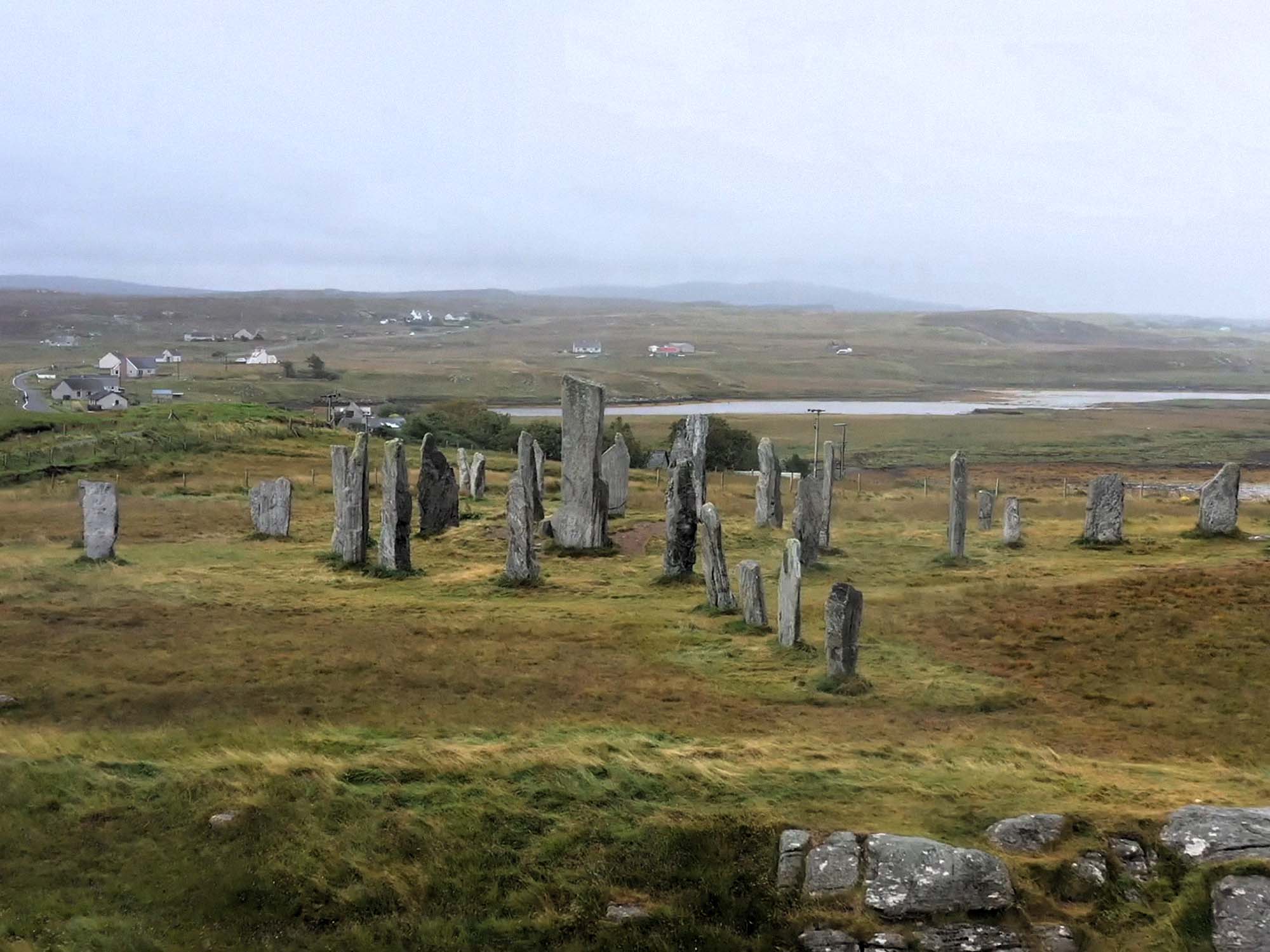
A 5,000-year-old complex of standing stones on the Isle of Lewis, arranged around a central monolith and prehistoric burial chamber, with possible astronomical alignments and later folklore concerning giants turned to stone.
Callanish Stones, also known as the Calanais Standing Stones and in Scottish Gaelic as Tursachan Chalanais, form one of Scotland’s largest and best-preserved Neolithic stone settings. The principal monument, usually designated Calanais I, stands on a ridge near the village of Calanais on the west coast of the Isle of Lewis. Archaeological evidence indicates that the main circle was erected between approximately 2900 and 2600 BC, making it older than the principal stone circle at Stonehenge.
The monument was constructed from local Lewisian gneiss, a metamorphic rock formed billions of years before the stones were erected. Thirteen stones form the central ring around a monolith measuring approximately 4.8 metres high. Rows of additional stones extend east, west and south, while two parallel lines create an avenue approximately 83 metres long to the north. Together, these alignments give the monument its distinctive cross-shaped layout.
A small chambered cairn lies inside the circle at the foot of the central monolith. Archaeological investigation indicates that the stone circle and central monolith were already standing when the burial chamber was added, probably around the middle of the third millennium BC. The chamber was used for successive burials before being disturbed and robbed during the Bronze Age. Its inclusion shows that Calanais served a funerary purpose as well as being a gathering place for ceremonies and other forms of ritual activity.
The original purpose of the wider stone arrangement remains uncertain. The alignments have frequently been interpreted in relation to movements of the sun and moon. One prominent theory connects the monument with the major lunar standstill, an event occurring approximately every 18.6 years when the moon reaches its most extreme rising and setting positions. From Calanais, the low moon appears to move along the outline of the southern hills. This may have allowed observers to follow and predict the lunar cycle, although the monument’s use as an astronomical observatory has not been conclusively established.
Ritual activity may have continued at Calanais for approximately 2,000 years. Between around 1200 and 800 BC, use of the monument appears to have declined. As the climate became cooler and wetter, peat began accumulating across the site. By the 19th century, the lower sections of many stones were buried beneath approximately 1.5 metres of peat, making them appear considerably shorter than they are today.
In 1857, landowner Sir James Matheson ordered the peat around the monument to be removed. The work exposed the full height of the stones and revealed the chambered cairn within the circle. Later archaeological excavations, particularly those carried out between 1979 and 1988, established the sequence in which the circle, stone rows and burial chamber had been constructed. Some stones had disappeared over time, probably through agricultural activity, while two fallen stones were later returned to their original positions.
Calanais I forms part of a much larger prehistoric landscape. At least eleven additional stone circles and settings survive in the surrounding area, including Calanais II and Calanais III within walking distance of the principal monument. Some were constructed later than the main circle, indicating that the surrounding landscape remained an important centre for ceremonial activity over many generations.
The stones also developed a substantial body of local folklore. They have been called Na Fir Bhrèige, commonly translated as “the False Men”, because their upright forms resemble human figures when viewed from a distance. According to one later Christian legend, the stones were once giants who refused to convert to Christianity or assist Saint Kieran in building a church and were consequently turned to stone. Another tradition claims that a supernatural figure called the Shining One walks along the stone avenue at midsummer. These stories belong to the later folklore of the site and are not explanations of its Neolithic construction.
The Callanish Stones are now protected as a scheduled monument and are managed by Historic Environment Scotland in partnership with the local organisation Urras nan Tursachan. The nearby Calanais Visitor Centre contains exhibitions about the archaeology, folklore and communities associated with the stones and the wider prehistoric landscape.
Location: On a ridge near the village of Calanais, overlooking Loch Roag on the west coast of the Isle of Lewis.
Address: Calanais, Isle of Lewis HS2 9DY, Scotland
Category: archaeological site, monument
Tags: standing stones, stone circle, megaliths, Neolithic, chambered cairn, prehistoric burial, ritual site, lunar alignment, giants, folklore
Darkness Level: ☠ ☠ ☠ ☠ ☠
Homepage: calanais.org
Map: Open in Google Maps
Gallery