Biester Palace

A late-19th-century Romantic palace in Sintra distinguished by elaborate Neo-Gothic interiors, religious and esoteric symbolism, an underground initiatory chamber and tunnels, and its use as a filming location for The Ninth Gate.
Biester Palace, known in Portuguese as Palácio Biester and historically as Chalet Biester, is a late-19th-century residence on the wooded slopes above the historic centre of Sintra. The palace was commissioned by the wealthy Frederico and Amélia Biester as a summer residence and was designed principally by Portuguese architect José Luiz Monteiro. Construction took place during the 1880s, and the building was inaugurated around 1890.
The palace represents the eclectic architecture associated with Romantic Sintra, combining influences from Central and Northern European chalets with Neo-Gothic, revivalist and early Art Nouveau decoration. Its interiors involved several prominent artists and craftsmen of the period. Italian artist and theatrical designer Luigi Manini contributed decorative work, Leandro de Souza Braga produced elaborate carved woodwork and furniture, Rafael Bordalo Pinheiro contributed ceramic work, and French painter Paul Baudry is associated with fresco decoration. The building was conceived as a complete artistic environment rather than simply a conventional country house.
The ground floor contains the principal social rooms, including the library, music room, drawing room and ballroom, while bedrooms and more private areas occupy the upper level. One unusual technological feature is a manual lift associated with engineer Raúl Mesnier de Ponsard, later famous for Lisbon’s Santa Justa Lift. Residential lifts were still uncommon in Portugal when the palace was constructed.
The most unusual part of the palace is its extensive programme of religious and esoteric symbolism. This is particularly concentrated in the library, chapel and underground Câmara Iniciática, or Initiatory Chamber. The palace itself describes its symbolism through references to Christianity, Rome, the Knights Templar and occult or esoteric traditions. These elements belong to the intellectual and decorative programme created for the Biester residence rather than indicating that the medieval Knights Templar themselves ever occupied the building.
The chapel is a richly decorated Neo-Gothic space incorporating Christian imagery alongside symbols associated with medieval chivalric and Templar traditions. Its elaborate paintings, stained glass and decorative details contrast sharply with the Initiatory Chamber beneath the palace. The chamber is a small, austere room constructed almost entirely from exposed stone, with a vaulted ceiling and an architectural form inspired by medieval Christian sanctuaries.
The Initiatory Chamber is presented as a space connected with initiation into a sacred order influenced by Templar ideals. From the chamber, a narrow opening leads into a system of underground passages that divide into separate tunnels and emerge in the palace gardens. Whether formal initiation ceremonies were actually conducted there has not been independently established, but the chamber, tunnels and associated iconography were deliberately incorporated into the design and form one of the clearest examples of the esoteric interests represented throughout the property.
The palace is surrounded by approximately five hectares of landscaped grounds designed by French landscape gardener François Nogré. The park contains exotic trees and plants, waterfalls, ponds, grottoes, viewpoints and winding paths constructed across the steep hillside. Features include the Poço da Mina, Gruta da Pena, Australian Fern Lake and viewpoints towards the Moorish Castle and the surrounding Sintra landscape.
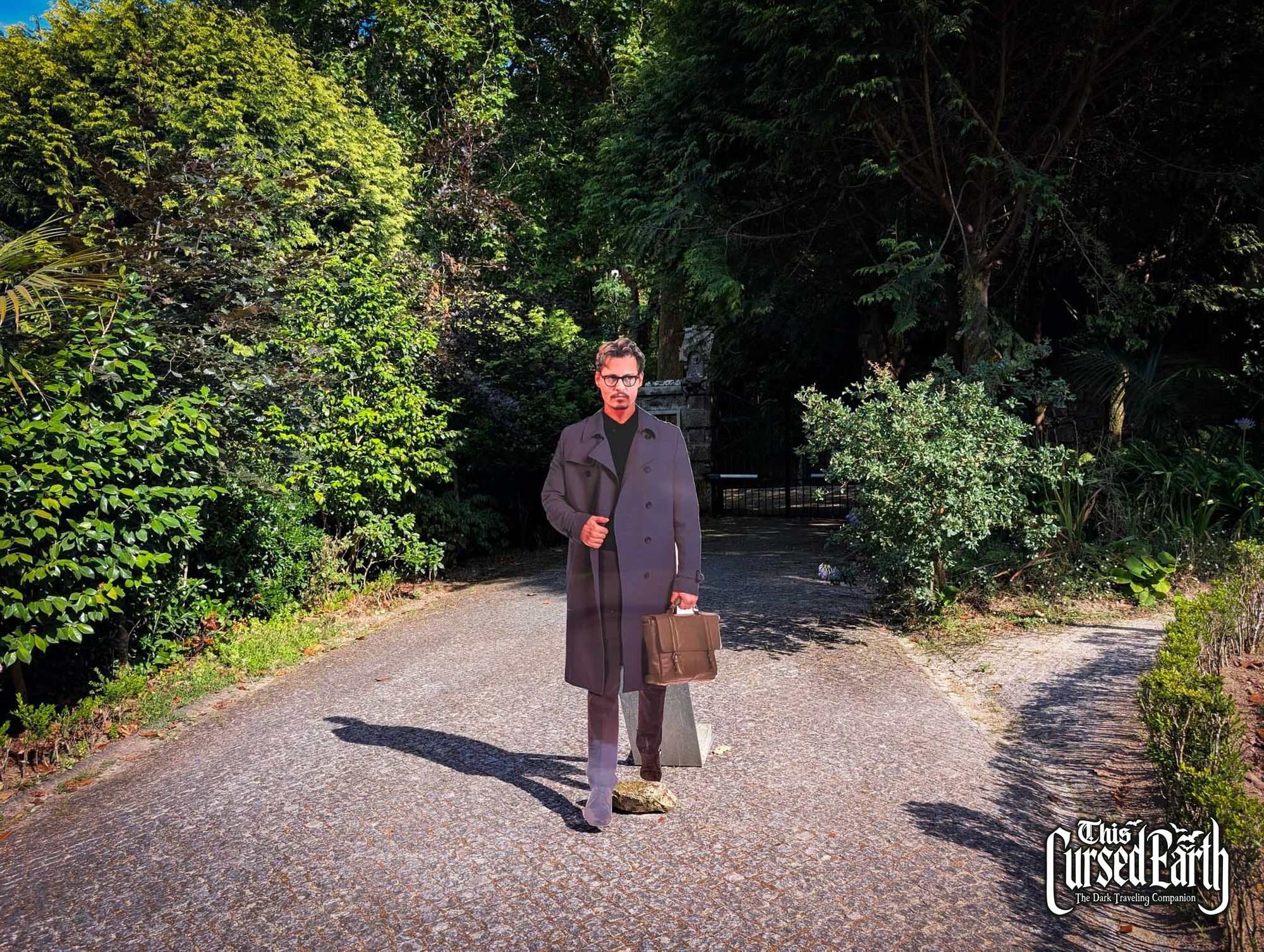
Biester Palace also has a significant connection with cinema. Roman Polanski used the property during filming of The Ninth Gate, starring Johnny Depp, in 1998. Several interiors, including the library and principal rooms, as well as parts of the gardens and exterior, were used in the production. The film follows rare-book dealer Dean Corso while he investigates a supposedly Satanic book connected with a method of summoning the Devil, making the palace’s existing religious and esoteric decoration particularly suited to the production.
Unlike many of Sintra’s better-known monuments, Biester Palace remained privately owned and inaccessible to the general public for much of its history. Following extensive restoration and conservation work, it opened to visitors in 2022. The public route now includes the principal reception rooms, private apartments, chapel, Initiatory Chamber, sections of the underground passages and the surrounding botanical park.
Location: On the wooded hillside above central Sintra, between the historic centre and the road towards Pena.
Address: Avenida Almeida Garrett 1A, 2710-567 Sintra, Portugal
Category: palace, historical residence, filming location
Tags: esotericism, occult symbolism, Templar symbolism, initiatory chamber, underground tunnels, Neo-Gothic, Romanticism, religious symbolism, The Ninth Gate, film history
Darkness Level: ☠ ☠ ☠ ☠ ☠ ☠
Homepage: biester.pt
Map: Open in Google Maps
Gallery