1859 Jail Museum
A remarkably intact 19th-century county jail in Independence, Missouri, where prisoners were confined in unheated limestone cells only a few metres from the jailer's family home. Built on the eve of the American Civil War, it held guerrillas, civilians and children during the violent Missouri–Kansas border conflict, witnessed two executions and the unsolved murder of its jailer, and later housed outlaw Frank James in considerably more comfortable circumstances.
1859 Jail Museum preserves the former Jackson County Jail and adjoining Marshal's Home near the historic square in Independence, Missouri. Behind the respectable red-brick residence facing Main Street lies a much harsher structure: two storeys of thick limestone containing twelve small cells secured by massive iron doors. The jail opened at almost exactly the moment when violence between pro-slavery and anti-slavery factions was tearing apart the Missouri–Kansas border region, and remained in use until 1933.
The building was the third Jackson County jail constructed in Independence. Architect Asa Beebe Cross designed the complex, and construction was completed in 1859 at a cost of $11,844.20. The arrangement deliberately placed two very different worlds side by side. The front contained the marshal's office and a comfortable Federal-style residence for the jailer and his family, while the stone cell block was hidden behind it. The jailer's wife commonly prepared meals for both her own household and the prisoners locked only a short distance away.
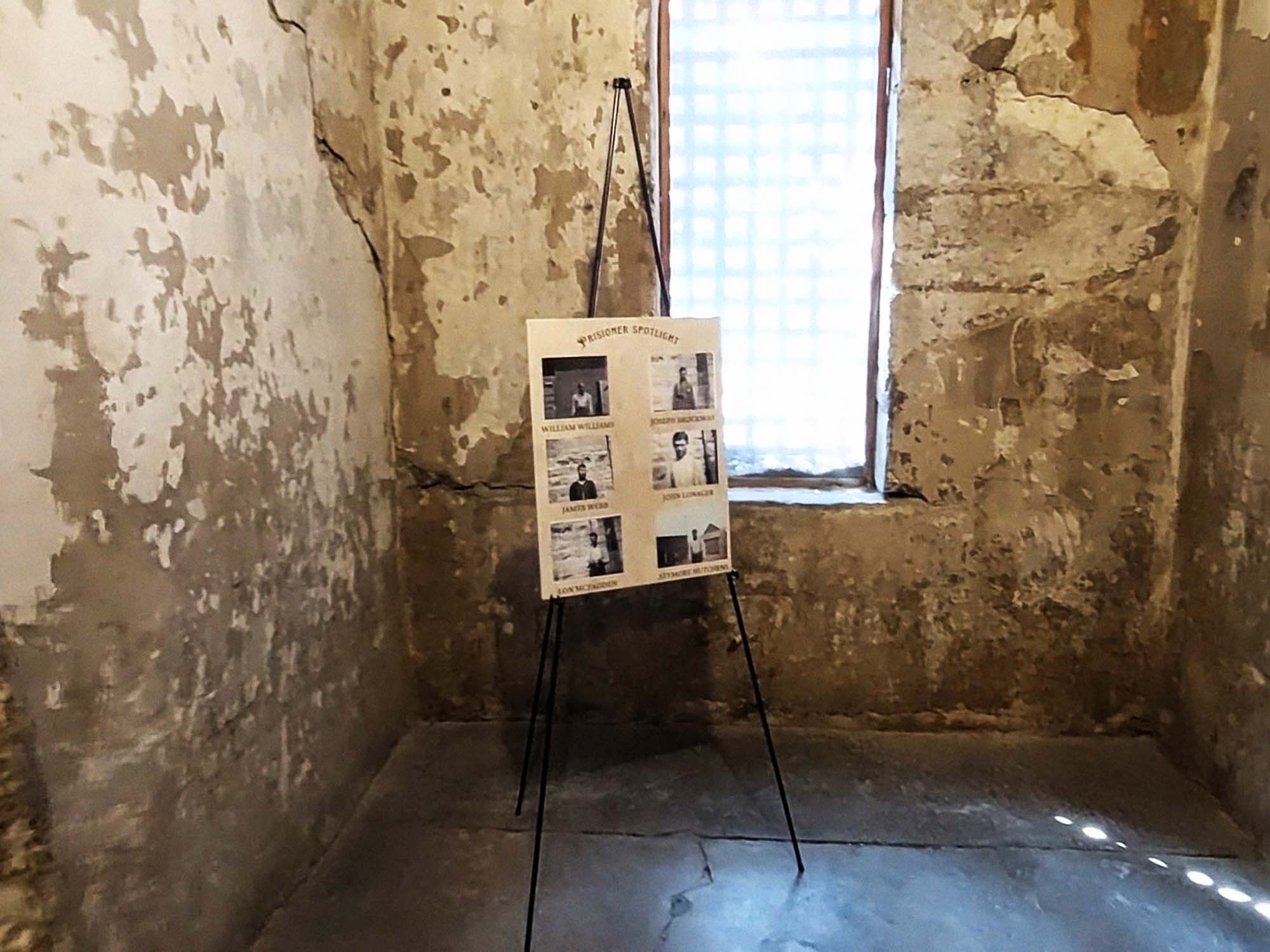
The original jail contained six cells downstairs and six upstairs. Each measured only around six by nine feet and was intended for three people. Walls approximately two feet thick were built from limestone, while each cell had both a grated iron door and a solid iron door. A barred opening admitted outside air and limited daylight, but there was no heating or cooling. At night, a single kerosene lamp in the corridor provided illumination. Museum historians record that some prisoners died from exposure during the building's years as a jail.
The timing of its construction was significant. The Kansas–Nebraska Act of 1854 had allowed settlers in Kansas Territory to decide whether slavery would be permitted, helping trigger the period remembered as Bleeding Kansas. Pro-slavery Missourians, anti-slavery settlers, militias and increasingly violent guerrilla groups crossed the border in both directions. By the time the new jail opened, hundreds had already died in the conflict and Jackson County had become one of its principal battlegrounds.
Among the jail's early prisoners was William Clarke Quantrill, who would later become one of the most notorious Confederate guerrilla commanders of the Civil War. Quantrill was briefly incarcerated here in the winter of 1860, before achieving infamy as leader of the force responsible for the 1863 raid on Lawrence, Kansas, in which around 150 men and boys were killed. The surviving jail therefore contained Quantrill before the violence that made his name synonymous with the brutal border war.
When the American Civil War began in 1861, the jail became both a military and civilian prison and served as headquarters for the United States Provost Marshal. During the First Battle of Independence in August 1862, Confederate and guerrilla forces briefly captured the building. It was subsequently used as a hospital. Control returned to Union authorities, and the jail again became an important part of the machinery used to suppress Confederate guerrilla activity in western Missouri.
Conditions became particularly severe after Union General Thomas Ewing issued General Order No. 11 on 25 August 1863. The order forced much of the civilian population from Jackson and neighbouring counties as part of an attempt to deprive guerrillas of food, shelter and local support. People suspected of disloyalty could be detained, including women and children accused of assisting Confederate guerrillas. The twelve small cells became so overcrowded that contemporary accounts said prisoners had to sleep in shifts. Cells originally intended for three people could hold as many as twenty during the war.
The violence did not end with the Confederacy's defeat. On the night of 13 June 1866, the jail became the scene of an attempted armed breakout that ended in murder. A former Confederate bushwhacker named Joab Perry, who had ridden with Quantrill and later associated with the forces of “Bloody Bill” Anderson, had been arrested for horse theft the previous day. Five or six armed men rode into Independence and demanded that jailer Henry Bugler surrender the keys so Perry could be freed.
Bugler refused and was shot. Contemporary reports disagree on whether he attempted to raise a weapon or was shot while retreating into the house, and even differ over whether the fatal bullet struck his heart or entered from behind. His four-year-old son John was also wounded in the gunfire. The attackers entered the building and started a small fire while searching for the keys, but the heavy iron cell doors defeated them and Perry remained locked inside. Bugler was carried upstairs to his bedroom, where he died.
No one was ever convicted of Henry Bugler's murder. Suspicion centred on former Confederate guerrillas associated with Quantrill, Bloody Bill Anderson and Archie Clement, but surviving evidence cannot establish which man fired the fatal shot. The killing became one more episode in a region where the Civil War continued through personal feuds, political violence and outlaw activity long after formal hostilities had ended. Bugler's pregnant widow Mary remained at the jail after his death and continued helping feed and care for the prisoners while raising their children.
The jail also witnessed executions. Historical Society research documents two hangings carried out at the property. In 1887, Edward Sneed was executed for the murder of Orleans Loomis. A gallows was erected outside the limestone jail in an area now forming part of the courtyard or later addition. Another condemned prisoner, Harry Jones, was hanged inside the jail itself: the staircase was removed and a gallows erected so that the execution could take place from the second-floor level. A third prisoner, James Brown, was scheduled to hang there but received a gubernatorial pardon and was instead sent to the Missouri State Penitentiary for life.
The jail's most famous resident arrived under very different circumstances. Following the killing of his brother Jesse in 1882, outlaw Frank James negotiated his surrender to Missouri Governor Thomas Crittenden. He was brought to Jackson County to face charges connected with the 1869 robbery of the Daviess County Savings Association in Gallatin and the murder of cashier Captain John Sheets. Original jail ledgers show that Frank spent 112 days here during this stage of his detention.
Frank James' imprisonment bore little resemblance to that endured by Civil War detainees. His family paid the county for his accommodation, and he received privileges unavailable to ordinary prisoners. His cell was furnished with a Brussels carpet, furniture and pictures; he was allowed to move around the jail and even hosted poker games in his cell. James was ultimately acquitted in his Missouri trial and was never convicted of the numerous robberies and killings attributed to the James–Younger gang. The cell associated with his stay remains one of the museum's principal surviving spaces.
As Jackson County grew, the original twelve cells became inadequate. A large brick addition was completed in 1907, adding twenty-eight cells. It was closely associated with county work gangs, whose prisoners were sent out under guard to construct roads and other public works. Earlier accounts often call these chain gangs, although the Historical Society notes that the later work gangs generally operated in supervised groups without necessarily being physically chained together.
The jail temporarily closed in 1920 when officials decided that maintaining it for a shrinking number of prisoners was too expensive. It reopened the following year as Prohibition created a new stream of inmates arrested during raids for alcohol offences. The final prisoners left in 1933, ending more than seventy years of confinement within the building.
The empty jail escaped demolition only narrowly. During the Great Depression, parts of the property were reused by relief organisations and the Works Progress Administration for activities including sewing, ironing and food preservation. The American Legion later occupied the complex, but by 1958 a building-materials dealer was close to receiving permission to demolish it in exchange for the salvageable brick, timber and limestone. The Jackson County Historical Society intervened, with former president and Independence native Harry S. Truman personally making the first telephone call to secure a $1,000 donation from Hallmark founder Joyce C. Hall.
The restored property opened as a museum in 1959, exactly a century after its construction, and was added to the National Register of Historic Places in 1970. Unlike many prison museums reconstructed inside later buildings, much of what is seen here is original: the limestone walls, narrow cells, heavy iron doors and domestic residence all belong to the jail that actually operated on the site.
The building has inevitably developed a paranormal reputation. Visitors and investigators have reported sudden cold, footsteps, growling sounds, breathing or gasping noises and the figure of a man dressed in blue. One story identifies the apparition as Henry Bugler, whose murder provides an obvious historical figure around which later ghost folklore could develop. There is no evidence demonstrating that these experiences are supernatural, and the museum itself is careful to describe its primary purpose as historical education rather than proving hauntings.
Nevertheless, paranormal investigation has become an acknowledged part of the site's modern life. The Jackson County Historical Society permits organised investigations after normal opening hours and runs occasional public events with an approved paranormal team. The rules are unusually specific: séances and Ouija boards are prohibited, and investigators are expected to respect the building as a historic property rather than treat it solely as a haunted attraction.
Location: Immediately north of Independence Square in the historic centre of Independence, Missouri.
Address: 217 N Main Street, Independence, MO 64050, United States
Category: prison, museum
Tags: Jackson County Jail, frontier justice, limestone jail, prison cells, American Civil War, Bleeding Kansas, Border War, General Order No. 11, William Clarke Quantrill, Frank James, Jesse James, Henry Bugler, murder, unsolved murder, jailbreak, hanging, execution, Edward Sneed, Harry Jones, Confederate guerrillas, bushwhackers, women prisoners, child prisoners, chain gang, paranormal, haunted prison, ghost lore
Darkness Level: ☠ ☠ ☠ ☠ ☠ ☠ ☠ ☠ ☠
Homepage: jchs.org
Map: Open in Google Maps
Gallery